
Brief Overview
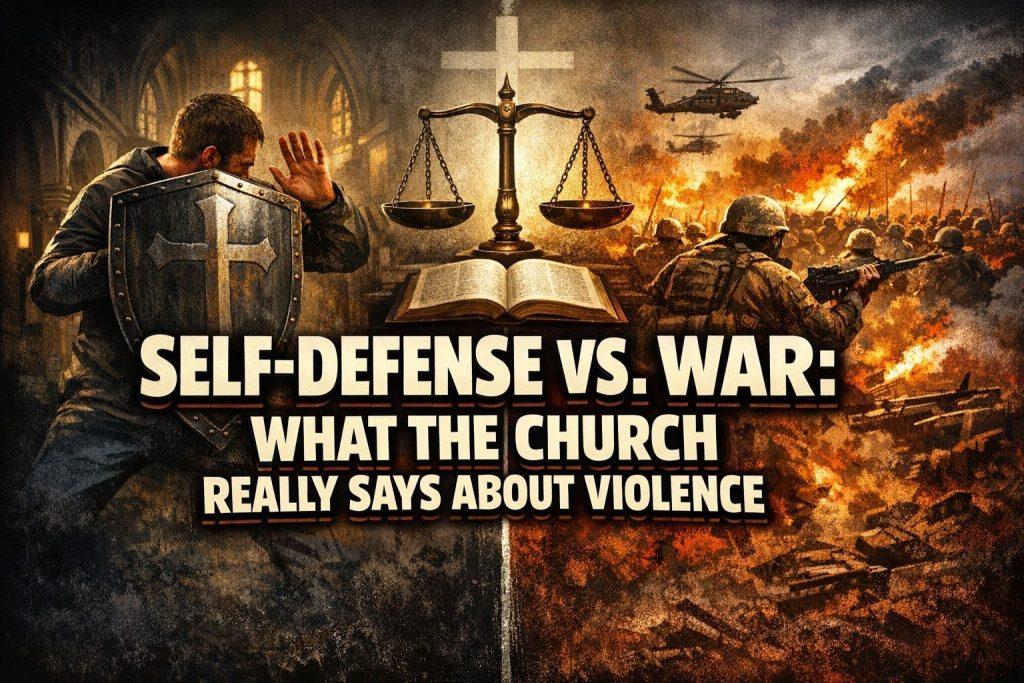
- The Catholic Church teaches that self-defense is not only a moral right but can be a grave duty, particularly when someone bears responsibility for the lives of others, yet this permission comes with strict conditions that most people conveniently ignore (CCC 2265).
- There is a real and morally significant difference between an individual defending his own life and a state committing an entire community to armed conflict, and collapsing that distinction produces serious errors in moral reasoning.
- The Church has never officially taught pacifism as the required Christian response to violence, and Catholics who invoke Christ’s words about turning the other cheek as a universal prohibition on all force are misreading both Scripture and the tradition.
- The permission to use force, whether personal or political, always operates within firm limits set by proportionality, last resort, and the absolute protection of innocent life, and exceeding those limits converts a justified act into a moral offense.
Christ’s Words on Violence Are Not the Whole Picture
Matthew 5:39 presents one of the most frequently misapplied verses in Catholic moral reasoning. When Christ tells his disciples to turn the other cheek, many Catholics read this as a blanket prohibition on every form of physical self-defense or military service. That reading does not survive contact with the broader Scriptural witness or the consistent interpretation of the Church’s tradition. Christ himself did not physically resist arrest in Gethsemane, but he also did not command Peter to disarm permanently. His instruction to Peter was specific to that moment: “Put your sword back into its place” (Matthew 26:52), not “throw your sword into the river and never carry one again.”
The tradition has consistently understood Christ’s counsel about non-resistance as a counsel of perfection applicable to personal injury, not a universal command that eliminates the duty to protect others. St. Augustine made this distinction with clarity in the fifth century, and Aquinas built on it in the thirteenth. The Catechism continues it today. The person who chooses not to defend himself against a personal attack, accepting injury out of love for the aggressor, performs a genuinely noble act. The person who refuses to defend an innocent third party from grave harm, appealing to the same Gospel text, commits a moral failure. These are not the same act, and treating them as identical distorts what the Church actually teaches.
The Right to Self-Defense Is Real, and So Are Its Limits
The Catechism is direct: the legitimate defense of persons and societies is not an exception to the prohibition against murder (CCC 2263). Self-defense works through what the tradition calls the principle of double effect. The person defending himself intends to preserve his life; the death of the aggressor, if it occurs, is foreseen but not intended as the goal. That distinction matters enormously in Catholic moral theology, because intention determines the moral character of an act in ways that consequences alone cannot.
CCC 2264 draws on Aquinas to establish the proportionality requirement that governs individual self-defense. Using more violence than necessary to repel a threat makes the act unlawful. A person cannot shoot an aggressor who poses no lethal threat and claim self-defense under Catholic moral principles. The force used must correspond to the force threatened. CCC 2265 then extends this framework beyond the individual level: legitimate defense can be not only a right but a grave duty for someone responsible for another’s life. A parent protecting a child, a police officer protecting a community, and a soldier protecting citizens under legitimate authority all operate within this extended framework of protective duty. Refusing to act when you hold that responsibility is not Christian pacifism. It is moral negligence.
Where Individual Self-Defense Ends and War Begins
Here is where the moral reasoning becomes genuinely demanding, and where many Catholics make serious errors. Individual self-defense and national war share the same foundational logic, namely that protecting innocent life can justify the use of force, but they differ in scale, authority, and moral complexity in ways that cannot be glossed over. An individual defending himself against a mugger does not need to satisfy the four conditions of just war theory. He needs to respond proportionately to an immediate, grave, and certain threat. A government committing its citizens to armed conflict must meet a far higher and more comprehensive standard.
CCC 2308 establishes that all citizens and all governments are obliged to work for the avoidance of war. Governments cannot be denied the right of lawful self-defense once all peace efforts have failed, but that “once” carries enormous weight. The state’s use of force is only legitimate when it proceeds from proper authority, serves a genuine just cause, deploys only proportionate means, pursues right intention, represents a last resort, and carries serious prospects of success. A government that uses the moral logic of individual self-defense, claiming a threat exists and therefore war is justified, while bypassing the demanding framework the Church applies to collective armed conflict, misuses the tradition. The stakes are too high for that shortcut.
The Duty to Protect Is Not Optional for Those in Authority
One of the most uncomfortable truths in Catholic teaching on violence is that authority and responsibility are inseparable. CCC 2265 states plainly that those holding legitimate authority have the right to repel by armed force aggressors against the civil community entrusted to their charge. The word “right” understates the moral weight here. When a government possesses the means to stop grave, certain, and ongoing aggression against its people and refuses to act out of a misplaced appeal to pacifism or political convenience, it fails in its fundamental duty to the common good.
This is not a comfortable teaching for Catholics who lean toward a purely pacifist position. The Church honors and respects those who choose non-violence as a personal witness, and CCC 2306 describes those who renounce violence as bearing legitimate testimony to the moral cost of armed conflict. CCC 2311 further establishes that conscientious objectors deserve equitable provision from public authorities. But personal witness and state responsibility are different categories. A soldier can, in conscience, refuse to participate in a war he believes is unjust. The political authority that bears responsibility for a community cannot simply opt out of that responsibility by appealing to gospel non-violence while its people suffer preventable grave harm.
The Line the Church Will Not Let Anyone Cross
Proportionality and non-combatant immunity are the absolute limits that apply to every use of force, personal or collective, and the Church does not allow exceptions to be carved out by necessity, urgency, or righteous cause. CCC 2312 states that the moral law remains valid during armed conflict and that not everything between warring parties becomes permissible simply because war has broken out. CCC 2313 is equally clear: non-combatants, wounded soldiers, and prisoners must be respected and treated humanely, and actions deliberately contrary to this are crimes, regardless of the orders that command them.
This applies at the individual level too. The person acting in self-defense who deliberately uses force beyond what the situation demands has crossed the line from legitimate protection to aggression. The soldier who follows an unlawful order to harm prisoners commits a crime, not an act of obedience. Blind obedience, the Catechism states explicitly, does not suffice to excuse those who carry out such actions (CCC 2313). The moral responsibility for a violent act always rests with the person who performs it, which means Catholics in uniform cannot outsource their conscience to the chain of command.
So, Where Does This Leave the Catholic Thinking About Violence?
The Catholic position on violence and force is neither pacifist nor permissive. It occupies a carefully reasoned and morally demanding middle ground that acknowledges the reality of human sinfulness, the genuine duty to protect innocent life, and the absolute limits that no cause can justify crossing. Romans 12:18 calls Catholics to live peaceably with all insofar as it depends on them. That “insofar” is doing real moral work. It acknowledges that some situations remove the option of pure non-violence without removing the obligation of moral seriousness.
The person who wants a simple answer from the Church, either “violence is always wrong” or “defend yourself and your country without restriction,” will find neither. What the Church offers instead is a framework that takes human dignity, justice, and the cost of violence with equal seriousness. That framework demands more intellectual honesty and moral courage than either extreme requires. A Catholic who accepts it cannot dismiss the gravity of taking human life with appeals to patriotism or just cause, and cannot dismiss the duty to protect the innocent with appeals to non-violence. Both truths belong together, and holding them together is the actual Catholic position.
Disclaimer: This article presents Catholic teaching for educational purposes. For official Church teaching, consult the Catechism and magisterial documents. For personal spiritual guidance, consult your parish priest or spiritual director. Questions? Contact editor@catholicshare.com
Sign up for our Exclusive Newsletter
- 📌 Add CatholicShare as a Preferred Source on Google
- 🎁 Join us on Patreon for Premium Content
- 🎧 Check Out These Catholic Audiobooks
- 📿 Get Your FREE Rosary Book
- 📱 Follow Us on Flipboard
-

Recommended Catholic Books
Discover hidden wisdom in Catholic books — invaluable guides enriching faith and satisfying curiosity. #CommissionsEarned
- The Early Church Was the Catholic Church
- The Case for Catholicism - Answers to Classic and Contemporary Protestant Objections
- Meeting the Protestant Challenge: How to Answer 50 Biblical Objections to Catholic Beliefs
As an Amazon Associate, I earn from qualifying purchases. Thank you for your support.