
Brief Overview
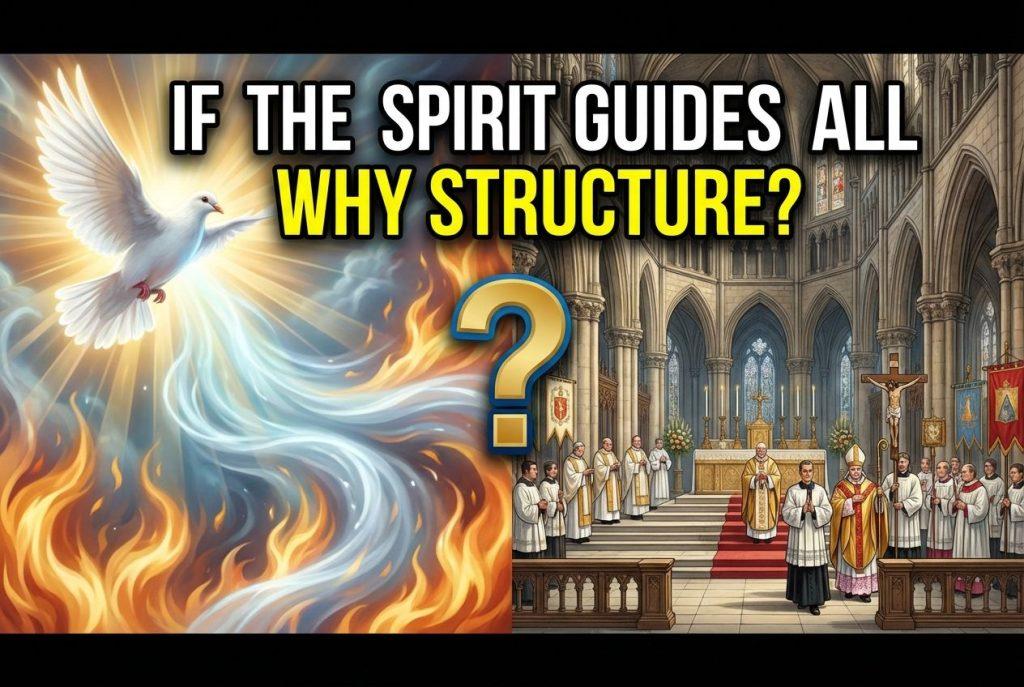
- The Holy Spirit’s guidance and the Church’s visible structure work together as complementary aspects of God’s plan for the Church rather than competing forces.
- Christ established the Church with a hierarchical structure of apostles and their successors to preserve unity, safeguard authentic teaching, and ensure continuity throughout history.
- The Holy Spirit animates the Church’s structure and guides individual believers while also working through the ordained ministry Christ established.
- The structure prevents confusion and division by providing clear authority to interpret revelation and resolve doctrinal disputes in a world of competing claims.
- Both hierarchical gifts and charismatic gifts come from the same Holy Spirit and serve the building up of the one Body of Christ.
- The relationship between personal spiritual guidance and ecclesial structure reflects the balance between freedom and order that exists throughout God’s creation.
The Question at the Heart of Faith
Many sincere believers wrestle with a question that touches the core of how they understand the Church. If the Holy Spirit truly guides every baptized Christian into truth, what purpose does the Church’s structured hierarchy serve? This question has sparked debate, driven divisions, and challenged Catholics and non-Catholics alike to understand the relationship between divine inspiration and human organization. The inquiry becomes more pressing when we consider the promise Christ made in John 16:13 that the Spirit would guide believers into all truth. Some wonder if institutional structures become unnecessary when each person has direct access to God through the Holy Spirit. Others question whether bishops, priests, and formal teaching authority might actually hinder the Spirit’s work rather than facilitate it. This concern merits serious consideration because it addresses how God chooses to work in the world and through his people. The Catholic answer does not diminish the Spirit’s guidance but rather reveals how structure and Spirit work together in perfect harmony. Understanding this relationship requires us to look at both Scripture and the lived reality of the early Church. We must examine what Christ actually established during his earthly ministry and what the apostles understood about authority and order in the community of believers. The question also invites us to consider the nature of truth itself and how communities preserve and transmit divine revelation across centuries.
The tension between Spirit and structure can seem like a contradiction only when we view them as opposing forces rather than complementary realities. Modern individualism makes it difficult for many to understand why God would work through institutional means rather than purely personal encounters. Our culture prizes direct experience and individual interpretation, sometimes viewing any external authority as inherently oppressive. Yet the Catholic tradition insists that the Holy Spirit chose to work both intimately with individuals and corporately through the structured community Christ established. This understanding flows from a sacramental worldview that sees material realities as capable of bearing spiritual truth. Just as Christ himself was God made flesh, the Church becomes a visible sign and instrument of invisible grace. The Spirit who hovered over the waters at creation and descended like a dove at Christ’s baptism is the same Spirit who established order, structure, and authority within the Church.
The Biblical Foundation for Structure
When we examine Scripture carefully, we find that structure and Spirit-guidance existed together from the beginning of salvation history. God did not leave the Israelites without organization but established priesthood, prophets, and eventually kingship within clear boundaries and roles. The Old Testament reveals a God who values both personal relationship and communal order. He spoke to individuals like Abraham, Moses, and the prophets, yet he also gave detailed instructions for worship, governance, and social organization. The same pattern continues in the New Testament where Jesus demonstrates both intimate personal ministry and deliberate structural establishment. Christ prayed throughout the night before choosing the Twelve Apostles, showing the significance of this selection. He did not simply gather disciples randomly but appointed specific individuals to specific roles with specific authority. In Matthew 16:18-19, Jesus tells Simon Peter that upon this rock he will build his church and gives him the keys of the kingdom. This gift of authority was not metaphorical but constituted a real transfer of power to bind and loose, representing the authority to make binding decisions for the community. The same authority was later extended to all the apostles in Matthew 18:18, creating a college of leadership with Peter as its head.
The Book of Acts shows the apostles immediately exercising structural authority after Pentecost. They replaced Judas through a formal selection process in Acts 1:15-26, demonstrating their understanding that apostolic office needed continuity. When conflicts arose about food distribution in Acts 6:1-6, the apostles established the order of deacons through prayer and laying on of hands. This action revealed that even practical church matters required formal structure and sacramental commissioning. The Council of Jerusalem in Acts 15 provides perhaps the clearest biblical example of how the Spirit works through structure. When a doctrinal dispute threatened to divide the early Church, the community did not simply tell everyone to pray individually and follow their personal guidance. Instead, the apostles and elders gathered in Jerusalem to discuss the matter formally. After debate and prayer, Peter spoke with authority, James made a judgment, and they issued a binding decision. The letter they sent to the churches began with the remarkable phrase in Acts 15:28, “It seemed good to the Holy Spirit and to us,” showing their understanding that the Spirit worked through their structured deliberation. If individual guidance alone were sufficient, this council would have been unnecessary and even inappropriate.
Paul’s letters consistently reinforce the importance of structure alongside spiritual gifts. In 1 Corinthians 12, Paul describes the Church as a body with many members, each having different functions. He lists both hierarchical offices like apostles and teachers and charismatic gifts like healing and tongues. The chapter makes clear that diversity of roles serves unity rather than competing with it. When Paul writes to Timothy and Titus, his letters contain detailed instructions about appointing bishops and deacons, specifying their qualifications and responsibilities. These pastoral epistles would be strange indeed if structure were unimportant or temporary. In Ephesians 4:11-14, Paul explains that Christ gave apostles, prophets, evangelists, pastors, and teachers “to equip the saints for the work of ministry, for building up the body of Christ, until we all attain to the unity of the faith.” This passage reveals that structured ministry exists to bring believers to maturity and prevent them from being “tossed to and fro by every wind of doctrine.” The structure protects the community from error while the Spirit animates the structure with life. Neither can be understood properly in isolation from the other.
Why Structure Matters for Unity
The Church exists in a fallen world where human weakness, pride, and misunderstanding constantly threaten the unity Christ desires for his people. In John 17:21, Jesus prayed that his followers would be one as he and the Father are one. This unity was not meant to be merely spiritual or invisible but a concrete reality that would witness to the world. History demonstrates repeatedly that without structural authority, Christian communities fragment into competing groups, each claiming Spirit guidance for contradictory teachings. The Protestant Reformation, whatever its initial intentions, resulted in thousands of denominations with incompatible doctrines, all appealing to Scripture and the Spirit’s guidance. This division itself suggests that personal interpretation alone cannot maintain the unity Christ intended. When everyone becomes their own final authority on doctrine, unity becomes impossible because fallen human beings inevitably disagree. The structure Christ established provides a way to maintain “the unity of the Spirit in the bond of peace” that Paul commends in Ephesians 4:3.
Structure serves unity by providing a visible principle of communion. When Catholics worldwide profess belief in the same doctrines, celebrate the same sacraments, and recognize the same pastoral authority, they manifest a unity that transcends culture, language, and personal preference. This unity does not suppress diversity but rather orders it toward a common good. The Catechism teaches that the Church is one because of her source in the Trinity, her founder in Christ, and her soul in the Holy Spirit (CCC 813). The visible structure makes this invisible unity tangible and historical. Without structure, each generation would need to reconstruct Christianity from scratch, subject to the prevailing cultural assumptions and individual limitations of each era. With structure, the Church can maintain continuity with the apostolic faith while genuinely developing in understanding. The bishops in communion with the pope form a visible link to the apostles, preserving the deposit of faith while allowing the Spirit to lead the Church into deeper comprehension of revealed truth.
The liturgical life of the Church also depends on structure for its unity and authenticity. The Mass celebrated in Tokyo is recognizably the same as the Mass in Rome or Nairobi because structural authority ensures proper form and content. This liturgical unity creates a profound sense of belonging to something larger than any individual community. When Catholics travel, they can participate fully in worship anywhere in the world because the structure provides consistency. This ordered worship also protects the faithful from liturgical innovation that might obscure or contradict the faith. While the Spirit certainly works in spontaneous prayer and charismatic worship, the structured liturgy ensures that the Church’s public prayer authentically expresses Catholic faith. The bishops guard this liturgical tradition not to stifle the Spirit but to ensure that what is celebrated actually conforms to apostolic teaching. Personal spiritual experiences must be tested against the Church’s faith, and structure provides the means for this discernment.
Structure as Protection Against Error
One of the most important functions of the Church’s structure is safeguarding authentic Christian teaching from distortion and heresy. The New Testament itself warns repeatedly about false teachers who would arise to lead believers astray. In 2 Peter 2:1, Peter warns of false prophets who will secretly bring in destructive heresies. Paul tells the Ephesian elders in Acts 20:29-30 that fierce wolves will come among them, and even from their own number men will arise speaking twisted things to draw away disciples. These warnings make no sense if individual Spirit-guidance were sufficient protection against error. The apostles understood that Christians would need authoritative teaching to distinguish truth from falsehood. The structure of bishops succeeding the apostles exists precisely to fulfill this protective function. When new teachings arise claiming to be Christian, the Church must be able to evaluate them against the apostolic deposit of faith. This requires more than each believer’s private judgment; it requires the teaching authority Christ established.
Throughout history, heresies have typically begun with individuals claiming special revelation or new understanding of Scripture. Arius, Nestorius, Pelagius, and countless others believed they were following the Spirit’s guidance, yet the Church recognized their teachings as incompatible with apostolic faith. Without the structural authority to definitively reject these errors, confusion would reign and believers would lack any reliable way to distinguish orthodoxy from heresy. The ecumenical councils of the early Church exercised precisely this teaching authority. When they declared that Christ is truly God and truly man, consubstantial with the Father, they spoke with authority the whole Church was obliged to accept. This was not arbitrary human authority but the Spirit working through the structure Christ established. The councils’ definitions protected the faith from reduction or distortion, allowing believers to worship the true God rather than a theological construct.
The Church’s teaching authority, called the Magisterium, continues this protective function today (CCC 85-87). The Magisterium does not create new doctrines but faithfully transmits what was handed down from the apostles. It interprets Scripture and Tradition authentically, providing the faithful with certainty about essential Christian truths. This teaching office exists in the name of Christ, not as a replacement for the Spirit’s guidance but as the means through which the Spirit guides the whole Church. When the pope and bishops teach in union on matters of faith and morals, Catholics trust that the Spirit prevents them from leading the Church into error. This does not mean every opinion of every bishop is infallible, but it does mean the Church’s definitive teaching on faith and morals can be trusted. This trust allows Catholics to build their lives on solid foundation rather than shifting theological fashions. The structure provides stability in a world of constant change and competing truth claims.
The Spirit Works Through Structure
The Catholic understanding rejects any opposition between Spirit and structure by recognizing that the Holy Spirit established and animates the Church’s hierarchical form. At Pentecost, the Spirit descended on the gathered disciples who were already organized around the Twelve Apostles. The Spirit did not abolish this structure but empowered it for mission. Peter, the one to whom Christ had given the keys, stood up to preach the first Christian sermon. The three thousand who were baptized that day were added to the community that gathered around the apostles’ teaching, fellowship, breaking of bread, and prayers (Acts 2:42). This structured community was the creation of the Spirit, not an unfortunate human addition to pure spiritual religion. The Spirit gave various gifts for ministry, but these gifts operated within the ordered life of the Church. When Philip preached in Samaria and people were baptized, Peter and John came from Jerusalem to lay hands on them so they might receive the Holy Spirit (Acts 8:14-17). This shows that even early in the Church’s life, certain spiritual gifts were transmitted through structured ministry.
The sacraments themselves reveal how the Spirit works through structured, material means. In baptism, the Spirit regenerates believers through water and the word. In confirmation, the Spirit is given through anointing with oil and laying on of hands by a bishop. In the Eucharist, the Spirit transforms bread and wine into Christ’s Body and Blood through the words of consecration spoken by an ordained priest. These sacraments require the Church’s structure for their validity. A person cannot baptize themselves; the sacrament requires another person acting in Christ’s name. The Eucharist requires a validly ordained priest; it cannot be celebrated by anyone who simply feels moved by the Spirit. This does not limit the Spirit but rather shows how the Spirit chose to work through the Church Christ established. The structure becomes the instrument of the Spirit’s action, not an obstacle to it. Just as God used the humanity of Jesus to save the world, the Spirit uses the structure of the Church to sanctify believers.
The Catechism teaches that the Holy Spirit builds, animates, and sanctifies the Church (CCC 747). The Church is the temple of the Holy Spirit, and the Spirit dwells within this structured reality. The bishops receive the Holy Spirit in their ordination, not for their private sanctification alone but to shepherd God’s people. Their teaching authority comes from the Spirit, and when they teach in communion with each other and the pope, the Spirit ensures they will not lead the Church astray. This does not mean bishops are sinless or that every administrative decision is inspired. Rather, it means that the Spirit faithfully protects the Church’s essential teaching mission despite human weakness. The same Spirit who inspired Scripture guides the Church in interpreting Scripture. The same Spirit who worked through the apostles works through their successors. Personal holiness certainly helps bishops fulfill their role better, but the office itself carries the Spirit’s guarantee regardless of the office-holder’s personal sanctity. This distinction between office and person allows the Church to maintain its divine mission even when served by flawed human beings.
Balancing Personal and Corporate Guidance
The Catholic approach to Spirit-guidance refuses to pit individual believers against the Church’s corporate wisdom. Every baptized person receives the Holy Spirit and is called to live under the Spirit’s influence. The gifts Paul lists in 1 Corinthians 12 and Romans 12 are given to individuals within the body for the common good. Catholics are encouraged to pray for the Spirit’s guidance in their daily decisions, vocations, and spiritual growth. Personal prayer, meditation on Scripture, and sensitivity to the Spirit’s promptings are essential to Christian life. The structure of the Church does not replace this personal relationship with God but provides the context and boundaries within which it flourishes. Just as children need both parental love and parental guidance to thrive, believers need both personal experience of God and the Church’s teaching to grow spiritually. The structure prevents individualistic spirituality from degenerating into mere subjectivism where each person creates a custom theology based on personal preference.
When personal spiritual experiences conflict with Church teaching, Catholics are taught to examine their experiences rather than assume the Church is wrong. The great mystics and saints sometimes had powerful spiritual experiences that seemed to transcend normal categories, yet they all submitted their experiences to the Church’s judgment. Saint Teresa of Avila, despite her extraordinary mystical visions, insisted that she believed what the Church taught and would reject any private revelation that contradicted it. Saint Ignatius of Loyola developed rules for the discernment of spirits precisely because he recognized that not every spiritual impulse comes from God. Some may come from our own psychology, others from demonic sources seeking to deceive. The Church’s teaching provides an objective standard against which to test subjective experiences. This does not mean genuine spiritual gifts are rejected; rather, they are authenticated through the Church’s discernment. The structure protects both the individual from deception and the community from disruption.
The relationship between charisms and hierarchy in the Church demonstrates this balanced approach. Charisms are special gifts the Spirit gives to individuals for building up the Church. These can include obvious supernatural gifts like healing and prophecy but also more ordinary gifts like teaching, administration, and service. The hierarchy, particularly the bishops, has the responsibility to recognize and order these gifts for the common good. Not everyone who claims a spiritual gift genuinely has one, and even genuine gifts can be misused. The bishop’s role includes discerning which gifts are authentic and ensuring they serve unity rather than division. This is not clerical control stifling the Spirit but pastoral care ensuring good order. The Catechism notes that “whether extraordinary or simple and humble, charisms are graces of the Holy Spirit which directly or indirectly benefit the Church” (CCC 799). Both hierarchical structure and charismatic gifts come from the same Spirit and must work together. When they seem to conflict, it usually indicates that either the charism is not genuine or the hierarchical authority is being exercised poorly. In either case, the solution is not to eliminate one in favor of the other but to seek the authentic relationship between them.
Historical Development and Consistency
The structure of bishops, priests, and deacons emerged very early in the Church’s life and remained consistent across diverse cultures and circumstances. By the early second century, saints like Ignatius of Antioch wrote about the threefold structure of ministry as already established and normative. In his letters, Ignatius insisted that nothing should be done without the bishop, that the Eucharist is valid only when celebrated by the bishop or someone he appoints, and that the bishop represents God to the local church. These are not late medieval innovations but reflect the apostolic understanding of how Christ structured his Church. The early Christians did not see this structure as competing with the Spirit’s guidance; they saw it as the Spirit’s provision for the Church’s life and mission. When disputes arose about doctrine or practice, Christians looked to the bishops in communion with each other to resolve them. This pattern was universal in the early Church, not a local peculiarity.
The development of Church structure was not arbitrary but responded to real needs while maintaining apostolic principles. As the Church grew, the office of bishop became attached to geographical sees rather than itinerant ministry. Councils developed as a way for bishops to gather and make decisions affecting the whole Church. The primacy of the Roman See emerged as bishops looked to Peter’s successor for final resolution of disputed questions. These developments were genuine developments rather than corruptions because they maintained continuity with apostolic principles while adapting to new circumstances. The Spirit guided these developments, not by dictating every detail, but by ensuring the Church remained faithful to its essential structure and mission. What changed was external form; what remained constant was the reality of apostolic authority passed down through ordination. The Catechism affirms that apostolic succession through the sacrament of Holy Orders maintains the bond of unity across time (CCC 815).
Critics sometimes point to historical abuses or corrupt leaders as evidence against the Church’s structural claims. It is certainly true that sinful popes, bishops, and priests have scandalized the faithful throughout history. Some have used their authority for personal gain; others have failed to teach or live the faith authentically. These failures demonstrate human weakness but do not invalidate the structure itself. The New Testament itself shows that Judas betrayed Christ and Peter denied him, yet the apostolic office continued. The wheat and weeds grow together until the harvest, as Jesus taught in Matthew 13:24-30. The holiness of the Church consists not in sinless members but in the means of sanctification she possesses and transmits. The sacraments remain valid even when administered by unworthy ministers because Christ himself is the true minister. The teaching remains true even when poorly explained or badly lived by those charged to proclaim it. The structure serves to preserve the faith despite human weakness rather than depending on human perfection.
Structure Enables Mission
The Church’s structure serves not only internal needs but also enables effective mission to the world. When Jesus sent out the Twelve in Matthew 10, he gave them authority and instructions, creating a missionary structure rather than independent evangelists. The same pattern continued in the early Church where mission was coordinated and authorized rather than purely spontaneous. Paul’s missionary journeys were undertaken with the approval and support of the church in Antioch. When he planted new churches, he appointed elders in each one and did not leave them without leadership. The structure ensured that new Christians received authentic teaching and sacraments rather than being left to figure out the faith on their own. This remains true in the Church’s missionary activity today. When the Church evangelizes in new cultures, it establishes local churches with bishops, priests, and the full sacramental life rather than merely sharing ideas. The structure makes the Church’s presence tangible and permanent rather than dependent on the continued presence of any individual missionary.
The visible unity provided by structure enhances the Church’s witness in the world. Jesus said in John 13:35 that people would know his disciples by their love for one another. This love becomes visible through concrete unity expressed in shared faith, worship, and governance. When the world sees Catholics of every race, nation, and language united in one Church, it witnesses something supernatural that transcends human divisions. Purely spiritual unity would be invisible and therefore unable to serve as a sign. The structure makes unity visible and therefore effective as witness. Similarly, the Church’s ability to speak with one voice on moral issues depends on her structural unity. When the pope and bishops teach together on matters like the dignity of human life, marriage, or social justice, the world hears a clear message. Without structure, Christianity speaks in countless contradictory voices, and the world dismisses religious truth as merely personal opinion.
The Church’s charitable and social mission also depends on structure for effectiveness and continuity. Catholic hospitals, schools, and relief organizations exist not just as individual initiatives but as expressions of the Church’s mission coordinated through hierarchical authority. This structure enables large-scale efforts that individual believers could never accomplish alone. It also ensures that charitable work genuinely expresses Catholic faith rather than being hijacked for other agendas. The bishops’ oversight of Catholic institutions protects their authentic identity and mission. When structure and Spirit work together, the Church can accomplish remarkable things in both evangelization and service. The saints who founded religious orders did so within the Church’s structure, seeking episcopal approval and papal recognition for their communities. This submission to authority did not limit their work but actually enabled it by connecting their particular charisms to the Church’s universal mission.
The Spirit’s Freedom Within Structure
Some fear that structure inevitably stifles the Spirit’s freedom and creativity. This concern misunderstands both the nature of genuine freedom and the purpose of structure. True freedom is not the absence of all limits but the ability to achieve one’s purpose. A bird is not more free without the “constraint” of wings; the structure of its body enables flight. Similarly, the Church’s structure enables rather than restricts the Spirit’s work. The Spirit is not a force of chaos but of order. As Paul writes in 1 Corinthians 14:33, “God is not a God of confusion but of peace.” The order that characterizes the Church’s structure reflects the ordered beauty of the Trinity itself. The Father, Son, and Spirit relate to each other in ordered ways while remaining perfectly free. The Son’s subordination to the Father in the economy of salvation does not indicate inferiority but reflects the ordered relationship within the Godhead. The Church’s structure similarly reflects this divine order in human community.
The history of the Church shows remarkable creativity and diversity flourishing within structured unity. Different religious orders express different spiritualities while all remaining Catholic. Various rites of the Church maintain distinct liturgical traditions while all celebrating the same sacraments. Theologians explore different schools of thought while all accepting the Church’s defined doctrines. This diversity would be impossible without the structure that maintains unity amid variety. The structure provides boundaries within which genuine development can occur safely. When an idea or practice crosses those boundaries, the Church’s teaching authority can correct it before it leads believers astray. This protective function actually enables greater freedom than would exist in a completely unstructured environment where no one could be sure what is authentically Christian. The clear teaching of the Church liberates believers from constant anxiety about whether they believe the right things.
The Spirit’s freedom also appears in how the Church herself develops and responds to new situations. Vatican II was a work of the Spirit through the structure of an ecumenical council. The bishops gathered from around the world and, after prayer, debate, and study, produced documents that renewed Catholic life and practice. This renewal was authentic precisely because it occurred through structured authority rather than popular rebellion. The council clarified the Church’s understanding of her nature and mission without contradicting previous teaching. It showed that tradition is living rather than dead, capable of genuine development while maintaining continuity. The subsequent reception and implementation of the council has required ongoing discernment through the ordinary teaching of popes and bishops. This process is messy and human but genuinely guided by the Spirit working through the structure Christ established. Those who claimed the Spirit’s authority to reject the council or those who invoked the council to reject tradition both erred by appealing to the Spirit against the Church’s structural authority.
Practical Application for Believers
Understanding the relationship between Spirit and structure has practical implications for how Catholics live their faith. First, it means taking Church teaching seriously as genuinely authoritative rather than merely advisory. When the Church definitively teaches on matters of faith and morals, Catholics accept this teaching as true and binding. This acceptance is not blind obedience to human authority but faith that the Spirit guides the Church as Christ promised. It means consulting Church teaching when making moral decisions rather than relying solely on personal feelings or contemporary opinion. The Catechism, papal encyclicals, and other magisterial documents become resources for understanding how to live as a Christian in the modern world. This does not eliminate personal discernment but provides the framework within which it occurs.
Second, it means active participation in the Church’s structured life rather than treating faith as purely private. Attending Mass regularly, receiving the sacraments, and living in communion with the local bishop are essential to Catholic life. These are not external obligations imposed on interior spirituality but the normal way the Spirit works in believers’ lives. The sacraments are encounters with Christ mediated through the Church’s structure. Personal prayer complements rather than replaces liturgical worship. Even when Church authorities are uninspiring or the liturgy is poorly celebrated, Catholics remain faithful to the structure because it is Christ’s provision rather than human invention. This faithfulness witnesses to trust in the Spirit’s guidance through the Church’s structure even when human elements disappoint.
Third, it means cultivating both docility to Church teaching and genuine personal relationship with God. These are not opposites but complementary aspects of Christian life. Catholics pray for the Spirit’s guidance in daily decisions while trusting that this guidance will not contradict the Church’s teaching. When personal discernment leads to conclusions that seem to conflict with Church teaching, this indicates a need for deeper prayer and study rather than assuming the Church is wrong. The lives of the saints show that authentic holiness always includes love for and obedience to the Church. Even saints who challenged church authorities on matters of discipline or reform never rejected the Church’s teaching authority itself. Their prophetic witness occurred within the Church, not in rebellion against it.
Common Objections Addressed
Some object that the Catholic emphasis on structure makes salvation depend on belonging to the right organization rather than on personal faith in Christ. This objection misunderstands Catholic teaching. The Church teaches that salvation comes through Christ alone, not through mere institutional membership. However, Christ established the Church as the normal means of salvation and gave her the sacraments as instruments of grace. Belonging to the visible Church is important precisely because this is how most people encounter Christ and receive the means of growing in relationship with him. The Catholic Church does not claim that everyone outside her visible boundaries is damned. Many elements of sanctification exist outside her visible structure, and people who through no fault of their own do not know Christ or his Church may achieve salvation through the grace that comes from Christ (CCC 846-848). However, this does not make the visible Church optional for those who know of her. The structure matters because it is the ordinary way God has chosen to work in human history.
Others argue that the early Church was more charismatic and less structured, and that institutional development represents a falling away from original Christianity. This claim does not withstand historical scrutiny. The New Testament itself shows structure emerging from the beginning with the apostles exercising clear authority. The laying on of hands for ordination appears in Acts and the Pastoral Epistles. Paul’s letters address church offices and their qualifications. The Book of Revelation addresses letters to the angels of seven churches, likely referring to their bishops. While charismatic gifts were certainly present in the early Church, they operated within a structured community under apostolic authority. The development of more elaborate structures in subsequent centuries represented genuine development of what was present from the beginning rather than corruption. The Spirit guided this development precisely so the Church could maintain unity and mission as she grew and faced new challenges.
Some believers feel that emphasizing the Spirit’s work through structure diminishes personal spiritual experience or makes individual Christians less important. The opposite is true. The structure exists to serve each believer’s sanctification and mission, not to replace personal relationship with God. Every baptized person is truly a temple of the Holy Spirit and called to holiness. The structure provides the means and guidance for this personal transformation but does not substitute for it. The comparison with the human body is helpful here. In 1 Corinthians 12, Paul teaches that the body has many members, each important and none able to say to another, “I have no need of you.” The structure represented by apostles and teachers works together with the gifts of all believers. Neither is dispensable; both come from the same Spirit. The Church needs both the stable guidance of structured authority and the creative diversity of individual charisms. The tension between them, when it exists, calls for discernment and charity rather than choosing one over the other.
Conclusion and Integration
The question “If the Spirit guides all, why structure?” rests on a false dichotomy that the Catholic tradition resolves by showing how Spirit and structure work together. The Holy Spirit who descended at Pentecost is the same Spirit who animated the apostolic structure Jesus established. The Spirit did not abolish hierarchy but empowered it for mission. Throughout the Church’s history, the Spirit has worked both through the teaching and sacramental ministry of bishops and through the varied gifts given to all believers. These are not competing modes of the Spirit’s action but complementary aspects of the one Church’s life. The structure preserves the apostolic faith and maintains unity across time and space. Personal spiritual gifts animate the structure and apply the Gospel to particular times and places. Neither alone would be adequate; together they manifest the full reality of the Church as the Body of Christ and Temple of the Holy Spirit.
The visible Church with her hierarchical structure is not a necessary evil or a concession to human weakness. She is the creation of the Spirit and the sacrament of Christ’s presence in the world. When Catholics profess belief in “one, holy, catholic, and apostolic Church,” they acknowledge that the Church’s unity, holiness, catholicity, and apostolicity all depend on both Spirit and structure. The Spirit makes the Church one, but this unity requires visible bonds including apostolic succession through ordained ministry (CCC 815). The Spirit makes the Church holy, but this holiness is mediated through sacraments that require valid ministers. The Spirit makes the Church catholic, but this universality finds expression in communion with the bishops and the pope. The Spirit makes the Church apostolic, but this means concrete continuity with the apostles through their successors. Each mark of the Church requires both spiritual reality and visible structure.
For individual believers, this understanding invites trust in the Spirit’s guidance of the Church’s teaching authority while also cultivating personal openness to the Spirit’s work. It means seeing Church authority not as competing with the Spirit but as the instrument of the Spirit’s guidance. It requires humility to submit personal judgment to the Church’s wisdom while also confidence that the Spirit genuinely works in each believer’s life. This balance between submission and personal faith characterizes mature Catholic spirituality. The saints model this integration by combining deep personal prayer with profound ecclesial obedience. They show that genuine freedom in the Spirit and faithful adherence to Church structure are not opposites but two aspects of one reality. The Catholic answer to our original question is not “either Spirit or structure” but “Spirit through structure and structure animated by Spirit.” This both-and approach may frustrate those who prefer clear either-or answers, yet it reflects the fullness of how God actually works in human history. The Incarnation itself shows that God chooses to work through material, visible, structured realities to accomplish spiritual purposes. The Church continues this pattern, and the Holy Spirit continues to guide believers both personally and through the structures Christ established. Understanding this allows Catholics to appreciate both the Church’s hierarchical order and the Spirit’s varied gifts as parts of one divine plan for human salvation.
Disclaimer: This article presents Catholic teaching for educational purposes. For official Church teaching, consult the Catechism and magisterial documents. For personal spiritual guidance, consult your parish priest or spiritual director. Questions? Contact editor@catholicshare.com
Sign up for our Exclusive Newsletter
- 📌 Add CatholicShare as a Preferred Source on Google
- 🎁 Join us on Patreon for Premium Content
- 🎧 Check Out These Catholic Audiobooks
- 📿 Get Your FREE Rosary Book
- 📱 Follow Us on Flipboard
-

Recommended Catholic Books
Discover hidden wisdom in Catholic books — invaluable guides enriching faith and satisfying curiosity. #CommissionsEarned
- The Early Church Was the Catholic Church
- The Case for Catholicism - Answers to Classic and Contemporary Protestant Objections
- Meeting the Protestant Challenge: How to Answer 50 Biblical Objections to Catholic Beliefs
As an Amazon Associate, I earn from qualifying purchases. Thank you for your support.