
Brief Overview
- The kingdom of God being “within” refers to the spiritual reign of God in human hearts and souls, not a physical location.
- Christ ascended to heaven, which is not merely a geographical place but a transcendent state of communion with God.
- Heaven represents both the dwelling place of God and the ultimate destination where humanity experiences perfect union with the divine.
- The Ascension marks Christ’s glorified humanity entering into God’s eternal presence, where He reigns at the right hand of the Father.
- Catholic teaching understands these realities as complementary rather than contradictory, addressing different dimensions of spiritual truth.
- The tension between “within” and “above” dissolves when we recognize that heaven transcends our earthly categories of space and location.
The Kingdom Within and the Nature of God’s Reign
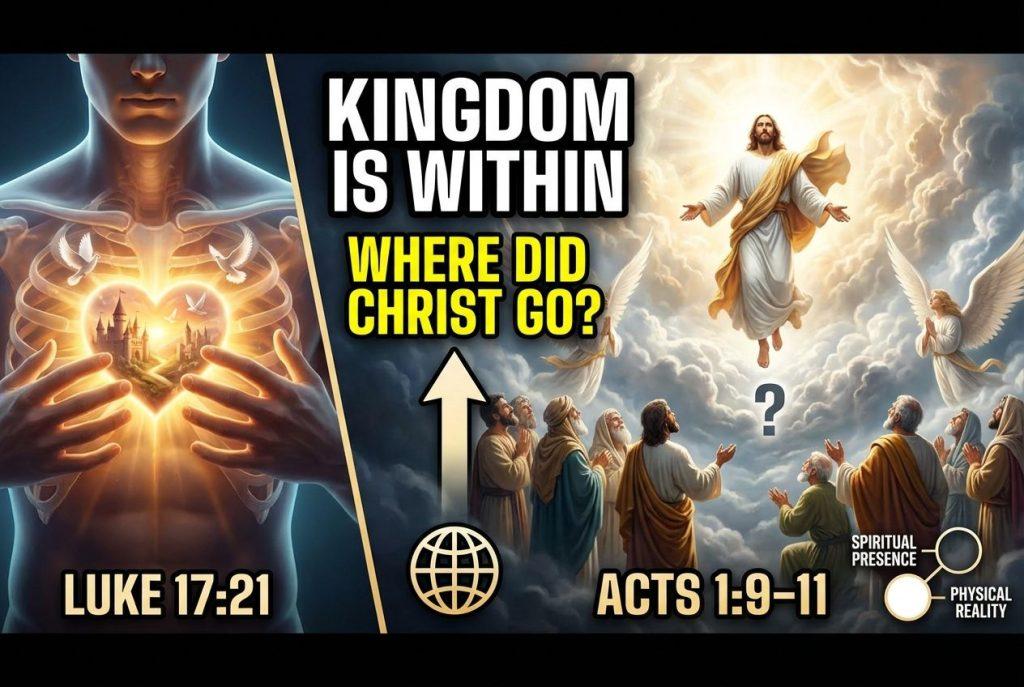
The phrase “the kingdom of God is within you” comes from Luke 17:21, where Jesus responds to the Pharisees who ask when the kingdom would come. This statement has puzzled believers for centuries, particularly when considered alongside Christ’s visible Ascension into heaven. Understanding this apparent tension requires careful attention to what Jesus meant by the kingdom and how Catholic teaching interprets both spiritual realities. The kingdom of God refers primarily to God’s sovereign rule and authority, which manifests in human hearts when people accept Christ and submit to His lordship. Jesus was not describing a physical territory or geographical location when He spoke of the kingdom being within. Rather, He emphasized that God’s reign becomes present and active in the interior life of believers. This interior presence does not exclude external realities but points to the essential nature of how God works in human experience. The kingdom exists wherever God’s will is embraced, wherever His grace transforms lives, and wherever people recognize Christ as Lord. Catholic theology has consistently taught that the kingdom has both a present and future dimension, existing now in incomplete form and awaiting full realization at the end of time. The kingdom within represents the beginning of this reality, the seed planted in human hearts that will grow to full maturity in the world to come.
The kingdom’s presence within believers does not contradict its external manifestation in the Church and in history. Catholic teaching recognizes that the kingdom of God operates on multiple levels simultaneously. When Jesus proclaimed that the kingdom was “in your midst” or “within you,” He was also identifying Himself as the kingdom’s living embodiment. Where Christ is present, there the kingdom exists in its fullness. The Pharisees stood in the very presence of the King, yet failed to recognize Him or His authority. Their question about when the kingdom would come revealed their misunderstanding; they expected dramatic political upheaval and visible signs, but Jesus redirected their attention to a more fundamental reality. The kingdom begins with interior conversion, with hearts turned toward God in faith and obedience. This interior reality then expresses itself outwardly in lives transformed by grace, in communities gathered around Christ, and in the Church’s sacramental life. The Catechism teaches that the kingdom is already present in mystery, growing like a mustard seed, working like leaven in dough (CCC 763). This growth happens both within individual souls and throughout human society as the Gospel spreads.
Understanding the kingdom as primarily spiritual rather than political or territorial helps clarify why Christ’s Ascension poses no contradiction. The kingdom within represents God’s gracious presence dwelling in human hearts through the Holy Spirit. Jesus promised that He and the Father would make their home with those who love Him, as recorded in John 14:23. This indwelling constitutes the kingdom’s essential reality for believers living between Christ’s first and second coming. When Jesus ascended to heaven, He did not abandon this interior presence but rather secured it by sending the Holy Spirit at Pentecost. The Spirit continues Christ’s presence within believers, applying His redemptive work to individual lives and building the Church. The kingdom within functions through grace, transforming human desires, healing wounded nature, and enabling people to live as children of God. Catholic tradition emphasizes that grace builds on nature rather than destroying it, perfecting human capacities rather than replacing them. The kingdom’s interior presence represents this gracious perfection, the divine life shared with human beings who remain fully human. This sharing anticipates the complete transformation that will occur when Christ returns and establishes His kingdom in its final, visible form. The kingdom within thus serves as both present reality and future promise, a down payment guaranteeing the full inheritance to come.
The Nature and Reality of Heaven
Heaven represents far more than a physical location somewhere in the sky or beyond the stars. Catholic theology has always understood heaven as fundamentally a state of being, a condition of perfect communion with God that transcends earthly categories of space and time. The Catechism defines heaven as “the ultimate end and fulfillment of the deepest human longings, the state of supreme, definitive happiness” (CCC 1024). This definition emphasizes experience and relationship rather than geographical coordinates. Heaven means entering into the very life of the Trinity, sharing in the eternal love that flows between Father, Son, and Holy Spirit. When Christ ascended to heaven, He entered not merely a different location but a different mode of existence altogether. His glorified humanity now participates fully in the divine glory that was always His by nature as God’s Son. The Ascension marks the definitive entrance of human nature into God’s domain, opening heaven to all who are united with Christ through faith. Heaven is where God is, and God cannot be confined to any particular place since He transcends all creation while remaining intimately present to every part of it.
The Church teaches that heaven is both mystery and reality, something we can partially understand through faith while remaining beyond complete human comprehension. Scripture uses symbolic language to describe heaven, speaking of it in terms of light, life, peace, wedding feasts, and the Father’s house. These images attempt to communicate realities that exceed our present experience and vocabulary. Heaven represents perfect fulfillment of everything good that humans desire and need. It means seeing God face to face in what theologians call the beatific vision, the direct contemplation of God’s essence (CCC 1028). This vision constitutes heaven’s supreme joy and the soul’s ultimate satisfaction. Everything created is good because it reflects God’s goodness in limited ways, but heaven offers the infinite Good Himself without mediation or limitation. The blessed in heaven do not merely enjoy created goods but possess God Himself, the source of all goodness. This possession occurs through knowledge and love, the blessed knowing God as He truly is and loving Him with perfect charity. Such knowledge and love transform the human person completely, elevating natural capacities to supernatural heights while preserving individual identity and personality.
Heaven exists as the blessed community of all who are perfectly incorporated into Christ, united with the Virgin Mary, the angels, and all the saints (CCC 1026). This communal dimension reveals heaven’s relational character. Heaven is not isolation or absorption into an impersonal absolute but rather perfect communion, the fullness of love shared among persons. The saints remain distinct individuals, each with unique identity and history, yet all united in their shared love of God and one another. The communion of saints means that relationships formed on earth continue in heaven, purified and perfected. Earthly loves reach their proper fulfillment when all desires are perfectly ordered toward God. Heaven involves not only vertical relationship with God but horizontal relationships with other saints. The blessed share their joy, each one’s happiness contributing to the happiness of all. This sharing reflects the Trinity’s own life, where Father, Son, and Spirit remain distinct Persons while sharing one divine nature. Heaven represents humanity’s entrance into this Trinitarian communion, finite persons invited to participate in infinite love. The blessed retain their human nature with all its proper characteristics, but this nature is glorified, freed from every limitation and imperfection that mars earthly existence.
Christ’s Ascension Into Heaven
The Ascension stands as a definitive event in salvation history, marking the completion of Christ’s earthly mission and the beginning of His eternal reign at the Father’s right hand. The Gospels and Acts provide complementary accounts of this event, each contributing important details to our understanding. Acts 1:9-11 describes how Jesus was lifted up before the apostles’ eyes and a cloud took Him from their sight. Two angels then appeared, announcing that Jesus would return in the same way He departed. Luke 24:50-51 places the Ascension near Bethany, on the Mount of Olives, emphasizing its connection to Jerusalem and the fulfillment of Old Testament prophecy. The Ascension was not a disappearance or dematerialization but a visible departure, witnessed by those who had accompanied Jesus throughout His ministry. The cloud that received Christ symbolizes the divine presence, recalling how God manifested Himself in clouds throughout Israel’s history. Christ did not simply vanish but was taken up, actively ascending by His own power while also being received by the Father. This dual action reflects His identity as both God and man, the eternal Son returning to the Father while bringing human nature into God’s presence for the first time.
The Ascension reveals the glory that Christ possessed from eternity but had veiled during His earthly life. After His resurrection, Jesus appeared to His disciples with a glorified body that possessed new properties while remaining genuinely physical. He could eat and drink, could be touched and recognized, yet He could also appear and disappear, pass through locked doors, and travel instantly between locations. His risen body retained the wounds of crucifixion as eternal witnesses to His sacrifice, but these wounds now shone with glory rather than causing pain. The forty days between Resurrection and Ascension allowed the disciples to become accustomed to Christ’s glorified state and to receive His final teachings about the kingdom. During this time, Jesus ate with them and taught them, demonstrating that His resurrection was bodily and real rather than merely spiritual or symbolic. Catholic teaching affirms that Christ truly rose in the flesh, the same body that died on the cross now transformed by divine power. The Ascension continued this glorification, bringing Christ’s humanity fully into the divine realm where it now reigns forever. His glorified body no longer experiences the limitations of earthly existence but enjoys perfect freedom and power.
The Catechism explains that Christ’s Ascension marks “the definitive entrance of Jesus’ humanity into God’s heavenly domain, whence he will come again” (CCC 665). This entrance occurred not for Christ’s benefit alone but for the sake of all humanity. By ascending to heaven in His human nature, Christ opened the way for all people to follow. His Ascension functions as our promise and guarantee, demonstrating that human nature can enter into God’s presence and share divine life. Catholic theology emphasizes that Christ remains forever both God and man, the hypostatic union of divine and human natures in one divine Person continuing eternally. Heaven now contains not only God and angels but also glorified human nature in the person of Christ. The Incarnation was not a temporary arrangement but a permanent reality, God forever united to human nature. Christ’s presence in heaven as both God and man means that humanity has a representative and advocate before the Father. He sits at the Father’s right hand, a position indicating supreme authority and honor. This throne imagery should not be understood literally but symbolically, expressing Christ’s participation in divine sovereignty. Where the Father reigns, there Christ reigns also, for they share one divine will and power.
Reconciling Interior Presence and Transcendent Reality
The apparent tension between the kingdom within and Christ’s Ascension to heaven dissolves when we recognize that spiritual realities operate differently from physical ones. God’s omnipresence means He can be fully present everywhere simultaneously without being confined to any location. The kingdom existing within believers and Christ reigning in heaven represent complementary truths rather than competing claims. Christ’s Ascension to the Father’s right hand establishes His cosmic authority and completes His mission, while the Spirit’s presence in believers makes that completed work effective in individual lives. Catholic theology distinguishes between Christ’s physical, bodily presence in heaven and His spiritual presence through grace and the sacraments on earth. His body occupies a specific location in heaven, yet His divine nature remains present throughout creation. As God, Christ is everywhere; as man, He is in heaven. This distinction allows us to affirm both His Ascension and His promise to remain with the Church always, even to the end of the age. The kingdom within operates through the Spirit whom Christ sent after His Ascension, bringing Christ’s benefits to believers without requiring His bodily presence.
The relationship between interior and exterior spiritual realities reflects the Catholic understanding of sacramental theology. God works through visible signs to communicate invisible grace, through earthly elements to convey heavenly realities. The kingdom within does not exist in opposition to external structures and institutions but finds expression through them. The Catholic Church teaches that the kingdom is present in the Church, which serves as the kingdom’s seed and beginning on earth (CCC 669). The Church’s visible structure with its hierarchy, sacraments, and doctrine mediates the invisible reality of Christ’s reign. When Jesus spoke of the kingdom being within, He did not dismiss external expressions but emphasized that these external forms must correspond to interior conversion. The Pharisees possessed the external forms of religion but lacked interior submission to God’s will. Jesus called them to recognize that true religion begins with the heart, with personal encounter with God that then shapes all external behavior and observance. The kingdom within transforms how people relate to God and neighbor, producing the fruits of love, justice, and peace that characterize God’s reign.
Heaven’s transcendent character means it cannot be located on any map or reached by physical travel. Christ’s Ascension involved movement upward from earth toward sky, but this movement was symbolic rather than directional in a geographical sense. Heaven is not “up there” beyond the atmosphere or in another galaxy but exists in a different order of reality altogether. When Christ ascended, He passed from the visible to the invisible, from temporal to eternal existence. The cloud that received Him represented the boundary between earthly and heavenly realms, between created and uncreated reality. The apostles could no longer see Him because He entered a mode of being that transcends physical sight. Yet He remained as real as before, more real in fact, since He now manifested the full glory of His divine nature without the veil of earthly humility. Heaven represents the fullness of reality rather than its absence, the perfection of being rather than its negation. When believers die and go to heaven, they do not cease to exist but rather begin to exist more fully, experiencing life as God intended without the distortions introduced by sin and death.
The Glorified Body and Spiritual Reality
Christ’s Ascension in His glorified body reveals important truths about heaven’s nature and the final destiny of all believers. Catholic teaching affirms that salvation includes the body as well as the soul, that humans are not spirits trapped in flesh but unified persons composed of body and soul together. Christ rose bodily from the dead and ascended bodily to heaven, demonstrating that heaven is not purely spiritual in the sense of being immaterial. The glorified body possesses true physicality while transcending the limitations of earthly existence. It no longer suffers corruption, decay, or death but enjoys eternal life in perfect health and vigor. Scripture promises that Christ “will transform our lowly body to conform with his glorified body,” as St. Paul writes in Philippians 3:21. This transformation will occur at the resurrection when Christ returns in glory to judge the living and the dead. Until then, the souls of the blessed enjoy the beatific vision in heaven while awaiting reunion with their bodies. This intermediate state demonstrates that the soul can exist apart from the body but that such separation is unnatural and temporary, lasting only until the general resurrection.
The properties of the glorified body illustrate how heaven transcends earthly limitations while remaining real. Traditional Catholic theology identifies four gifts of the glorified body based on Christ’s resurrection appearances and theological reflection. First, subtlety refers to the body’s perfect submission to the soul, freed from the gross materiality that resists spiritual control. The glorified body obeys the soul’s intentions immediately and completely, manifesting spiritual states physically. Second, agility indicates freedom from spatial limitations, the ability to move instantly wherever the soul desires without the constraints of distance or physical barriers. Christ’s appearances to the disciples in different locations demonstrate this property. Third, impassibility means freedom from suffering, pain, death, and all forms of corruption. The glorified body cannot be wounded, harmed, or diminished in any way. Fourth, brightness or clarity refers to the body’s radiant beauty, reflecting the soul’s glory outwardly in visible splendor. These gifts transform the body without destroying its nature, perfecting human physicality rather than replacing it with something else entirely.
Understanding the glorified body helps clarify how Christ’s humanity now exists in heaven. He did not shed His body when He ascended but brought it with Him in transformed state. His body remains genuinely physical in the sense that it is matter united to form, but this matter has been completely transfigured by divine power. The glorified body is no longer subject to the laws of physics that govern ordinary matter but operates according to higher principles. It can interact with earthly reality, as Christ did when He ate with the disciples after His resurrection, yet it also transcends earthly limitations. This dual capacity reflects how heaven relates to earth, existing beyond earthly conditions while remaining capable of affecting earthly events. Christ’s glorified body in heaven enables His continuing activity on earth through the sacraments. In the Eucharist, Catholics believe Christ becomes truly present body, blood, soul, and divinity under the appearances of bread and wine. His glorified body possesses the capacity to be present in multiple locations simultaneously, not by being divided or diminished but by a miraculous extension of His presence. This eucharistic presence differs from ordinary physical presence but remains genuinely real and substantial.
The Kingdom’s Future Consummation
The kingdom within and Christ’s reign in heaven both point forward to a future consummation when God’s purposes reach complete fulfillment. Catholic eschatology teaches that history moves toward a definite goal, the establishment of God’s kingdom in its final, visible form. Christ’s first coming inaugurated the kingdom, His Ascension enthroned Him as eternal King, and His second coming will manifest His reign to all creation. The kingdom exists now in incomplete form, present but not yet fully realized, inaugurated but awaiting consummation. Believers experience the kingdom’s power and blessings while still living in a world marked by sin, suffering, and death. The kingdom within represents this present experience of grace, the firstfruits of complete redemption. When Christ returns, He will complete what He began, transforming not only individual believers but the entire cosmos. The new heavens and new earth will emerge, a renewed creation freed from all corruption and perfectly aligned with God’s will. At that time, the distinction between interior and exterior will dissolve, for what is now hidden in the heart will become visible to all.
The Church’s liturgy anticipates this future consummation, celebrating now what will be fully realized then. Each time Catholics gather for Mass, they participate in the heavenly liturgy, joining their worship with that of angels and saints before God’s throne. The earthly celebration mirrors and participates in eternal realities, bringing heaven and earth into communion. The Eucharist represents the kingdom’s presence in sacramental form, Christ truly present though veiled under physical signs. Receiving communion unites believers with Christ and with one another, forming the Church into His body and anticipating the eternal banquet in heaven. The Mass looks backward to Christ’s sacrifice, celebrates His present reign, and points forward to His return. This three-fold temporal structure characterizes all Catholic worship and spirituality. The kingdom came in Christ’s ministry, comes now through the Spirit’s work, and will come definitively at history’s end. These three comings represent one unified divine action unfolding in time, God gradually revealing and accomplishing His plan.
Catholic teaching about purgatory also relates to the kingdom’s gradual realization in human lives. Purgatory purifies those who die in God’s grace but still bear the remnants of sin’s effects. This purification completes the transformation begun on earth, preparing souls for heaven’s perfect holiness. The kingdom begins within through conversion but requires ongoing growth and purification. Few people achieve perfect sanctity before death, most needing further refinement to become capable of bearing heaven’s glory. Purgatory represents God’s mercy, His refusal to abandon those who truly love Him but remain imperfect. After purgatory’s cleansing, the soul enters immediately into the beatific vision, experiencing the kingdom’s fullness. The process from initial conversion to final glorification shows how the kingdom within gradually transforms the whole person. What begins as seed becomes tree, what starts as pledge becomes full possession. God respects human freedom and the slow pace of genuine transformation, working gradually rather than forcing instant perfection. The kingdom grows organically as grace heals nature, faith matures, and love deepens.
Heaven as Communion With God
The essential character of heaven consists in perfect communion with God, the complete and unmediated experience of divine presence. The Catechism states that heaven is “the blessed community of all who are perfectly incorporated into Christ” (CCC 1026). This definition emphasizes relationship rather than location, communion rather than merely occupation of space. Heaven means knowing God as He is rather than through created intermediaries, seeing Him face to face rather than through a glass darkly. Theologians call this immediate vision the beatific vision, the blessed or happy vision that constitutes heaven’s essential joy. The beatific vision exceeds natural human capacity, requiring a supernatural gift called the light of glory that elevates the intellect to contemplate divine essence. Natural human knowledge operates through sense experience and conceptual abstraction, but the beatific vision involves direct intuition of God’s being. The blessed see God not by forming concepts about Him but by direct participation in His own self-knowledge. God knows Himself perfectly, and the blessed share in this divine self-knowledge according to their finite capacity.
This direct knowledge of God produces perfect happiness because it fulfills the deepest human desires and needs. Humans are made for God, oriented toward Him as their ultimate end and final good. All earthly desires represent distorted or partial expressions of the fundamental desire for God Himself. When people seek pleasure, beauty, knowledge, love, or power, they seek limited reflections of divine perfection. Only infinite Good can satisfy desires ultimately oriented toward the infinite. Heaven provides this satisfaction, not by offering greater quantities of created goods but by giving the Creator Himself. The blessed possess God and are possessed by Him in mutual love. This possession does not diminish God or confine Him but allows the creature to receive divine life in the measure appropriate to finite being. Heaven adapts itself to each soul’s unique capacity, each person receiving the fullness they can hold. Yet all are perfectly satisfied, each one’s cup completely full even though cups vary in size. The blessed do not envy those who receive more or feel superior to those who receive less, for all share the same essential gift of God’s presence.
Communion with God in heaven includes communion with all the blessed, the Church triumphant united in perfect charity. Love of God necessarily involves love of neighbor, for loving what God loves means loving those He has created and redeemed. In heaven, this love reaches perfection, freed from all selfishness and distortion. The blessed love one another with pure charity, each one rejoicing in the happiness of all. Earthly relationships continue but transformed, freed from the possessiveness and exclusivity that often mark human love. Married couples will know each other in heaven, but their relationship will be transfigured by their mutual relationship with God. All particular loves find their place within universal charity, each valued properly without idolatry or diminishment. The communion of saints demonstrates that heaven is not solitary contemplation but shared celebration, not isolation but community. The blessed worship God together, each voice joining the eternal song of praise. They also continue to care for the Church on earth, interceding for those still struggling in this life. The connection between heaven and earth remains strong, the blessed actively engaged in God’s purposes rather than passively enjoying private bliss.
Theological Implications and Practical Application
The relationship between the kingdom within and Christ’s Ascension to heaven carries significant implications for Christian life and spirituality. If the kingdom is primarily interior and spiritual, then authentic Christianity must focus on interior conversion rather than merely external conformity. External practices and structures serve to foster interior transformation rather than replacing it. The Church’s sacraments, liturgy, moral teachings, and devotional practices all aim at forming hearts that truly love God and neighbor. Without interior receptivity, external observance becomes hollow formalism of the kind Jesus criticized in the Pharisees. Yet interior conversion must express itself outwardly, bearing fruit in changed behavior and visible witness. The kingdom within naturally manifests itself without, transforming how believers live in the world. Faith without works is dead, as St. James teaches, not because works save but because genuine faith inevitably produces good works. The interior and exterior dimensions of Christian life must be properly integrated, neither dimension neglected in favor of the other.
Christ’s Ascension and heavenly reign remind believers that earthly life is not ultimate but penultimate, important but not all-important. The Christian lives simultaneously in two orders, remaining fully engaged in earthly responsibilities while orienting all activity toward eternal goals. This dual citizenship means refusing to absolutize temporal concerns or trivialize eternal ones. Political systems, economic arrangements, cultural achievements, and personal accomplishments all matter but matter as means rather than ends. They serve human flourishing when properly ordered toward God but become idolatrous when treated as ultimate. The kingdom within provides proper perspective on earthly life, helping believers maintain balance between engagement and detachment. Christians work to improve earthly conditions without expecting perfect justice before Christ’s return. They value created goods without worshipping them, enjoy earthly pleasures without depending on them for ultimate satisfaction. This balanced approach avoids both worldly absorption and false spirituality that despises material creation.
The promise of glorified bodies in heaven affirms the goodness of material creation and bodily existence. Christianity does not teach escape from the body but rather the body’s redemption and transformation. Earthly life in the body has eternal significance, each choice shaping the person who will rise on the last day. Care for the body, proper stewardship of health, and respect for physical creation all reflect Christian anthropology. Yet the body serves the soul rather than vice versa, physical needs subordinated to spiritual growth. The disciplined life that Catholic tradition recommends, including fasting, chastity, and moderation, aims not at despising the body but at properly ordering bodily appetites. Virtue consists in enjoying bodily goods in the right measure, for the right reasons, in the right contexts. The glorified body represents this proper integration of spirit and matter, physical nature completely harmonized with spiritual purpose. Christians should treat their bodies as temples of the Holy Spirit, instruments for serving God and neighbor rather than obstacles to spiritual progress.
Scripture and Tradition on Heaven’s Nature
Sacred Scripture employs various images to describe heaven, each highlighting different aspects of this mystery that exceeds human comprehension. Jesus spoke of heaven as the Father’s house with many rooms, a place prepared for His disciples in John 14:2-3. This domestic imagery emphasizes heaven’s welcoming character, the sense of belonging and homecoming that awaits believers. Heaven is where humanity truly belongs, the homeland from which we are currently exiled. St. Paul describes heaven in terms of vision and knowledge, stating that now we see in a mirror dimly but then face to face, now we know in part but then shall know fully in 1 Corinthians 13:12. This progression from partial to complete knowledge indicates heaven’s revelatory character, the disclosure of realities now hidden. The Book of Revelation offers elaborate symbolic descriptions of heavenly worship, with angels and elders falling before God’s throne, endless songs of praise, and the Lamb who was slain receiving glory and honor. These liturgical images suggest heaven’s celebratory nature, eternal festival in God’s presence.
The Church Fathers developed these biblical themes, offering theological reflection on heaven’s nature while maintaining appropriate humility before the mystery. St. Augustine taught that heaven consists primarily in seeing God, this vision producing complete happiness because it fulfills human nature’s deepest orientation. He emphasized that heaven is not boring or static but involves eternal exploration of infinite mystery, the blessed never exhausting the depths of divine beauty and goodness. St. Thomas Aquinas provided systematic analysis of the beatific vision, explaining how finite intellects can truly know infinite God without comprehending Him completely. The blessed see God’s essence truly but not totally, their knowledge real but limited by their finite capacity. Aquinas also discussed the relationship between knowledge and love in heaven, arguing that seeing God produces love and that this love further intensifies knowledge in ascending spiral. The blessed grow forever in their capacity to receive God, though they remain always perfectly satisfied with what they currently receive.
Later Catholic theologians continued exploring these themes, addressing questions about personal identity in heaven, relationships between the blessed, and the resurrection body’s properties. The Church’s official teaching maintains essential doctrines while allowing diversity of theological opinion on many details. Catholics must believe that heaven exists, that the blessed see God face to face, that this vision produces perfect happiness, and that the body will rise in glorified form. Beyond these core teachings, much remains mysterious, known fully only to God Himself. The Church encourages appropriate curiosity and speculation while warning against excessive speculation that goes beyond what revelation teaches. Heaven’s reality exceeds our present ability to imagine or conceive, as St. Paul quotes Isaiah in 1 Corinthians 2:9: “no eye has seen, nor ear heard, nor the heart of man conceived, what God has prepared for those who love him.” This exceeding character should inspire hope rather than frustration, joy rather than despair, for it promises that reality will surpass our highest expectations.
Living Between Kingdom Within and Kingdom Come
Christian existence in the present age involves living in creative tension between already and not yet, between the kingdom within and the kingdom to come. Believers possess the Spirit as down payment guaranteeing full inheritance, experience God’s grace as firstfruits promising complete harvest. This in-between status requires patience and hope, virtues that sustain faith when circumstances seem to contradict God’s promises. The kingdom within provides strength for enduring earthly trials, the indwelling Spirit comforting and empowering believers for their journey. Yet this interior strength does not eliminate suffering or remove difficulty but rather transforms how Christians experience and respond to hardship. The kingdom within means sharing Christ’s cross as well as His resurrection, participating in His sufferings while awaiting glorification. St. Paul teaches that present sufferings are not worth comparing with the glory that will be revealed in Romans 8:18, this future glory illuminating present pain with hope’s light.
The Ascension demonstrates that Christ has gone before to prepare a place for His followers, His glorified humanity guaranteeing the same destiny for all who believe. When believers struggle with doubt, suffering, or spiritual darkness, they can look to Christ enthroned in heaven as proof that God’s promises are trustworthy. He who promised is faithful, and what He accomplished in His own body He will accomplish in the bodies of all who belong to Him. The Ascension provides objective, historical confirmation of Christian hope, visible evidence that God can raise the dead and exalt the humble. Christ did not merely claim to be going to heaven but was seen ascending before reliable witnesses who testified to what they saw. This apostolic witness grounds Christian faith in historical events rather than subjective feelings or philosophical speculation. The kingdom within, though invisible to outsiders, rests on objective reality of Christ’s resurrection and Ascension.
Prayer serves as primary means of maintaining connection between the kingdom within and the kingdom to come, interior reality and transcendent destiny. When Christians pray, they exercise their citizenship in heaven while remaining physically on earth. Prayer lifts hearts and minds to God, creating space for His presence and action. The liturgy especially functions as meeting point between heaven and earth, the Church’s worship joining the eternal worship around God’s throne. Catholics believe that each Mass makes present Christ’s once-for-all sacrifice, bringing earthly participants into contact with heavenly realities. The communion of saints functions through prayer, the blessed in heaven interceding for those on earth while the earthly Church honors those in glory. This mutual exchange maintains connection across the boundary between earthly and heavenly existence. Prayer also cultivates the kingdom within, disposing hearts to receive God’s grace and conform to His will. Through regular prayer, especially participation in the sacraments, Christians grow in holiness and prepare for heaven’s fullness. What we practice now in fragmentary fashion we will do perfectly then, worship begun on earth continuing forever in heaven.
Conclusion
The apparent tension between the kingdom of God being within and Christ ascending to heaven resolves when we understand both statements according to Catholic theological tradition. The kingdom within refers to God’s gracious reign in human hearts, His presence through the Holy Spirit transforming believers from within. This interior presence does not exhaust the kingdom’s reality but represents its beginning in individual lives. Christ’s Ascension to heaven established His cosmic authority and completed His redemptive mission, opening heaven to humanity and enabling the Spirit’s outpouring. Heaven itself transcends simple spatial categories, existing as the transcendent state of perfect communion with God rather than merely a location beyond the sky. Christ’s glorified humanity now dwells in heaven, His bodily Ascension demonstrating that human nature can enter God’s presence and that believers will follow. The relationship between interior presence and transcendent destiny reveals Christianity’s both-and character, its refusal to collapse complex realities into simple formulas. Catholics hold together divine transcendence and divine immanence, God’s absolute otherness and His intimate nearness. The kingdom within and Christ’s heavenly reign both serve God’s single purpose of bringing humanity into eternal communion with Himself. Understanding these realities as complementary rather than contradictory helps believers maintain proper balance, fully engaged in earthly life while oriented toward eternal destiny. The kingdom that begins within will be consummated when Christ returns, interior transformation completed in full glorification. Until that day, Christians live by faith not sight, trusting promises they cannot yet fully verify, hoping for what remains invisible, loving the God they know imperfectly but truly. This lived tension between present and future, interior and exterior, earthly and heavenly defines authentic Christian existence. The kingdom is here, the kingdom is coming, and Christ reigns forever in heaven, guaranteeing that God’s purposes will reach their appointed goal.
Disclaimer: This article presents Catholic teaching for educational purposes. For official Church teaching, consult the Catechism and magisterial documents. For personal spiritual guidance, consult your parish priest or spiritual director. Questions? Contact editor@catholicshare.com
Sign up for our Exclusive Newsletter
- 📌 Add CatholicShare as a Preferred Source on Google
- 🎁 Join us on Patreon for Premium Content
- 🎧 Check Out These Catholic Audiobooks
- 📿 Get Your FREE Rosary Book
- 📱 Follow Us on Flipboard
-

Recommended Catholic Books
Discover hidden wisdom in Catholic books — invaluable guides enriching faith and satisfying curiosity. #CommissionsEarned
- The Early Church Was the Catholic Church
- The Case for Catholicism - Answers to Classic and Contemporary Protestant Objections
- Meeting the Protestant Challenge: How to Answer 50 Biblical Objections to Catholic Beliefs
As an Amazon Associate, I earn from qualifying purchases. Thank you for your support.