
Brief Overview
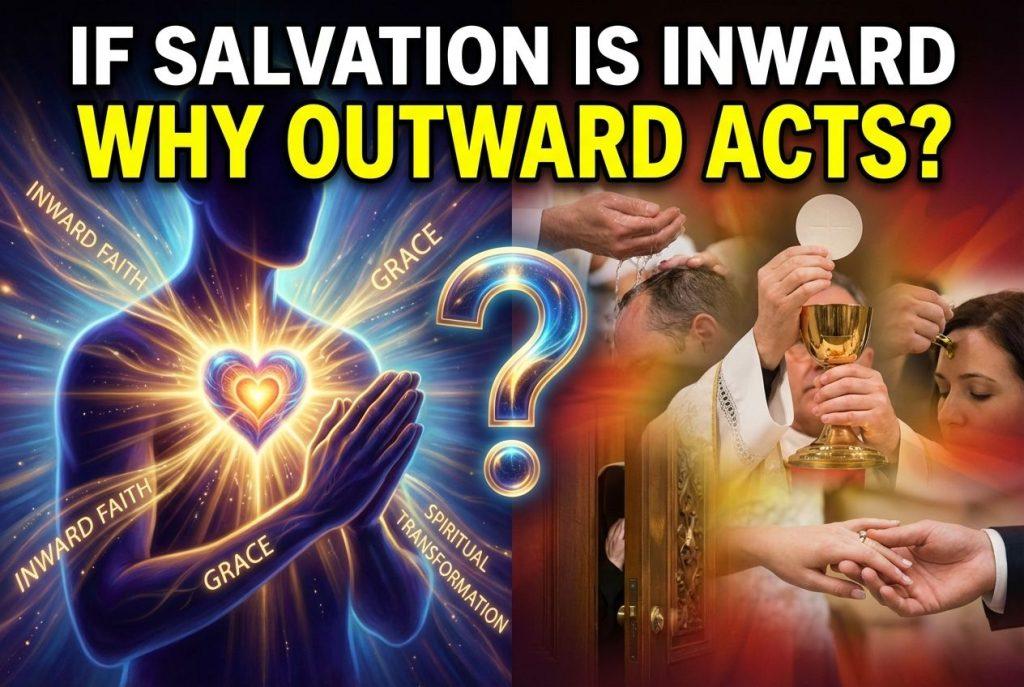
- The Catholic Church teaches that salvation involves both an interior transformation of the heart and exterior actions that flow from that changed heart.
- Faith and works are not opposed to each other but are inseparable aspects of authentic Christian life that cooperate with God’s grace.
- The visible and material world matters to God because He created it good and entered it Himself through the Incarnation of Jesus Christ.
- Outward acts serve as expressions of interior conversion and also as means through which God communicates His grace to others.
- Scripture consistently presents faith as something that naturally produces works when it is genuine and alive.
- The relationship between interior faith and exterior actions reflects the unity of body and soul in human nature and the sacramental principle of Christianity.
The Foundation of Interior Conversion
Catholic teaching begins with a clear affirmation that salvation starts within the human heart. The Catechism emphasizes that interior repentance forms the foundation of genuine conversion to God. This interior movement involves a radical reorientation of one’s entire life toward God and away from sin. The heart must turn to God with genuine sorrow for past offenses and a firm resolve to avoid sin in the future. This interior conversion precedes and animates all external expressions of faith. Without this interior transformation, external religious actions become empty rituals disconnected from authentic relationship with God. The grace of the Holy Spirit initiates this interior work by touching the human heart and drawing it toward divine love. Interior repentance includes recognition of personal sinfulness, acceptance of God’s mercy, and desire for reconciliation with Him. This movement of the heart represents the most fundamental aspect of salvation. God searches the heart and knows the true intentions of every person. Interior conversion establishes the proper disposition for receiving sanctifying grace.
The interior nature of conversion connects directly to the biblical understanding of the heart as the center of human personhood. Scripture repeatedly emphasizes that God looks at the heart rather than outward appearances. The prophets called Israel to circumcision of the heart rather than mere external observance of the law. Jesus criticized the Pharisees for maintaining external appearances while their hearts remained far from God. Authentic religion must begin in the depths of the human person where free will encounters divine grace. The interior life of prayer, meditation, and communion with God forms the wellspring from which all authentic Christian action flows. Without interior conversion, a person might perform many religious duties while remaining fundamentally unchanged. The transformation that God desires reaches into the deepest recesses of human consciousness and will. This interior work of grace reshapes desires, reorders loves, and redirects the fundamental orientation of the person. The Catholic tradition has always recognized that external conformity to rules cannot substitute for genuine interior transformation. Conversion must be real and not merely apparent.
The Unity of Interior and Exterior in Human Nature
Human beings exist as unified creatures composed of both body and soul. Catholic anthropology rejects any dualism that separates these two dimensions as though they were independent realities. The body is not a prison for the soul but an integral part of human personhood. When God created humanity, He formed both body and soul together as complementary aspects of a single nature. The material body participates fully in human dignity and spiritual destiny. Salvation extends to the whole person, not just to some immaterial aspect isolated from bodily existence. This unity means that interior states naturally find expression in exterior actions. Thoughts and feelings seek embodiment in words and deeds. Love that remains entirely hidden within the heart fails to achieve its natural completion. Human beings communicate and relate through bodily expressions and material actions. The body makes visible what exists invisibly in the soul. This connection between interior and exterior belongs to the very structure of human nature as God designed it.
The unity of body and soul has significant implications for understanding salvation. God desires to save the whole person, not merely some spiritual core abstracted from material existence. The resurrection of the body stands as a central doctrine of Christian faith precisely because bodily existence matters eternally. Jesus rose bodily from the dead and ascended into heaven with His human body. This bodily resurrection testifies that matter itself participates in the divine plan of redemption. Grace transforms the entire person, sanctifying both soul and body. Spiritual realities manifest themselves through bodily actions in ways appropriate to human nature. Prayer involves the body through physical postures, spoken words, and ritual gestures. Charity expresses itself through bodily actions that meet the material needs of others. Christian life engages the whole person in relationship with God. Interior faith naturally seeks exterior expression because human beings are embodied souls. The separation of interior faith from exterior works contradicts the fundamental unity of human nature.
The Incarnation as Foundation for Sacramental Reality
The mystery of the Incarnation establishes the theological foundation for understanding why outward acts matter in salvation. God the Son took on human flesh and entered fully into material existence. The Word became flesh and dwelt among us, revealing God through visible, tangible, material reality. Jesus Christ possesses both divine and human natures united in one person. His human nature includes a real human body that suffered, died, and rose again. The Incarnation demonstrates that God values material creation and chooses to work through physical means. Divine grace does not bypass the material world but enters into it and transforms it. The Incarnation reveals that spiritual realities can be mediated through physical realities. Jesus healed people through physical touch, used mud and saliva to restore sight, and instituted sacraments using material elements like water, bread, and wine. The physical actions and bodily presence of Jesus communicated divine grace to those who encountered Him. This incarnational principle continues in the life of the Church.
The sacramental system of the Catholic Church flows directly from the incarnational principle established in Jesus Christ. A sacrament is defined as a visible sign of invisible grace, an outward expression of inward reality. The sacraments use material elements and physical actions to communicate spiritual grace. Water washes away sin in baptism, bread and wine become the Body and Blood of Christ, oil anoints the sick, and spoken words impart absolution. These visible signs actually accomplish what they signify by the power of God working through them. The sacramental principle recognizes that God meets human beings where they are as embodied creatures who need visible signs. Faith itself is strengthened and nourished through these tangible encounters with divine grace. The Catholic understanding of sacraments would make no sense if salvation were purely interior and spiritual with no connection to material reality. The sacraments demonstrate that outward acts can be genuine instruments of grace. They establish that visible actions participate in the invisible work of salvation. The incarnational and sacramental dimensions of Catholic faith show why exterior expressions matter in the life of grace.
Faith and Works in Biblical Teaching
Sacred Scripture presents faith and works as inseparable dimensions of authentic Christian life rather than opposed alternatives. The Letter of James explicitly states that faith without works is dead. James asks whether faith alone can save someone and answers his own question negatively. He uses the example of claiming to have faith while refusing to help a brother or sister in need. Such faith, divorced from charitable action, proves itself to be dead and useless. James declares that a person is justified by works and not by faith alone. This biblical teaching directly addresses the question of whether salvation can remain purely interior. The inspired author insists that genuine faith necessarily produces works. The absence of works indicates the absence of genuine faith. Living faith expresses itself through concrete actions that embody its inner reality. James compares faith without works to a body without breath, a corpse that appears to be human but lacks the animating principle of life. This analogy shows that works function like the breath that proves a body is alive.
The Apostle Paul, often cited in support of salvation by faith alone, actually teaches a more nuanced relationship between faith and works. Paul emphasizes that justification comes through faith in Jesus Christ rather than through works of the Mosaic Law performed in an attempt to earn salvation. He opposes a legalistic approach that treats salvation as a reward earned through human effort apart from grace. However, Paul also teaches that faith works through love and that believers are created in Christ Jesus for good works. He instructs the Galatians that what matters is faith working through love. He tells the Ephesians that they are saved by grace through faith, but immediately adds that they are created for good works which God prepared beforehand. Paul expects that genuine faith will manifest itself in transformed behavior. He provides detailed ethical instructions for Christian living and warns that those who practice certain sins will not inherit the kingdom of God. The apparent tension between faith and works in Paul’s writings dissolves when we recognize that he opposes works done apart from faith while affirming works that flow from faith.
The teachings of Jesus Himself connect faith with action throughout the Gospels. Jesus declares blessed those who hear the word of God and keep it. He warns that not everyone who says “Lord, Lord” will enter the kingdom of heaven, but only those who do the will of His Father. He teaches that the house built on rock belongs to the one who hears His words and acts on them. The judgment scene in Matthew 25 shows Christ separating people based on whether they fed the hungry, welcomed strangers, clothed the naked, and visited the sick and imprisoned. Jesus identifies Himself with those in need so that service to the poor becomes service to Him. This teaching reveals that outward acts of charity have eternal significance. The Lord praises the person who does what he knows rather than the one who merely knows without doing. Throughout the Gospels, Jesus calls people not merely to believe intellectually but to follow Him in action. Discipleship involves concrete behavioral changes and visible expressions of love. The biblical witness consistently connects interior faith with exterior action.
Grace as Both Gift and Transformation
Catholic theology teaches that salvation is entirely a gift of God’s grace and not something earned through human merit. No person can save himself through his own efforts or good works performed apart from divine assistance. Justification has been merited for humanity by the Passion of Christ who offered Himself on the cross as a living victim. The grace of the Holy Spirit cleanses from sin and communicates the righteousness of God through faith in Jesus Christ. This grace is freely given and cannot be purchased or earned by human achievement. The initial grace that leads to conversion is pure gift that precedes any human response. God’s merciful initiative offers forgiveness and righteousness from on high. The first work of grace is conversion itself, which moves the human heart toward God and away from sin. This fundamental teaching safeguards the truth that salvation comes from God alone. Human beings contribute nothing to the initial gift of justifying grace. The Catholic Church explicitly rejects any notion that people can save themselves through their own works apart from God’s grace.
However, Catholic teaching also affirms that justifying grace truly transforms the person who receives it. Grace is not merely a legal declaration that leaves the person unchanged; it is a real interior transformation that makes the person righteous before God. Justification is not only the remission of sins but also the sanctification and renewal of the interior person. Grace changes us at the deepest level by making us share in the divine nature. It detaches the person from sin, purifies the heart, and grants obedience to the divine will. Justification pours faith, hope, and charity into our hearts. This transformative understanding of grace has crucial implications for the relationship between interior faith and exterior works. If grace genuinely transforms the person, then this transformation will manifest itself in changed behavior. The sanctified person naturally begins to act differently because he has become different. Works flow from the transformed heart as natural expressions of the new life received through grace. The person moved by the Holy Spirit and animated by charity can then perform works that are genuinely good.
Cooperation with Grace and Human Freedom
God’s grace does not destroy human freedom but rather enables and perfects it. The Catholic understanding of salvation involves cooperation between divine grace and human liberty. Justification establishes cooperation between God’s grace and human freedom. The human person is not purely passive in receiving grace but actively responds to God’s invitation. On the human side, this cooperation expresses itself through the assent of faith to the Word of God and through charity prompted by the Holy Spirit. When God touches the human heart through the illumination of the Holy Spirit, the person is not inactive while receiving that inspiration. The individual could reject the grace offered but chooses instead to cooperate with it. However, without God’s grace, no one can move himself toward righteousness by his own free will. The initiative always belongs to God who first moves the heart. Human cooperation never merits the initial gift of grace. Yet once grace has been received, the transformed person genuinely participates in the ongoing work of salvation. This participation is itself enabled by grace working within the person.
The doctrine of merit must be understood within this framework of grace enabling human cooperation. Catholic teaching affirms that we can merit for ourselves and for others the graces needed for sanctification through works performed with God’s grace in communion with Jesus. This merit does not mean that we earn salvation through our own independent efforts. Rather, it recognizes that God generously allows our grace-enabled actions to contribute to the increase of grace and charity. Charity, which is the love of God poured into our hearts by the Holy Spirit, stands as the principal source of merit. The merits of our good works are themselves gifts of divine goodness. We can merit only because Christ’s grace works through us and our actions participate in His merit. This understanding preserves both the gratuity of salvation and the reality that transformed persons genuinely contribute to God’s work. The cooperation of the believer with divine grace necessarily includes outward acts because human action is how people cooperate in the world. Interior dispositions alone, without any external expression, would represent a kind of passivity incompatible with genuine human freedom and responsibility.
The Community Dimension of Salvation
Salvation, while personal, is not purely private or individualistic. God saves people within the context of a community, the Church, which is the Body of Christ and the People of God. Faith is received, nurtured, and lived within this communal context. The visible Church exists as the sacrament of salvation in the world. This ecclesial dimension of salvation requires visible, public expressions of faith. Baptism initiates the person into the visible community of believers. Participation in the Eucharist unites believers with one another and with Christ. The profession of faith is a public declaration that connects the individual to the believing community across time and space. The Church herself functions as a visible sign of invisible grace, pointing to the communion between God and humanity. Individual salvation connects to this larger communal reality and cannot be entirely separated from it. Private, purely interior faith disconnected from the visible Church would contradict the social nature of salvation as God has revealed it.
The commandment to love one’s neighbor requires outward acts that benefit others. Charity cannot remain locked within the heart but must express itself in service to those in need. The judgment scene in Matthew 25 emphasizes concrete acts of mercy toward the suffering. Feeding the hungry, welcoming strangers, clothing the naked, caring for the sick, and visiting prisoners are all external actions that require bodily presence and material assistance. These works of mercy demonstrate that salvation involves real relationships with other people, not just an interior relationship with God. The commandment to love God and neighbor forms an inseparable unity. Claiming to love God while neglecting the neighbor contradicts the nature of Christian charity. The First Letter of John states clearly that whoever does not love the brother whom he has seen cannot love God whom he has not seen. This teaching shows that love must take visible form in relationships with other people. The social and communal dimension of salvation ensures that outward acts remain essential to authentic Christian life.
Works as Evidence of Faith
Catholic teaching recognizes that outward acts serve as evidence of genuine interior faith. Works do not cause salvation, but they reveal whether faith is authentic or merely nominal. Dead faith, which lacks works, is actually no faith at all. True faith naturally produces works as a tree produces fruit. The quality of the fruit reveals the nature of the tree. Similarly, the presence or absence of good works indicates whether faith is alive or dead. This understanding preserves the priority of faith while insisting on its inseparability from works. Faith comes first as the foundation and root of justification. Works follow as the necessary expression and evidence of that faith. Without works, there is no way to distinguish genuine faith from mere intellectual assent or empty profession. Many people claim to believe in God, but their lives show no evidence of transformation. Such faith lacks the vital quality that connects the person to Christ and enables salvation. The letter of James addresses this precise problem by challenging believers to demonstrate their faith through their actions.
The evidential function of works applies both to individual self-examination and to communal discernment. Each believer should examine whether his life produces the fruit appropriate to faith. The absence of any good works should prompt serious questioning about whether genuine conversion has occurred. Paul instructs believers to examine themselves to see whether they are in the faith. This self-examination necessarily considers not only interior states but also outward behaviors that express those states. The community also observes the lives of believers to determine whether their profession of faith is credible. The Church has always recognized that persistent, unrepentant sin contradicts the claim to be in a state of grace. Public actions matter because they communicate to others and shape the witness of the community. The credibility of Christian testimony depends partly on the consistency between what believers profess and how they live. When Christians fail to live according to their faith, they scandal others and damage the Church’s witness. The evidential role of works thus serves both personal and communal purposes.
The Transformative Power of Action
Catholic spirituality recognizes that outward acts not only express interior states but also shape and strengthen them. Actions have a formative effect on the person who performs them. Virtues are formed through repeated acts that gradually become habitual dispositions. A person becomes generous by practicing acts of generosity, courageous by performing courageous deeds, and loving by doing loving actions. The external practice of virtue strengthens the interior virtue. This principle applies to the spiritual life as well. Acts of prayer, worship, penance, and charity cultivate the interior dispositions they express. The person who prays regularly develops a deeper prayer life. The individual who practices works of mercy grows in compassion and love. External religious practices are not merely expressions of faith but also means of deepening faith. The sacraments work in this way by conferring the grace they signify. The person who receives Communion encounters Christ and is transformed by that encounter. The penitent who confesses sins receives both absolution and spiritual strengthening.
This formative dimension of action explains why the Church prescribes certain practices and disciplines. Fasting, almsgiving, prayer, attendance at Mass, and reception of sacraments are not arbitrary rules but means of grace. These practices form Catholics into the likeness of Christ. The Second Vatican Council taught that participation in the liturgy is the primary source from which the faithful derive the true Christian spirit. Active participation in the Mass and sacraments shapes the interior life of believers. The practice of fasting trains the will to control bodily desires and redirects attention toward spiritual realities. Acts of charity toward the poor open the heart to greater love and make concrete the preferential option for those in need. The various spiritual practices of Catholic tradition all serve to transform the person from the inside out. Interior and exterior dimensions of Christian life work together in a dynamic process of conversion and sanctification. Neither dimension can be reduced to the other or eliminated in favor of the other.
The Final Judgment and Eternal Consequences
Catholic eschatology teaches that human beings will be judged according to their works. At the particular judgment immediately after death and at the general judgment at the end of time, people will give account for what they have done. The New Testament consistently presents this understanding of judgment based on deeds. Jesus describes the final judgment as a separation of sheep from goats based on whether people fed the hungry, welcomed strangers, clothed the naked, cared for the sick, and visited prisoners. The Book of Revelation states that the dead will be judged according to what they had done as recorded in the books. Paul teaches that each person will receive what is due for what he has done in the body, whether good or evil. These biblical passages show that actions have eternal consequences. The choices people make and the deeds they perform during their earthly lives determine their eternal destiny. This teaching about judgment according to works underscores the significance of outward acts in God’s plan of salvation.
The eternal consequences of human actions reflect the dignity and responsibility God grants to human freedom. God takes human choices seriously and allows them to have lasting significance. People genuinely shape their eternal destiny through how they respond to grace during their earthly lives. The doctrine of heaven and hell reflects the truth that human actions matter ultimately and eternally. Those who die in a state of grace and friendship with God enter eternal life. Those who die in mortal sin, having definitively rejected God’s love, experience eternal separation from Him. This teaching magnifies rather than diminishes the importance of interior faith. Faith must be living faith that perseveres to the end. But living faith necessarily produces works. The person who claims faith while living in persistent, unrepentant sin deceives himself. The Church teaches that faith can be lost through mortal sin. This possibility shows that salvation, while initiated by grace, requires ongoing cooperation throughout life. The final judgment will reveal the truth about each person’s life. Interior dispositions will be made manifest through the pattern of exterior actions that characterized each person’s life. Nothing will remain hidden.
The Witness of the Saints
The lives of the saints throughout Christian history demonstrate the inseparable unity of interior faith and exterior action. The saints were people of deep prayer and intimate communion with God who also performed remarkable works of charity, service, and sacrifice. Their interior lives of contemplation and union with God expressed themselves in external actions that transformed the world around them. Saint Francis of Assisi, known for his intense mystical experiences and interior closeness to Christ, also founded religious orders, rebuilt churches, preached repentance, and served lepers. Saint Teresa of Avila experienced profound mystical prayer while also reforming convents, writing spiritual works, and managing practical affairs. Saint Vincent de Paul cultivated a rich interior life while organizing relief for the poor, reforming clergy, and establishing charitable institutions. The pattern repeats across centuries and cultures. The saints show that holiness involves both interior transformation and exterior action. Their lives give concrete expression to the Catholic understanding that salvation engages the whole person in relationship with God and neighbor.
The witness of the saints also reveals how interior faith empowers and motivates exterior works. The saints performed extraordinary acts of charity and service because they were transformed by grace and motivated by love of God. Their actions flowed from hearts set on fire with divine love. They did not perform good works to earn salvation but because they had been saved and wanted to serve the God they loved. Their example shows that works proceed from faith rather than competing with it. The heroic virtue of the saints demonstrates what becomes possible when human beings cooperate fully with divine grace. Their lives challenge all believers to allow faith to express itself in concrete actions. The Church proposes the saints as models precisely because their integrated lives of prayer and action show authentic Christianity. The cult of the saints in Catholic practice keeps before believers the concrete examples of how faith and works unite in holy lives. The communion of saints connects believers across time and space in a community of faith that produces visible fruit.
Addressing Common Objections
Some Christians object that emphasizing outward works undermines confidence in salvation by making it depend on human performance. This objection misunderstands the Catholic position. The Church teaches that salvation depends entirely on God’s grace, not on human achievement. However, grace transforms people so that they become capable of genuine good works. These works are themselves gifts of grace rather than independent human accomplishments. The cooperation of believers with grace does not make salvation uncertain because God’s grace is powerful enough to accomplish His saving purpose. The confidence of the believer rests on God’s faithfulness, not on personal performance. At the same time, Catholic teaching avoids presumption by insisting that believers must persevere in faith and charity until death. The biblical warnings about falling away and losing salvation would be meaningless if outward actions were irrelevant. The Catholic position preserves both confidence in God’s grace and the sobering reality that human freedom can reject grace. This balanced understanding corresponds to the full biblical witness.
Another objection claims that requiring outward acts adds human works to Christ’s finished work of salvation. This objection falsely assumes that any human participation in salvation diminishes Christ’s role. Catholic teaching affirms that Christ alone saves and that His sacrifice on the cross is the sole meritorious cause of salvation. Human works add nothing to what Christ accomplished. However, Christ’s saving work applies to individual believers through their union with Him by faith working through love. The works believers perform in union with Christ participate in His work rather than competing with it. Paul teaches that he works hard through Christ’s energy which powerfully works within him. Christian action is Christ’s action in and through His members. The grace of Christ empowers believers to do good works and makes those works fruitful. This understanding exalts Christ’s grace rather than diminishing it. The transformative power of grace that makes believers capable of good works testifies to the completeness of Christ’s redemptive work. A salvation that left people unchanged and unable to do good would represent an incomplete redemption.
Practical Application in Daily Life
The Catholic understanding of interior faith and exterior works has immediate practical implications for daily Christian living. Believers should cultivate both interior prayer life and exterior service to others. Times of silent prayer, meditation on Scripture, participation in the sacraments, and personal conversation with God nourish the interior life. These practices should lead naturally to acts of charity, justice, mercy, and service in the world. The rhythm of Catholic life alternates between gathering for worship and scattering for mission. Believers come together to receive grace through word and sacrament, then go forth to bring that grace to others through their words and deeds. The liturgy ends with a sending forth that commissions the faithful to love and serve the Lord. This pattern reflects the essential connection between receiving grace and sharing it with others. Interior conversion must bear fruit in changed behavior in all areas of life including family, work, citizenship, and social relationships.
The integration of faith and works challenges believers to examine whether their lives consistently embody their beliefs. Catholics should regularly ask themselves whether their external actions align with their internal convictions. Do we treat others with the dignity their nature as image-bearers of God demands? Do our economic choices reflect concern for the poor and vulnerable? Does our speech build up or tear down? Do we practice the works of mercy in concrete ways? These questions help believers assess whether faith is expressing itself in action. The examination of conscience before confession should include both interior sins of thought and desire and exterior sins of word and deed. Growth in holiness requires attention to both dimensions. The spiritual life is not compartmentalized from ordinary life but permeates all activities and relationships. Every action can become an expression of love for God when performed with right intention. The Catholic vision sees all of life as potentially sacred when lived in union with Christ. This integrated approach to Christian living shows why outward acts matter even though salvation begins within the heart.
The Continuing Role of the Church
The Catholic Church continues to mediate between interior grace and exterior expression through her teaching, sacraments, and pastoral care. The Church guards the deposit of faith and teaches the truth about salvation. She administers the sacraments through which grace is communicated to believers. She provides spiritual direction, moral guidance, and communal support for living the Christian life. The visible structures and activities of the Church serve the invisible work of sanctification. The hierarchy, liturgy, canon law, and institutions of the Church exist to facilitate the encounter between God and His people. Critics sometimes view these visible structures as unnecessary additions to simple faith. However, the Catholic understanding sees them as divinely established means through which Christ continues His saving work. The Church herself is a sacrament, a visible sign and instrument of salvation. Her visibility and structure belong to her nature as instituted by Christ. The Church makes visible in the world the invisible reality of God’s saving love.
The ongoing life of the Church shows the continuing importance of outward acts in salvation. Generation after generation, believers enter the Church through baptism, receive instruction in the faith, participate in the Eucharist, confess sins, receive anointing in sickness, marry in the Church, and are buried with Christian rites. These visible, communal actions mark the progress of individuals through life within the faith community. They make tangible the invisible work of grace in souls. The Church year with its seasons, feasts, and fasts structures the spiritual lives of believers. The liturgical calendar provides rhythm and pattern to devotion. The Church’s social teaching applies the Gospel to contemporary issues and guides believers in living their faith in the world. All these dimensions of ecclesial life demonstrate that Christianity is not merely an interior, invisible relationship with God. It is a concrete, embodied, communal way of life. The Church’s visible existence and structured life show that outward acts belong essentially to the Christian faith as God has revealed it. The separation of interior faith from exterior ecclesial life represents a modern innovation contrary to the consistent witness of Scripture and tradition.
Conclusion: The Unified Vision of Salvation
The Catholic answer to the question of why outward acts matter if salvation is inward rests on a unified vision of the human person, grace, and the Church. Salvation begins with interior conversion of the heart but necessarily expresses itself in exterior actions. Faith and works are not competing alternatives but complementary aspects of genuine Christian life. Interior grace transforms people so that they become capable of works that glorify God and serve neighbor. These works flow from grace, participate in Christ’s redemptive work, and bear witness to the reality of faith. The incarnational principle established in Jesus Christ shows that God values matter and uses physical means to communicate spiritual grace. Human beings as unified creatures of body and soul need visible signs and concrete practices. The communal nature of salvation requires visible expressions that build up the Body of Christ. The final judgment according to works shows that human actions have eternal significance. The witness of the saints demonstrates how interior holiness and exterior service unite in transformed lives. Catholic teaching preserves the biblical balance between faith and works, grace and cooperation, interior and exterior dimensions of Christian life. This balanced vision corresponds to the full revelation of God’s plan of salvation and the complete truth about human nature.
Disclaimer: This article presents Catholic teaching for educational purposes. For official Church teaching, consult the Catechism and magisterial documents. For personal spiritual guidance, consult your parish priest or spiritual director. Questions? Contact editor@catholicshare.com
Sign up for our Exclusive Newsletter
- 📌 Add CatholicShare as a Preferred Source on Google
- 🎁 Join us on Patreon for Premium Content
- 🎧 Check Out These Catholic Audiobooks
- 📿 Get Your FREE Rosary Book
- 📱 Follow Us on Flipboard
-

Recommended Catholic Books
Discover hidden wisdom in Catholic books — invaluable guides enriching faith and satisfying curiosity. #CommissionsEarned
- The Early Church Was the Catholic Church
- The Case for Catholicism - Answers to Classic and Contemporary Protestant Objections
- Meeting the Protestant Challenge: How to Answer 50 Biblical Objections to Catholic Beliefs
As an Amazon Associate, I earn from qualifying purchases. Thank you for your support.