
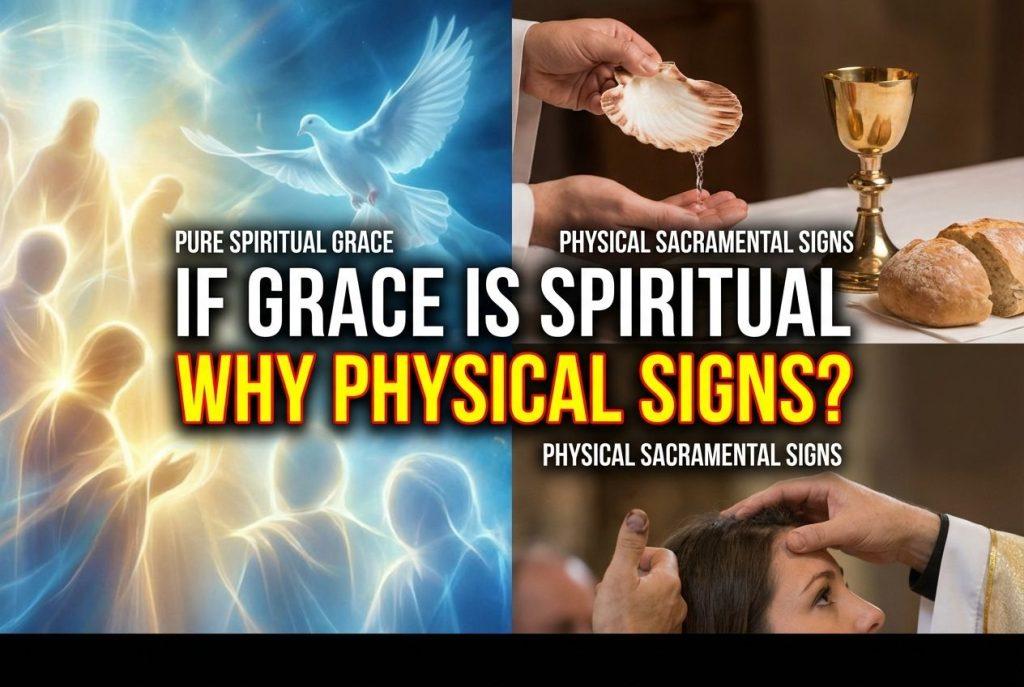
Brief Overview
- The Catholic Church teaches that sacraments are efficacious signs of grace instituted by Christ, combining visible physical elements with invisible spiritual reality.
- Human beings are created as a unity of body and soul, making physical signs necessary for us to receive and understand spiritual realities.
- The Incarnation of Jesus Christ establishes the foundation for using physical matter to convey divine grace since God himself took on human flesh.
- Sacraments work through physical signs such as water, bread, wine, and oil because these material elements correspond to our nature as embodied spirits.
- Physical signs in the sacraments are not mere symbols but actual instruments through which Christ communicates grace to his Church.
- The use of tangible signs reflects God’s pedagogy of salvation, meeting humanity where we are as beings who perceive and communicate through the senses.
The Nature of Human Persons as Body and Soul
The question of why grace uses physical signs requires understanding Catholic teaching on human nature. The Church holds that each person exists as a unified whole of body and soul, not as two separate entities temporarily joined together. This understanding shapes everything about how God relates to his creatures. We are not purely spiritual beings trapped in physical bodies, nor are we merely material creatures who somehow developed consciousness. Instead, the human person represents a unique synthesis of matter and spirit created in God’s image. This unity means that our bodies are not obstacles to spiritual life but essential to who we are as human beings. The Catechism emphasizes this truth when it describes man as a being at once corporeal and spiritual (CCC 362). Our material bodies participate in the dignity of being made in God’s image precisely because they are animated by spiritual souls. The whole person, body and soul together, receives God’s call and responds to divine grace. This unity has significant implications for how grace works in our lives. Since we are embodied spirits, we naturally perceive reality through our senses and communicate through physical means. We touch, see, hear, taste, and smell the world around us. We express our thoughts and feelings through words, gestures, and actions that others can perceive with their senses.
Human communication always involves physical signs because we are social beings who need such signs to interact with one another. Even the most abstract ideas must be conveyed through spoken words, written text, or physical gestures. A mother’s love for her child finds expression in embraces, gentle touches, and attentive care. A teacher communicates knowledge through spoken lectures, written materials, and visual demonstrations. In every aspect of human life, the spiritual dimension of our existence manifests through physical realities. God respects this fundamental aspect of our nature when he chooses to communicate grace through visible signs. Rather than bypassing our bodily nature or treating it as somehow inferior, the sacramental system honors the way God actually created us. Physical signs in the sacraments are not concessions to human weakness but affirmations of human dignity. They recognize that we are not angels, pure spirits who have no need of material things. We are human beings whose spiritual lives are inseparably bound to our bodily existence.
The Incarnation as Foundation
The ultimate reason for physical signs in sacraments lies in the mystery of the Incarnation. When the eternal Word of God became flesh in Jesus Christ, heaven and earth met in an unprecedented way. God did not remain distant from physical creation but entered fully into material reality. The Second Person of the Trinity took on a human body, experienced hunger and thirst, felt pain and joy, and ultimately suffered death on a cross. This earthly ministry of Jesus demonstrates how God works through physical means to accomplish spiritual purposes. Christ healed the sick by touching them with his hands. He forgave sins through spoken words that people could hear. He fed multitudes with real bread and fish. He washed his disciples’ feet with water. Every miracle and teaching of Jesus involved physical elements accessible to human senses. The Gospel of John captures this truth in its opening chapter when it declares that the Word became flesh and dwelt among us (CCC 461). This statement is not merely poetic language but a profound theological truth about how God chooses to save humanity.
Christ’s physical body became the instrument of our salvation. His human hands reached out to bless and heal. His human voice proclaimed the good news of the kingdom. His human flesh and blood were offered on the cross for the forgiveness of sins. The material reality of his body mattered tremendously because through it, divine grace flowed into the world. After his resurrection and ascension, Christ did not abandon this sacramental principle of working through physical means. Instead, he established the Church and entrusted to her the sacraments as the continuation of his saving work. The Catechism teaches that Christ now acts through the sacraments he instituted to communicate his grace (CCC 1084). Just as the Father sent the Son into the world in bodily form, so Christ sends forth his Church with concrete, visible signs of his presence and power. The sacraments extend the Incarnation throughout time and space, making the saving work of Christ available to every generation. They are not arbitrary additions to Christian life but flow naturally from the logic of the Incarnation itself. If God became man to save us, it makes perfect sense that he would continue to use material things to convey his grace.
Sacraments as Efficacious Signs
The Catholic Church defines sacraments as efficacious signs of grace instituted by Christ and entrusted to the Church (CCC 1131). This definition contains several crucial elements that explain the relationship between physical signs and spiritual grace. First, sacraments are signs, meaning they point to a reality beyond themselves. Like a stop sign indicates that drivers must halt their vehicles, sacramental signs point to the invisible action of God. However, sacraments differ from ordinary signs in a fundamental way. They are efficacious signs, meaning they actually accomplish what they signify. A stop sign merely represents the concept of stopping, but a sacrament truly confers the grace it represents. When water is poured in baptism while the proper words are spoken, the person really does receive new life in Christ. When bread and wine are consecrated in the Eucharist, they truly become the Body and Blood of Christ. The physical signs do not just symbolize grace; they actually communicate it.
This effectiveness flows from the reality that Christ himself acts in the sacraments. The human minister may perform the visible action, but the true minister is always Christ working through his Church. The Catechism explains that the sacraments are powers that come forth from the Body of Christ, which is ever-living and life-giving (CCC 1116). They make present and communicate the work of salvation accomplished by Jesus through his passion, death, and resurrection. The physical signs serve as instruments through which divine power flows into the souls of the faithful. Water, oil, bread, and wine become vehicles of supernatural grace because Christ uses them for this purpose. They remain what they are in their natural substance, yet they take on a new meaning and power when employed in sacramental worship. The relationship between the physical sign and spiritual grace is not magical or mechanical but personal and covenantal. God freely chooses to bind himself to these signs, promising to work through them when they are properly used according to his will.
The Church’s teaching on how sacraments work uses the Latin phrase ex opere operato, which means by the work worked. This theological concept emphasizes that sacraments confer grace through the power of Christ’s saving work, not through the worthiness of either the minister or the recipient (CCC 1128). When a priest baptizes a person, the sacrament is valid and effective even if the priest himself is in a state of sin, because Christ is the true baptizer. This teaching protects the faithful from uncertainty about whether they have truly received grace. They need not worry whether their priest was holy enough or whether their own faith was strong enough at the moment of reception. If the sacrament was properly celebrated according to the Church’s intention, grace was truly given. Of course, the fruitfulness of the sacrament in a person’s life does depend on their disposition and willingness to cooperate with grace. Two people may receive the same sacrament with very different results because one opens their heart to God while the other remains closed. Yet the objective reality of grace being offered remains constant, guaranteed by Christ’s promise to work through these physical signs.
The Pedagogy of Physical Signs
God’s use of physical signs in the sacraments reflects what the Church calls divine pedagogy, the careful and wise way God teaches and forms his people. Throughout salvation history, God has consistently accommodated his revelation to human capacities and ways of knowing. He speaks to us in language we can understand and works through means that fit our nature as embodied beings. The Old Testament provides numerous examples of this divine pedagogy. God gave Israel physical signs to mark their covenant relationship with him. Circumcision served as a visible mark in the flesh signifying membership in God’s people. The Passover meal used real lamb, unleavened bread, and bitter herbs to commemorate the Exodus from Egypt. The sacrificial system involved the offering of actual animals whose blood was shed. The temple in Jerusalem stood as a concrete location where God’s presence dwelt in a special way. All these physical elements helped the Chosen People understand and remember spiritual truths about their relationship with God.
Jesus continued and perfected this pattern of divine pedagogy in his ministry. He used parables drawn from everyday life to teach about the kingdom of heaven. He compared God’s kingdom to seeds, yeast, treasure, and pearls. He spoke of shepherds and sheep, farmers and fields, kings and servants. These images connected spiritual realities to concrete experiences his listeners could readily understand. Christ’s teaching method recognized that abstract spiritual truths become more accessible when linked to tangible examples from ordinary life. The sacraments represent the fullest development of this divine pedagogy. They take created things and transform them into instruments of grace. Water, the substance that cleanses and gives physical life, becomes in baptism the means of spiritual cleansing and new birth. Bread and wine, which sustain bodily life, become in the Eucharist the very Body and Blood of Christ that nourish the soul. Oil, used for healing and strengthening the body, becomes in confirmation and anointing of the sick a sign of the Holy Spirit’s power. Each sacramental sign builds on the natural properties and meanings of the physical element, elevating it to convey supernatural grace.
This approach makes the sacraments universally accessible across cultures and historical periods. Every human society understands the basic significance of water for washing, bread for eating, oil for anointing, and human touch for blessing. While specific cultural expressions may vary, the fundamental human experiences underlying these signs remain constant. A person in ancient Jerusalem and a person in modern New York can both grasp the meaning of washing with water or sharing a meal. The physical signs thus serve as a common language through which God speaks to all people. They also engage the whole person in worship, not just the intellect. Sacramental celebration involves the eyes seeing sacred signs, the ears hearing words of blessing, the hands receiving or touching holy things, and sometimes the mouth tasting or the nose smelling sacred elements. This multisensory engagement helps root spiritual realities in lived experience rather than leaving them as mere abstract concepts.
The Sacramental Worldview
The Catholic understanding of physical signs conveying grace rests on a broader sacramental worldview that sees all creation as capable of mediating God’s presence. The material world is not inherently opposed to the spiritual realm but can serve as a vehicle for divine self-revelation. This perspective stands in contrast to worldviews that see matter as evil or that sharply separate the sacred from the secular. Catholic theology affirms that everything God created is fundamentally good. The opening chapters of Genesis repeatedly declare that creation is good, culminating in the statement that everything God made is very good. Though sin has marred creation, it has not destroyed the essential goodness of material reality. The physical world retains its capacity to reflect its Creator and mediate his presence to those who have eyes to see. This truth appears throughout Scripture. The psalmist proclaims that the heavens declare the glory of God and the firmament shows his handiwork. Saint Paul teaches that God’s invisible attributes can be perceived in the things he has made. The created order itself functions as a kind of primordial sacrament, revealing truths about the Creator to those who contemplate it with faith.
The Incarnation confirms and elevates this sacramental dimension of creation. When the Word became flesh, God united himself to matter in the most intimate way possible. The body of Jesus was not a temporary disguise or a prison for his divine nature but the true instrument of salvation. Christ’s physical actions brought healing, his physical touch conveyed blessing, and his physical body offered on the cross accomplished redemption. This means that matter itself has been sanctified, shown to be capable of mediating divine life. The sacraments build on this foundation laid by the Incarnation. They use elements from the created world as Christ used his own body, making them instruments through which grace flows. Water, bread, wine, and oil all come from the earth God created and are now taken up into the mystery of salvation. Through sacramental consecration, these ordinary things become extraordinary bearers of spiritual power. They remain truly physical, with all their material properties intact, yet they now function as channels of divine life.
This sacramental worldview has practical implications for how Catholics understand their relationship to the material world. Physical things are not obstacles to spiritual growth but potential aids in the life of grace. The human body is not an enemy to be conquered but a gift to be honored and properly used. Work, food, marriage, and other aspects of earthly life can all become occasions for encountering God when approached with faith. The Church encourages the use of sacramentals in addition to the seven sacraments themselves. Holy water, blessed candles, religious images, and other blessed objects serve as reminders of God’s presence and channels of his blessing. While sacramentals do not confer grace in the same automatic way that sacraments do, they prepare the heart to receive grace and sanctify various aspects of daily life. This practice extends the sacramental principle beyond the specific celebrations of the seven sacraments into the ordinary rhythms of Christian living.
The Role of Faith in Receiving Sacraments
While the physical signs of the sacraments truly convey grace through Christ’s power, their fruitfulness in individual lives requires faith on the part of the recipient. The Church teaches that sacraments are sacraments of faith, both presupposing faith and nourishing it through word and ritual (CCC 1123). This relationship between physical sign and faith prevents sacramental worship from degenerating into magic or superstition. The physical elements do not work automatically like charms regardless of the spiritual disposition of the person. Rather, the signs call forth and strengthen faith, which then opens the heart to receive the grace being offered. Adults coming to baptism must profess their faith in Christ before receiving the sacrament. Those approaching the Eucharist are called to examine their conscience and ensure they are in a state of grace. Penitents in confession must genuinely repent of their sins and intend to amend their lives. In each case, the physical sign requires an interior disposition of faith and openness to God’s action.
This requirement of faith does not contradict the teaching that sacraments work ex opere operato by Christ’s power. Both truths must be held together. The sacrament objectively confers grace by virtue of Christ’s promise and action. This remains true regardless of the subjective state of the minister or the exact degree of faith in the recipient. However, the actual benefit the recipient derives from this grace depends greatly on their cooperation. A person receiving communion with deep faith and love experiences more profound spiritual effects than one receiving with distraction and tepidity, even though both receive the true Body and Blood of Christ. The physical signs themselves invite and encourage faith. When water is poured in baptism, the visible action of cleansing helps the person understand and believe in the invisible cleansing of sin. When oil is applied in confirmation, the physical anointing makes tangible the spiritual anointing with the Holy Spirit. The sensory experience of the sacramental signs gives the mind and heart something concrete to grasp, helping faith to become more real and vivid rather than remaining merely abstract.
The Church’s liturgical celebrations surround the essential sacramental signs with words of explanation and prayer that further illuminate their meaning. Scripture readings during Mass help the faithful understand what God is doing in the Eucharist. The prayers of consecration make explicit the transformation taking place. This combination of sign and word together forms the complete sacramental action. The physical element without the accompanying word would be incomplete, just as the word without the physical element would fail to engage the whole person. Parents who bring infants for baptism profess faith on behalf of their children, who are too young to believe for themselves. The Church’s faith carries the child in these early years, with the expectation that the baptized person will later personally embrace the faith they received as a gift. This practice demonstrates how the sacramental community itself functions as a context for faith. No one believes in isolation; we are all supported by the faith of the Church into which we are incorporated through the sacraments.
Scripture’s Witness to Physical Signs
The biblical testimony consistently shows God working through physical means to accomplish spiritual purposes. From the earliest chapters of Genesis to the final visions of Revelation, material things serve as vehicles for divine presence and action. This scriptural pattern provides the foundation for the Church’s sacramental theology and practice. In the Old Testament, God frequently commanded the use of physical signs in worship. The covenant with Abraham was marked in the flesh through circumcision. The Exodus from Egypt was commemorated with a meal of lamb, bread, and wine. The Law given at Sinai prescribed detailed physical rituals involving animals, grain, oil, and incense. The tabernacle and later the temple provided concrete locations where God’s glory dwelt among his people. All these physical elements were not contrary to spiritual worship but essential to it. They helped Israel remember God’s mighty deeds and maintain their covenant relationship with him through tangible, memorable actions.
The prophets sometimes criticized external rituals when performed without interior conversion, but they never rejected the value of physical signs themselves. Isaiah complained that God was weary of offerings and festivals when those presenting them had unjust hearts. Amos condemned solemn assemblies celebrated by those who oppressed the poor. Yet these same prophets continued to participate in temple worship and looked forward to a restored liturgy in the messianic age. Their critique targeted hypocrisy and empty formalism, not the principle of using material things in divine worship. The prophets understood that physical and spiritual were meant to go together, not stand in opposition. Jesus himself regularly participated in the physical rituals of Jewish worship. He went to the synagogue on the Sabbath, celebrated Passover with his disciples, and visited the temple in Jerusalem. His ministry involved constant use of material things to convey spiritual realities. He touched lepers to heal them, made mud with his saliva to cure blindness, and multiplied loaves and fishes to feed the hungry. His most significant actions all involved physical elements: he was baptized with water in the Jordan, he instituted the Eucharist with bread and wine at the Last Supper, and he accomplished redemption through his physical suffering and death on the cross.
The New Testament epistles continue this pattern of recognizing physical signs as vehicles of grace. Paul speaks of baptism as a washing of regeneration and renewal. He describes the Eucharist as a participation in the body and blood of Christ. James instructs the sick to call for elders who will anoint them with oil and pray over them. John’s Gospel emphasizes the importance of eating Christ’s flesh and drinking his blood for eternal life. The Book of Revelation depicts heavenly worship using physical imagery of robes, crowns, incense, and altar. Throughout the New Testament, spiritual realities consistently find expression through material signs. This scriptural witness provides solid ground for the Church’s sacramental theology. The use of physical elements in conveying grace is not a later innovation or a compromise with paganism but a continuation of the biblical pattern established by God himself. From the beginning of salvation history to its fulfillment in Christ, physical signs have been God’s chosen means of communicating with his embodied creatures.
The Distinction Between Sacraments and Sacramentals
Understanding why grace uses physical signs requires clarity about the distinction between sacraments and sacramentals. While both involve material elements blessed for spiritual purposes, they differ significantly in their origin, effectiveness, and role in Christian life. The seven sacraments were instituted by Christ himself and confer grace by his power working through them. Sacramentals, by contrast, are sacred signs instituted by the Church that prepare people to receive grace and sanctify various circumstances of life (CCC 1667). This difference in origin means that sacraments possess a unique authority and effectiveness that sacramentals do not share. When the Church blesses water to make it holy water, this is a sacramental that can dispose people to receive grace and protect them from evil, but it does not confer grace in the direct way that baptismal water does. A blessed rosary or scapular serves as a valuable aid to prayer and devotion, but it does not have the same power as the oil used in confirmation or anointing of the sick.
Sacramentals work through the prayer of the Church rather than ex opere operato as sacraments do. When a priest blesses an object or person, the effectiveness depends on the faith and devotion of those involved and the Church’s intercessory prayer. God may certainly grant graces in response to such blessings, but there is no guarantee in the same way there is with sacraments. A person who receives baptism or communion worthily will definitely receive grace because Christ promised to work through these signs. A person who uses holy water or wears a blessed medal may experience spiritual benefits, but these flow from God’s generosity in response to prayer rather than from an automatic guarantee. Despite this difference in efficacy, sacramentals play an important complementary role to the sacraments in Catholic life. They extend the sacramental principle into many situations where the formal celebration of a sacrament would not be appropriate. A home can be blessed to sanctify family life. Vehicles can be blessed to invoke God’s protection during travel. Religious articles can be blessed to serve as reminders of God’s presence in daily activities. These blessings recognize that all of life can be oriented toward God, not just the specific moments when sacraments are celebrated.
The multiplication of sacramentals throughout Catholic tradition demonstrates the Church’s sacramental worldview in action. Far from being limited to seven occasions, the principle of physical signs conveying spiritual benefit extends to countless aspects of daily existence. Blessed palms on Palm Sunday, blessed ashes on Ash Wednesday, blessed candles at Candlemas, and blessed throats on the feast of Saint Blaise all show how physical elements can be sanctified and used to draw people closer to God. The use of sacramentals must be guided by proper instruction and faith to avoid superstition. The Church warns against treating blessed objects as magical charms that work automatically regardless of faith. A blessed medal worn around the neck is valuable as a reminder to pray and trust in God’s protection, not as a good luck charm that functions independently of relationship with God. Similarly, sprinkling holy water in one’s home while praying for God’s blessing differs fundamentally from treating it as a magical potion. Proper catechesis helps Catholics understand both the value and the limits of sacramentals, preventing either neglect of these good gifts or their superstitious misuse.
Physical Signs and the Communion of Saints
The use of physical signs in sacramental worship connects to the broader Catholic understanding of the communion of saints and the Church as the Body of Christ. The sacraments do not function as merely private transactions between an individual and God but incorporate believers into a visible, embodied community. The physical nature of sacramental signs reflects and reinforces this communal dimension of Christian life. Baptism provides the clearest example of this communal aspect. The newly baptized person does not simply establish an invisible spiritual relationship with Christ but becomes a visible member of his Body, the Church. The physical action of baptism, performed in the presence of the community and requiring others to serve as godparents, demonstrates that this incorporation is public and social. The person’s new identity as a Christian is marked physically through the washing with water and can be recognized by others. Similarly, the Eucharist creates and manifests the unity of the Church as Christ’s Body. When Catholics gather for Mass, they all receive the same consecrated bread and wine, sharing in the one Body and Blood of Christ. This common reception of the same physical elements makes tangible the spiritual unity of believers with Christ and with each other.
The visible, physical character of the sacraments helps maintain the Church’s unity across time and space. Catholics in every country and century celebrate the same basic sacramental actions using the same fundamental elements. Water, bread, wine, and oil transcend cultural boundaries and historical periods, providing continuity amid diversity. A baptism in ancient Rome, medieval Paris, and modern Tokyo all involve the same essential action of washing with water. This physical continuity of sacramental practice binds together the universal Church in a visible way that transcends merely invisible spiritual bonds. The sacramental principle extends to the veneration of relics and sacred images, practices that have deep roots in Christian tradition. The physical remains of saints or objects associated with them serve as tangible connections to these holy people and reminders of God’s grace at work in their lives. Icons and statues provide visual representations that help the faithful focus their prayers and remember the examples of Christ and the saints. These practices flow from the same sacramental worldview that sees material things as capable of mediating spiritual realities.
Some Christians reject such practices as idolatry or superstition, insisting that worship should be purely spiritual without physical aids. However, this position fails to take seriously the Incarnation and its implications. If God himself became physically present in Jesus Christ, and if Christ continues to work through physical signs in the sacraments, then created things clearly can serve as vehicles of grace and aids to devotion. The Church carefully distinguishes between the worship due to God alone and the veneration shown to saints or respect given to sacred objects. No Catholic should pray to a statue or icon as if it were God, but using these physical representations to help focus prayer and remember holy examples follows naturally from incarnational theology. The communion of saints includes both the living and the dead, and physical signs help maintain this connection across the boundary of death. When a priest blesses a body at a funeral and commits it to the earth in hope of resurrection, these physical actions honor the deceased person’s body and express faith in the resurrection of the flesh. The body matters not just during life but also in death because it will rise again. This Christian hope for bodily resurrection undergirds the entire sacramental system.
Addressing Common Objections
Various objections have been raised throughout Christian history to the Catholic understanding of grace working through physical signs. Examining these objections and the Church’s responses helps clarify the theological principles at stake. One common objection claims that physical signs are unnecessary because grace is purely spiritual and should be received directly through faith alone. This position often appeals to biblical passages emphasizing inward faith over external observance. However, this interpretation sets up a false opposition between faith and physical signs. Catholic teaching insists that both are necessary, not in competition but in harmony. Faith is certainly essential for receiving the sacraments fruitfully, but God has chosen to work through visible means that accommodate our nature as embodied beings. Rejecting physical signs as unnecessary would logically lead to rejecting the Incarnation itself as unnecessary. If God can communicate with pure spirits through purely spiritual means, why did he need to become flesh? The answer is that he became flesh precisely because we are not pure spirits but beings of body and soul united. The sacramental system flows from this same logic.
Another objection suggests that physical signs make sacraments too mechanical or automatic, reducing grace to a kind of spiritual technology. Critics worry that teaching about sacraments working ex opere operato encourages a magical view of grace that bypasses the need for personal faith and conversion. This concern has merit as a warning against certain abuses, but it misunderstands authentic Catholic teaching. The Church has consistently maintained that interior disposition matters greatly for receiving sacraments fruitfully. The fact that grace is objectively offered through the physical signs does not mean it is automatically effective regardless of the recipient’s state of soul. A person who approaches the sacraments with faith and proper disposition receives abundant graces. A person who approaches without faith or in a state of serious sin may receive the sacrament validly but fail to benefit from it or even commit sacrilege. The physical signs guarantee that grace is truly present and offered, but they do not bypass human freedom or make interior conversion unnecessary.
Some object that Catholic emphasis on physical signs reflects pagan influence rather than authentic Christianity. They point to similarities between sacramental practices and various pagan rituals involving sacred objects, special locations, and material sacrifices. This observation contains a kernel of truth in that many cultures throughout history have recognized some principle of material things mediating spiritual realities. However, this common intuition may reflect a universal human awareness of the connection between physical and spiritual realms rather than evidence of corruption. God created human nature with its need for signs and symbols; it is not surprising that various religions would attempt to meet this need, however imperfectly. Christianity does not simply copy pagan practices but transforms and elevates legitimate human religious instincts by grounding them in the true revelation of God in Christ. Where pagans sought to manipulate divine power through magic, Christians submit to God’s will working through the means he has chosen to establish. Where pagans attributed inherent power to material objects themselves, Christians recognize that grace flows from Christ’s saving work and not from the physical elements as such.
Others raise practical concerns about whether physical signs can truly remain effective across all cultures and historical periods. What seems meaningful in one context may appear strange or meaningless in another. In response, the Church points to the fundamental human experiences that ground the sacramental signs. Every culture knows the cleansing power of water, the nourishment provided by bread, the healing properties of oil, and the significance of human touch. While specific cultural expressions vary, these basic human realities remain constant. The Church does allow some flexibility in how sacraments are celebrated to accommodate different cultural contexts, provided the essential matter and form remain intact. For example, different types of bread may be used for the Eucharist as long as it is truly wheat bread, and baptism may be performed by immersion or pouring as long as water truly touches the person. This combination of essential unity with cultural flexibility demonstrates the wisdom of God’s sacramental design. The signs remain recognizable and meaningful across diverse contexts while allowing appropriate adaptation to local circumstances.
Practical Implications for Spiritual Life
Understanding why grace works through physical signs has important practical implications for living the Christian life. This knowledge should shape how Catholics approach the sacraments, care for their bodies, and view the material world. First and most directly, recognizing the power of physical signs should inspire great reverence for the sacraments themselves. These are not empty rituals or mere symbols but true encounters with Christ that convey real grace. Approaching them with casual indifference shows a failure to grasp their significance. Catholics should prepare themselves carefully before receiving sacraments, examining their conscience, nourishing their faith, and seeking to be as spiritually disposed as possible to receive what God offers. At the same time, the objective power of sacramental signs should provide great confidence and peace. Believers need not constantly worry whether they have enough faith or whether the priest was holy enough for the sacrament to be valid. If the sacrament was properly celebrated, grace was truly given regardless of subjective feelings or perceived unworthiness. This assurance allows Christians to approach the sacraments with both reverence and trust, neither presuming on God’s grace nor doubting his generous love.
The sacramental principle extends beyond reception of the seven sacraments to how Catholics live their entire lives. If physical things can convey grace, then the material world deserves respect and proper use. The body is not an obstacle to spiritual life but a temple of the Holy Spirit that should be cared for and kept pure. Food, drink, sleep, and exercise all contribute to spiritual health because body and soul are united. Neglecting physical needs harms spiritual life just as surely as neglecting prayer and virtue. Similarly, the goods of creation should be used gratefully as gifts from God rather than despised as distractions from spiritual concerns. The beauty of nature can lift the mind to contemplate the Creator. The enjoyment of legitimate pleasures in moderation gives thanks to God for his generosity. Work done well honors God by participating in his creative activity. Marriage unites two bodies in a way that images Christ’s union with his Church. All these aspects of material existence can become occasions for encountering God when approached with faith and the right intention.
Catholics should cultivate awareness of God’s presence mediated through physical signs in daily life, not just during sacramental celebrations. Using holy water when entering church or home serves as a reminder of baptismal identity. Making the sign of the cross employs a physical gesture to invoke the Trinity and recall Christ’s sacrifice. Genuflecting before the tabernacle acknowledges Christ’s real presence in the Eucharist through a bodily action. These small physical practices help maintain consciousness of spiritual realities throughout the day. The use of sacramentals provides multiple opportunities to sanctify ordinary activities. Blessing a meal before eating gives thanks for God’s provision. Keeping a crucifix or religious image in one’s home creates a visual reminder to pray. Wearing a blessed medal or scapular expresses trust in God’s protection and keeps the mind oriented toward heavenly things. While these practices do not replace the sacraments proper, they complement them by extending the sacramental principle throughout daily life. They help bridge the false separation between sacred and secular by recognizing that all of life can be offered to God.
The Eschatological Dimension
The relationship between physical signs and spiritual grace also has an important eschatological dimension, pointing toward the final fulfillment of God’s plan for creation. The sacramental system is not meant to last forever but belongs specifically to the present age between Christ’s first and second comings. Understanding this temporal limitation helps clarify the purpose of physical signs in conveying grace. In heaven, the blessed will see God face to face, experiencing direct communion with him that requires no mediation through signs and symbols. There will be no need for sacraments when we possess the reality they now signify. Saint Paul speaks of putting away childish things and seeing clearly rather than through a glass darkly. The sacraments belong to this present time when we walk by faith rather than sight, needing visible helps to grasp invisible realities. However, the current necessity of physical signs does not mean they are merely temporary concessions that will be discarded as irrelevant. The sacraments point toward a future fulfillment that will be just as physical as it is spiritual. Christian hope includes the resurrection of the body, not just the immortality of the soul. The whole person, body and soul united, will be glorified in the final kingdom.
The Eucharist particularly demonstrates this eschatological dimension. When Catholics receive communion, they participate now in the wedding feast of the Lamb that will be fully revealed in the world to come (CCC 1130). The physical action of eating Christ’s body and drinking his blood anticipates the complete union with God that awaits in heaven. This sacrament serves as a pledge of future glory, a foretaste of the banquet that will never end. Every Mass thus has both a memorial aspect, looking back to Christ’s sacrifice, and a prophetic aspect, looking forward to his return. The physical signs of bread and wine that truly become Christ’s body and blood bridge past, present, and future in a mystery that transcends ordinary time. The Catholic teaching on the resurrection of the body means that physicality itself has an eternal dimension. The body is not a temporary shell to be cast off when we die but an essential part of who we are that will be raised and glorified. This hope dignifies the body and all material creation. If matter is destined for glory, then its use in mediating grace during this present life makes perfect sense as a preparation for the final state.
The renewal of all creation at the end of time will transform the physical universe without destroying it. Just as Christ’s risen body was the same body that died yet gloriously transformed, so the new heavens and new earth will be continuous with the present creation yet incomparably more glorious. Physical signs in the sacraments anticipate this final transformation of matter. The water of baptism points toward the living waters flowing from the throne of God. The bread and wine of the Eucharist anticipate the tree of life whose leaves heal the nations. This eschatological perspective prevents both an overly materialistic understanding that sees physical signs as ends in themselves and an overly spiritualized view that regards them as temporary necessities to be eventually discarded. Instead, physical and spiritual are seen as destined for ultimate harmony in God’s kingdom, with the sacraments serving as present signs and anticipations of that future unity.
Conclusion
The question of why grace uses physical signs when grace itself is spiritual finds its answer in the nature of the human person, the reality of the Incarnation, and God’s pedagogy of salvation. Physical signs are not arbitrary additions to spiritual life but necessary accommodations to human nature as body and soul united. We are not pure spirits who can relate to God through purely mental or emotional means. We are embodied creatures who perceive, communicate, and understand through our senses and through physical interaction with the world around us. God respects the way he created us when he chooses to work through visible, tangible signs. The Incarnation provides the theological foundation for this sacramental principle. When the eternal Word became flesh in Jesus Christ, God united divinity to materiality in the most intimate way possible. Christ’s physical body became the instrument of salvation, his human actions conveyed divine grace, and his material suffering accomplished spiritual redemption. The sacraments continue this incarnational logic by using physical elements as instruments through which Christ communicates his grace to believers. They are not human inventions but divine gifts that reflect God’s wisdom in dealing with his creatures.
Throughout salvation history, God has consistently worked through physical means to accomplish spiritual purposes. From the earliest covenants marked by physical signs through the elaborate ritual system of the Old Testament to the sacramental life of the Church, visible signs have been God’s chosen method of communication with his people. This pattern culminates in the sacraments instituted by Christ, which are efficacious signs that truly convey the grace they signify. Understanding this truth should inspire both reverence for the sacraments and confidence in their power to sanctify. The physical signs guarantee that grace is truly present and offered, while the requirement of faith and proper disposition ensures that sacramental worship remains personal and transformative rather than mechanical or magical. The sacramental worldview extends beyond the seven sacraments to embrace the entire created order as capable of mediating God’s presence. This perspective dignifies material reality without treating it as ultimate, recognizes the value of physical practices in spiritual life, and points toward the final resurrection when body and soul will be united in glory. Physical signs conveying spiritual grace are not a temporary concession to human weakness but a permanent feature of how God relates to the creatures he made in his image.
Disclaimer: This article presents Catholic teaching for educational purposes. For official Church teaching, consult the Catechism and magisterial documents. For personal spiritual guidance, consult your parish priest or spiritual director. Questions? Contact editor@catholicshare.com
Sign up for our Exclusive Newsletter
- 📌 Add CatholicShare as a Preferred Source on Google
- 🎁 Join us on Patreon for Premium Content
- 🎧 Check Out These Catholic Audiobooks
- 📿 Get Your FREE Rosary Book
- 📱 Follow Us on Flipboard
-

Recommended Catholic Books
Discover hidden wisdom in Catholic books — invaluable guides enriching faith and satisfying curiosity. #CommissionsEarned
- The Early Church Was the Catholic Church
- The Case for Catholicism - Answers to Classic and Contemporary Protestant Objections
- Meeting the Protestant Challenge: How to Answer 50 Biblical Objections to Catholic Beliefs
As an Amazon Associate, I earn from qualifying purchases. Thank you for your support.