
Brief Overview
- The Catholic Church teaches that God saves by grace alone, yet the sacraments are the ordinary means through which this grace reaches believers.
- Sacraments are not human inventions or substitutes for grace but divine gifts instituted by Christ himself to communicate his saving work.
- The principle of ex opere operato means that sacraments convey grace by Christ’s power working through them, not by human merit or worthiness.
- Grace exists before, during, and after the sacraments, but Christ chose to bind his Church to these sacred signs as the ordinary channels of divine life.
- Understanding the relationship between grace and sacraments requires recognizing that God freely chooses the means by which he distributes his gifts.
- The sacramental system does not diminish God’s sovereignty or grace but rather demonstrates how he works through material creation to sanctify humanity.
The Nature of Grace in Catholic Teaching
Grace stands at the absolute center of Catholic theology as the free and undeserved gift of God’s own life. The Catechism of the Catholic Church teaches that grace is favor, the free and undeserved help that God gives us to respond to his call to become children of God, adoptive sons, partakers of the divine nature and of eternal life (CCC 1996). This definition makes clear that salvation comes entirely from God’s initiative and generosity. Nothing we do earns grace; nothing we accomplish merits it; nothing we achieve purchases it. Grace flows from God’s love alone. The Catholic Church has consistently rejected any notion that human beings can save themselves through their own efforts, good works, or religious observances. Salvation belongs to God alone, and every step toward eternal life depends completely on his gracious action. The Church teaches this truth without reservation or qualification. Human nature, wounded by original sin, lacks the capacity to reach God or to heal itself. Only divine intervention can bridge the gap between fallen humanity and the all-holy God. The Council of Trent, responding to questions about salvation during the Reformation era, clarified that justification comes from grace, not from human merit. The Catholic understanding of grace emphasizes that God initiates, sustains, and completes the work of salvation. From the first stirrings of faith to the final perseverance in holiness, every moment depends on grace.
This grace that God offers takes different forms according to his wise design. Sanctifying grace is the permanent gift that resides in the soul, transforming it and making it holy (CCC 2000). This grace makes believers partakers in the divine nature, capable of acting as God’s children. Sanctifying grace heals the soul wounded by sin and elevates it to share in God’s own life. The transformation that sanctifying grace accomplishes goes far beyond moral improvement or behavioral change. Grace fundamentally alters the nature of the human person, creating a new relationship with God. Actual grace, by contrast, refers to God’s interventions and help in specific moments of life (CCC 2000). Actual graces are temporary promptings that enlighten the mind and strengthen the will. They help people respond to God’s call, resist temptation, and grow in virtue. Both forms of grace work together in the Christian life. Sanctifying grace establishes the permanent state of holiness, while actual graces provide the moment-by-moment assistance needed to live faithfully. The distinction between these forms of grace helps believers understand how God works in their lives. Grace is not a single monolithic reality but a rich and varied gift adapted to human needs. God pours out different graces at different times according to what each person requires. This variety demonstrates God’s loving attention to the particular circumstances of each soul.
The source of all grace is the redemptive work of Jesus Christ. Through his incarnation, life, death, and resurrection, Christ won salvation for the human race. His paschal mystery opened the floodgates of divine grace. The Holy Spirit, sent by the Father and the Son, applies the fruits of Christ’s redemption to individual believers. Grace flows from the Trinity into human hearts. The Father planned salvation from eternity; the Son accomplished it in history; the Spirit distributes its benefits throughout time. This Trinitarian origin of grace means that salvation is entirely God’s work. The three divine Persons collaborate in the one work of redemption. Christ’s sacrifice on the cross satisfied divine justice and reconciled humanity to God. His resurrection conquered death and opened the way to eternal life. The ascension of Christ means that humanity now sits at God’s right hand in the person of the God-man. The sending of the Spirit at Pentecost inaugurated the age of the Church and the distribution of grace through sacred means. Everything in the economy of salvation testifies to God’s gratuitous love. Believers receive grace not because they deserve it but because God freely chooses to give it. The entire Christian life unfolds under the sign of divine generosity.
Christ’s Institution of the Sacraments
Jesus Christ, during his earthly ministry, established specific sacred signs that would continue his saving work throughout history. The Catechism teaches that all seven sacraments were instituted by Jesus Christ our Lord (CCC 1114). These sacred signs did not emerge from human tradition or ecclesiastical creativity. Christ himself, the eternal Word made flesh, determined that certain ritual actions would serve as channels of grace. The sacraments originate in Christ’s own words and deeds. During his hidden life and public ministry, Jesus performed actions and spoke words that anticipated the sacramental economy. His miracles of healing foreshadowed the spiritual restoration the sacraments would accomplish. His words of forgiveness pointed toward the sacrament of reconciliation. His sharing of meals reached its climax in the institution of the Eucharist. The mysteries of Christ’s life laid the foundation for what he would later give to the Church through the sacraments. Everything visible in the Savior has passed over into his mysteries, according to Saint Leo the Great. The sacraments make present and available the saving power that flowed from Christ’s earthly ministry. They extend his touch, his voice, his healing presence across the centuries. When a priest baptizes, Christ himself baptizes. When the Church absolves sins, Christ himself forgives. The sacraments are powers that come forth from the Body of Christ, which is ever-living and life-giving (CCC 1116). They are actions of the Holy Spirit at work in Christ’s Body, the Church.
The institution of the sacraments reveals Christ’s wisdom in providing for the ongoing needs of his followers. Christ knew that he would not remain physically present on earth after his ascension. Yet he desired to continue his ministry of teaching, healing, forgiving, and sanctifying. The sacraments solve this problem by making Christ’s saving actions perpetually available. Through the sacramental system, every generation of Christians encounters the living Christ. The sacraments transcend the limitations of time and space. A believer baptized in the twenty-first century experiences the same regeneration that the apostles received at Pentecost. A penitent who confesses sins today receives the same forgiveness that Christ offered to the paralytic in Capernaum. The Eucharist makes present the one sacrifice of Calvary across all times and places. The sacraments thus represent not an addition to Christ’s work but the continuation of it. They do not supplement the cross but apply its merits. Christ’s historical actions become contemporaneous through sacramental signs. This brilliant design ensures that no Christian is deprived of direct contact with the Redeemer. The physical absence of Jesus does not mean his absence simpliciter; he remains present and active through the sacraments. The Church treasures these gifts as her most precious possession, the masterworks of God in the new and everlasting covenant (CCC 1116).
The specific number and nature of the sacraments emerged gradually as the Church reflected on Christ’s teaching under the guidance of the Holy Spirit. Jesus did not leave a written manual of sacramental theology. He instituted sacred signs and entrusted them to the apostles, who passed them on to their successors. The Church, by the power of the Spirit who guides her into all truth, has gradually recognized this treasure received from Christ (CCC 1117). Over the centuries, the Church discerned that among liturgical celebrations there are seven that are, in the strict sense, sacraments instituted by the Lord. This discernment did not invent new sacraments but identified which rites possess the character of sacraments properly so-called. Baptism, Confirmation, Eucharist, Penance, Anointing of the Sick, Holy Orders, and Matrimony all trace their origin to Christ’s institution. Each sacrament corresponds to a specific need in the Christian life. Baptism initiates believers into the Church. Confirmation strengthens them for witness. The Eucharist nourishes them with Christ’s Body and Blood. Penance reconciles them after sin. Anointing of the Sick provides grace in illness. Holy Orders creates ministers for the sacraments. Matrimony sanctifies the union of husband and wife. The seven sacraments together form a comprehensive system of grace that accompanies believers from birth to death and addresses every significant moment of existence.
The Efficacy of Sacramental Grace
The Catholic Church teaches that sacraments are efficacious signs of grace, instituted by Christ and entrusted to the Church, by which divine life is dispensed to us (CCC 1131). The term “efficacious” means that sacraments actually accomplish what they signify. They do not merely symbolize grace or express faith; they convey grace. This teaching stands in contrast to theories that view sacraments as purely symbolic actions or human responses to God. Catholic doctrine holds that sacraments work objectively, producing grace in those who receive them properly. The visible rites by which the sacraments are celebrated signify and make present the graces proper to each sacrament. When a priest pours water and says the baptismal formula, the person being baptized truly receives new spiritual life. When the bishop lays hands on a candidate for Confirmation, the Holy Spirit truly descends in fullness. When the priest pronounces the words of consecration, bread and wine truly become Christ’s Body and Blood. The sacraments bear fruit in those who receive them with the required dispositions. This efficacy does not depend on the worthiness of the minister or the recipient but on the power of God working through the sacramental action. The principle has profound implications for understanding how grace operates in the Church.
The Church expresses this teaching through the Latin phrase ex opere operato, which literally means “by the very fact of the action being performed” (CCC 1128). This principle means that sacraments convey grace by virtue of the saving work of Christ, accomplished once for all. The power inherent in the sacramental action itself, not the holiness of the minister, produces the effect. Saint Augustine clarified that “the sacrament is not wrought by the righteousness of either the celebrant or the recipient, but by the power of God.” A priest in the state of mortal sin can still validly administer the sacraments because Christ is the true minister. The human celebrant acts as an instrument of divine action. This teaching protects believers from anxiety about the hidden spiritual state of their pastors. It guarantees that the sacraments remain reliable channels of grace regardless of human unworthiness. The ex opere operato principle does not mean that sacraments work magically or automatically without any human cooperation. The fruits of the sacraments depend on the disposition of the one who receives them (CCC 1128). A person who receives a sacrament with faith, repentance, and openness to grace will benefit more fully than someone who approaches mechanically or with unrepented sin. The objective efficacy of the sacrament coexists with the subjective need for proper disposition.
This sacramental efficacy derives from the fact that Christ himself is at work in the sacraments. It is he who baptizes, he who acts in his sacraments to communicate the grace that each sacrament signifies (CCC 1127). The Father always hears the prayer of his Son’s Church, which expresses her faith in the power of the Spirit in each sacrament. The Holy Spirit transforms into divine life whatever is subjected to his power. When the Church celebrates a sacrament, all three divine Persons are active. The Father wills the sanctification of believers. Christ makes present his saving mysteries. The Spirit effects the transformation of recipients. This Trinitarian action ensures that sacraments accomplish what they promise. God does not lie or deceive. If he establishes a sign that promises grace, he unfailingly gives that grace. The reliability of the sacraments reflects the faithfulness of God. Believers can trust that when the Church performs the sacramental rite according to Christ’s institution, grace truly flows. This certainty does not rest on human feelings or perceptions. Many people receive sacraments without experiencing emotional consolation or dramatic spiritual experiences. The efficacy of the sacrament does not depend on feelings. Grace works in the depths of the soul, often imperceptibly. Faith trusts God’s promise rather than subjective experience.
The sacraments convey what the Church calls “sacramental grace,” which is the grace of the Holy Spirit given by Christ and proper to each sacrament (CCC 1129). Each sacrament confers its own particular grace suited to its purpose. Baptismal grace washes away original sin and actual sins, regenerates the soul, and incorporates the person into Christ and his Church. Confirmation grace strengthens faith, deepens union with Christ, and empowers witness. Eucharistic grace nourishes spiritual life and deepens communion with Christ. The grace of Penance reconciles sinners with God and the Church. The grace of Anointing offers strength in illness and preparation for death. The grace of Holy Orders configures the ordained to Christ the Head and empowers them to act in his person. The grace of Matrimony assists spouses to love each other faithfully and raise children. These particular graces reflect the wisdom of Christ’s design. God does not distribute grace haphazardly but according to the needs of different states and moments of life. The Spirit heals and transforms those who receive him by conforming them to the Son of God. The fruit of the sacramental life is that the Spirit of adoption makes the faithful partakers in the divine nature by uniting them in a living union with the only Son, the Savior (CCC 1129). The entire sacramental system aims at the divinization of believers, their transformation into the likeness of Christ.
Why God Chose Sacramental Means
The question “If God saves by grace, why sacraments?” often assumes that grace and sacraments exist in tension or competition. This assumption reflects a false dichotomy. God could have chosen to distribute grace invisibly, directly implanting faith and holiness in human hearts without any external means. His power knows no limits, and he depends on nothing outside himself. Yet God freely chose to work through material, visible, tangible means. This choice reveals something profound about God’s nature and his design for creation. The sacramental principle runs throughout salvation history. God consistently uses material realities to convey spiritual truths and effects. In the Old Testament, God commanded specific rituals involving water, oil, blood, and bread. The Passover lamb was not merely a symbol but the means by which God protected Israelite families. The bronze serpent lifted up by Moses actually healed those who looked upon it. These Old Testament types foreshadowed the sacramental economy of the New Covenant. God’s method has always involved the sanctification of matter in service of spirit. The sacraments represent the fulfillment and perfection of this pattern.
The incarnation of the Word provides the ultimate theological foundation for the sacraments. When God became man in Jesus Christ, he validated material creation as a suitable bearer of divine presence. The eternal Son did not disdain to take human flesh. He did not regard matter as evil or unworthy. By becoming incarnate, Christ united divinity and humanity, spirit and matter, in his own person. The incarnation reveals that God works through material creation to accomplish spiritual purposes. Christ’s humanity served as the instrument of divinity in the work of redemption. His physical body, blood, death, and resurrection saved the world. This sacramental principle continues in the Church, which is the Body of Christ. Just as Christ’s humanity communicated divine life, so the Church’s sacramental actions communicate grace. The material elements of water, bread, wine, and oil become vehicles of the Holy Spirit. This pattern honors creation by making it participate in redemption. It also accommodates human nature, which is not purely spiritual but an embodied composite of soul and body. Humans know reality through their senses. They learn through material signs and symbols. The sacraments speak to the whole person, engaging body and soul, senses and spirit.
God’s choice of sacramental means also manifests his desire for a personal, communal relationship with believers rather than a purely internal, individualistic one. The sacraments are celebrated in the Church and by the Church. They are “by the Church” because she is the sacrament of Christ’s action (CCC 1118). They are “for the Church” because the sacraments make the Church by manifesting and communicating the mystery of communion with God. No one baptizes himself. No one ordains himself. No Christian celebrates the Eucharist in isolation. The sacraments bind believers together as members of one Body. They create and express communion. This communal dimension reflects the nature of God himself, who is a Trinity of persons in loving communion. Salvation is not a purely private transaction between an individual and God. It incorporates believers into a people, a family, a body. The sacramental system embodies this truth. When the Church gathers to celebrate the sacraments, believers experience tangibly their membership in something larger than themselves. They see with their eyes and hear with their ears the proclamation of God’s grace. They touch and taste the gifts of salvation. This external, public, communal character guards against the tendency to reduce faith to subjective feelings or private interpretations.
The necessity of sacraments for salvation, rightly understood, does not contradict salvation by grace. The Church teaches that for believers, the sacraments of the New Covenant are necessary for salvation (CCC 1129). This necessity is not absolute but reflects God’s ordinary plan. God has bound salvation to the sacrament of Baptism, but he himself is not bound by his sacraments (CCC 1257). This distinction is crucial. God can and does save people who, through no fault of their own, do not receive the sacraments. Those who die for the faith without having received Baptism, those who desire Baptism but die before receiving it, and those who, in ignorance, seek God with a sincere heart can all be saved. God’s mercy extends beyond the visible boundaries of the sacramental system. Nevertheless, the Church teaches that the sacraments are the ordinary means of salvation. Christ established them as the normal channels through which grace flows. To refuse or neglect the sacraments when they are available represents a rejection of God’s provision. Those who know Christ’s command to be baptized and deliberately refuse cannot claim to be following him. The necessity of the sacraments, therefore, stems not from any deficiency in God’s grace but from Christ’s positive institution and command.
Scripture and the Sacramental Economy
Sacred Scripture, both Old and New Testaments, testifies to God’s use of material means in his saving work. The biblical foundation for the sacramental principle appears throughout salvation history. God did not save Noah’s family through an invisible, purely spiritual intervention but through the concrete reality of an ark built according to divine specifications. The wood and pitch that made the ark waterproof became instruments of salvation. The crossing of the Red Sea involved actual water through which the Israelites passed to freedom while their enemies perished. The manna in the wilderness was real bread that fell from heaven to sustain God’s people. The water that flowed from the rock at Horeb was literal water that quenched physical thirst. These Old Testament events functioned as types that prefigured the sacraments. Saint Paul explicitly connects baptism with the crossing of the Red Sea and the Eucharist with the manna and water from the rock. The pattern established in the Old Covenant continues and intensifies in the New. God’s method of working through material creation to accomplish spiritual ends runs consistently through both testaments. This continuity demonstrates that the sacramental economy reflects something essential about how God relates to his creation.
The New Testament presents Jesus Christ as the fulfillment of all Old Testament types and the institutor of the new sacramental order. The Gospels record specific moments when Jesus established sacramental actions. Before his ascension, Christ commanded his disciples to “make disciples of all nations, baptizing them in the name of the Father and of the Son and of the Holy Spirit” (Matthew 28:19). This command instituted the sacrament of Baptism as a necessary part of Christian initiation. Jesus himself received baptism from John, sanctifying water for sacramental use. At the Last Supper, Jesus took bread, gave thanks, broke it, and said, “This is my body, which is given for you. Do this in remembrance of me” (Luke 22:19). Similarly with the cup: “This cup that is poured out for you is the new covenant in my blood” (Luke 22:20). These words instituted the Eucharist, the sacrament that re-presents Christ’s sacrifice and gives believers his Body and Blood as spiritual food. After his resurrection, Jesus appeared to the apostles and said, “Receive the Holy Spirit. If you forgive the sins of any, they are forgiven; if you retain the sins of any, they are retained” (John 20:22-23). This passage establishes the sacrament of Penance, giving the Church authority to absolve sins in Christ’s name.
The Gospel of John particularly emphasizes the sacramental dimension of Christ’s ministry. In his dialogue with Nicodemus, Jesus declares, “Truly, truly, I say to you, unless one is born of water and the Spirit, he cannot enter the kingdom of God” (John 3:5). This statement clearly connects baptism with spiritual rebirth and entrance into God’s kingdom. The necessity of being “born of water” has been understood by the Church from apostolic times as referring to sacramental baptism. Later in John’s Gospel, Jesus proclaims, “I am the bread of life. Whoever comes to me shall not hunger, and whoever believes in me shall never thirst” (John 6:35). He then intensifies this teaching by insisting, “Unless you eat the flesh of the Son of Man and drink his blood, you have no life in you. Whoever feeds on my flesh and drinks my blood has eternal life, and I will raise him up on the last day” (John 6:53-54). This profound teaching on the Eucharist presents the sacrament not as an optional devotional practice but as essential for eternal life. The physical realism of Jesus’ language shocked his hearers and continues to challenge readers today. Yet the Church has always understood these words as establishing the Real Presence of Christ in the Eucharist and the necessity of receiving this sacrament.
Saint Paul’s letters provide further testimony to the sacramental life of the early Church. Writing to the Romans, Paul explains the meaning of baptism: “Do you not know that all of us who have been baptized into Christ Jesus were baptized into his death? We were buried therefore with him by baptism into death, in order that, just as Christ was raised from the dead by the glory of the Father, we too might walk in newness of life” (Romans 6:3-4). This passage reveals that baptism accomplishes a real spiritual effect, uniting believers with Christ’s death and resurrection. Baptism is not merely a public profession of faith or a symbolic gesture. It actually immerses believers into Christ’s paschal mystery, effecting a transformation of their spiritual state. In his First Letter to the Corinthians, Paul addresses the Eucharist: “The cup of blessing that we bless, is it not a participation in the blood of Christ? The bread that we break, is it not a participation in the body of Christ?” (1 Corinthians 10:16). Later in the same letter, Paul warns that “whoever eats the bread or drinks the cup of the Lord in an unworthy manner will be guilty concerning the body and blood of the Lord” (1 Corinthians 11:27). These statements assume the real presence of Christ in the Eucharist and the objective holiness of the sacrament. Scripture thus provides abundant evidence that the apostolic Church celebrated sacraments and understood them as powerful means of grace instituted by Christ himself.
The Relationship Between Faith and Sacraments
Catholic teaching maintains that sacraments and faith exist in a reciprocal relationship, each supporting and strengthening the other. Sacraments are called “sacraments of faith” because they not only presuppose faith but also nourish, strengthen, and express it (CCC 1123). This mutual relationship answers concerns that sacramental theology diminishes the importance of faith. Faith is absolutely necessary for salvation. Without faith, it is impossible to please God. The sacraments do not replace faith or render it unnecessary. Rather, they support and deepen faith. The preaching of the Word of God is required for the sacramental ministry itself, since the sacraments are sacraments of faith, drawing their origin and nourishment from the Word (CCC 1122). Before someone can receive a sacrament fruitfully, they must hear the Gospel and respond with faith. The mission to baptize is implied in the mission to evangelize. The Church proclaims the good news so that hearers may believe, and she baptizes believers so that they may receive the grace of regeneration. Faith comes before the sacrament in the order of personal appropriation.
Yet the sacraments also precede and produce faith in another sense. The Church’s faith precedes the faith of the believer who is invited to adhere to it (CCC 1124). When parents bring an infant for baptism, the child has not yet made a personal act of faith. The faith of the Church, professed by parents and godparents, surrounds the child and makes baptism possible. The sacrament plants the seed of faith that will later grow and develop. Baptized infants receive sanctifying grace and the theological virtues of faith, hope, and charity, even though they cannot yet exercise these gifts consciously. As the child grows, the grace received in baptism works invisibly to prepare the soul for explicit faith. The sacrament thus precedes personal faith and makes it possible. This pattern reflects the priority of grace over human response. God acts first, initiating the relationship of salvation. Humans respond to God’s prior action. The sacraments embody this pattern by conferring grace that enables faith. They are not rewards for faith already possessed but gifts that create and strengthen faith. This understanding preserves the gratuity of grace while insisting on the necessity of faith.
The ancient principle lex orandi, lex credendi, “the law of prayer is the law of faith,” expresses the intimate connection between liturgy and belief (CCC 1124). The Church believes as she prays. The sacramental celebrations of the Church shape and express her faith. What the Church does in her liturgy reveals what she believes about God, Christ, salvation, and grace. The sacraments function as living catechesis, teaching believers through ritual actions what words alone cannot fully convey. A person who participates in the Eucharist over many years absorbs a profound theology of Christ’s presence, sacrifice, and gift of himself. The washing with water in baptism communicates truths about purification, death to sin, and rebirth more effectively than abstract explanations. The anointing with oil conveys the strengthening power of the Holy Spirit. The sacraments thus serve a pedagogical function, instructing believers in the content of faith through symbolic actions. They also express the faith of the Church. When the community gathers to celebrate a sacrament, it professes publicly what it believes. The words and gestures of the liturgy give voice to the Church’s confession of faith. This public, communal expression protects the faith from being reduced to private opinion or individualistic interpretation.
The relationship between faith and sacraments also involves a reciprocal strengthening. Faith disposes believers to receive the sacraments fruitfully. Someone who approaches a sacrament with living faith, repentance for sin, and openness to grace receives more abundant fruits than someone who approaches mechanically or with unrepented sin. The quality of one’s disposition affects the quantity of grace received, though the objective efficacy of the sacrament does not depend on this disposition. Meanwhile, the sacraments strengthen and deepen faith. Regular reception of the Eucharist nourishes faith just as food nourishes the body. The sacrament of Penance restores faith that has been weakened by sin. Confirmation fortifies faith for the challenges of bearing witness in the world. This mutual reinforcement creates a positive spiral of growth. Faith leads to the sacraments; the sacraments strengthen faith; stronger faith leads to more fruitful reception of the sacraments. The Christian life progresses through this interaction of word and sacrament, proclamation and ritual, belief and celebration. Neither element can be reduced to the other or eliminated without damage to the whole. The Church needs both preaching and sacraments, teaching and liturgy, doctrine and worship. The sacramental principle does not compete with faith but completes it.
The Church as Sacrament
Understanding the relationship between grace and sacraments requires grasping the Church’s own sacramental nature. The Second Vatican Council taught that the Church is “a sacrament or as a sign and instrument both of a very closely knit union with God and of the unity of the whole human race.” The Church herself functions sacramentally, signifying and effecting the grace she proclaims. Christ left not merely a body of teachings or a moral code but a living community animated by his Spirit. This community, the Church, continues his mission through time. She preaches his Gospel, celebrates his sacraments, and makes present his saving power. The Church is not simply an organization of like-minded believers who gather voluntarily. She is the mystical Body of Christ, united to him as members to a head. Christ the Head acts through his Body to distribute grace. This organic union between Christ and Church explains how the Church can administer sacraments with divine authority and power. When the Church baptizes, Christ baptizes. When the Church absolves sins, Christ forgives. When the Church consecrates bread and wine, Christ makes present his Body and Blood. The Church functions as the visible manifestation of Christ’s invisible action.
The Church’s sacramental nature means that she is both visible and invisible, human and divine. The visible structure of hierarchy, liturgy, and doctrine serves the invisible reality of grace, faith, and communion with God. These two aspects cannot be separated. Some Christians have attempted to distinguish between an “institutional church” and a “spiritual church,” valuing the latter while disdaining the former. Catholic theology rejects this dichotomy. The visible and invisible dimensions of the Church form one complex reality, human and divine. The institutional elements of the Church exist not as ends in themselves but as instruments of grace. The hierarchical structure ensures apostolic continuity and authentic teaching. The liturgical rites provide stable forms for celebrating the sacraments. The doctrinal definitions protect the deposit of faith from corruption. These visible structures serve the invisible work of sanctification. They make possible the distribution of grace across time and space. Without the institutional Church, the sacraments would have no guardian or minister. The grace Christ won would remain inaccessible to most of humanity. The visible Church, far from being a regrettable necessity or a concession to human weakness, belongs to God’s wise design for salvation.
The Church’s role as minister of the sacraments highlights the communal nature of salvation. No one is saved in isolation from the Church. Even hermits in the desert remain united to the Church through baptism and depend on her for their spiritual life. The sacraments bind believers together as members of one Body. Baptism incorporates new members into the Church. The Eucharist expresses and deepens the communion of the faithful. Holy Orders creates ministers to serve the community. Matrimony establishes a domestic church. Even Penance and Anointing of the Sick, though they seem to address individual needs, have a communal dimension because sin affects the whole Body and healing restores the member to full communion. This communal character of the sacraments reflects the social nature of humanity. God did not create isolated individuals but persons ordered to community. The Church embodies this truth. She is a people, not a collection of individuals. The sacramental life trains believers to think in terms of “we” rather than merely “I.” It teaches that grace comes through membership in Christ’s Body, not through solitary spiritual effort. This emphasis on the Church’s mediating role does not diminish the directness of each person’s relationship with God but rather situates that relationship within its proper context.
The Church’s authority to determine the proper matter, form, and minister of each sacrament flows from her identity as the guardian of the sacraments entrusted to her by Christ. Christ instituted the sacraments and gave them to the apostles, who passed them on to their successors. The Church received this treasure with the responsibility to preserve it intact and transmit it faithfully. No individual Christian, no matter how holy or learned, has authority to alter the sacraments. Even the pope cannot change the essential elements of a sacrament, though he can regulate certain aspects of their celebration. This limitation protects the sacraments from human manipulation. The Church serves the sacraments; she does not invent them or own them. Her role is custodial, not creative. The ancient principle lex orandi, lex credendi applies here. The Church believes as she prays, and she may not change the liturgy arbitrarily but only in obedience to the faith and with religious respect for the mystery of the liturgy (CCC 1125). This stability ensures that Christians in every age and place encounter the same sacraments that Christ instituted. The Church’s fidelity to the sacramental forms given by Christ manifests her fidelity to Christ himself. She guards what he entrusted to her and distributes it generously to all who seek it.
Sacraments and the Life of Grace
The seven sacraments correspond to the stages and needs of human life, providing grace for every significant moment and transition. This comprehensive coverage demonstrates the wisdom of Christ’s institution. Three sacraments initiate Christian life: Baptism, Confirmation, and Eucharist, often called the sacraments of initiation. Baptism is the gateway through which believers enter the Church and receive the first infusion of sanctifying grace. Confirmation strengthens the grace of baptism and deepens the believer’s union with Christ and the Church. The Eucharist completes Christian initiation and sustains spiritual life through regular reception of Christ’s Body and Blood. These three sacraments establish the foundation of Christian existence. Two sacraments provide healing: Penance and Anointing of the Sick. Penance offers forgiveness of sins committed after baptism and reconciliation with God and the Church. No matter how gravely someone has sinned, this sacrament opens the way back to grace. Anointing of the Sick provides strength for those facing serious illness or approaching death. These healing sacraments manifest God’s mercy and his desire to restore sinners and comfort the suffering. Two sacraments serve the communion and mission of the faithful: Holy Orders and Matrimony. Holy Orders configures the recipient to Christ the Head and empowers him to act in Christ’s person in teaching, governing, and sanctifying the faithful. Matrimony sanctifies the union of husband and wife and gives them grace to fulfill their duties. These sacraments of service build up the Church and extend Christ’s mission.
Each sacrament confers specific graces suited to its purpose and effects. Baptism removes all sin, both original and personal, and all punishment due to sin. It regenerates the soul, making the baptized person a new creation in Christ. It incorporates the person into the Church and makes them a member of Christ’s Body. Baptism imprints an indelible character on the soul, marking the person permanently as belonging to Christ. This character means that baptism can never be repeated or erased. Someone baptized in infancy but who later rejects the faith remains baptized; the sacramental seal endures. If such a person returns to the Church, they need not be rebaptized. The grace of baptism, though dormant during the time of unbelief, can be revived through repentance. Confirmation deepens baptismal grace and gives a fuller outpouring of the Holy Spirit. It increases the gifts of the Spirit and strengthens the person for Christian witness. Like baptism, confirmation imprints an indelible character and can never be repeated. The Eucharist, unlike the other sacraments, may and should be received frequently. Each worthy reception increases sanctifying grace and strengthens union with Christ. The Eucharist preserves, increases, and renews the life of grace received in baptism.
The sacrament of Penance reconciles sinners with God and the Church, forgiving sins committed after baptism. Grave sins must be confessed in this sacrament for forgiveness to be received. The sacrament also forgives venial sins and imparts grace to avoid sin in the future. The penitent who confesses sins with contrition, receives absolution, and completes the assigned penance emerges from the sacrament restored to God’s friendship. The spiritual effects of Penance include peace of conscience, spiritual consolation, and the strength to resist temptation. Regular confession helps believers grow in self-knowledge and humility. It provides a concrete encounter with God’s mercy. The discipline of examining one’s conscience, confessing sins, and receiving counsel from a priest fosters spiritual maturity. Anointing of the Sick unites the suffering person with Christ’s passion, giving grace to bear illness with patience and courage. It prepares the person for death, if that is God’s will, by forgiving sins and strengthening faith. The sacrament sometimes effects physical healing when this would benefit the person’s spiritual good. Holy Orders configures the recipient to Christ and empowers him to celebrate the sacraments, preach the Gospel, and shepherd the flock. The sacrament imprints an indelible character, like baptism and confirmation. Matrimony gives spouses grace to love each other faithfully, welcome children generously, and raise them in the faith. The sacrament makes their natural union a participation in Christ’s covenant with the Church.
The sacramental life creates a rhythm and structure for Christian existence. Believers begin with baptism, are strengthened in confirmation, and sustained by regular reception of the Eucharist. When they fall into sin, they seek reconciliation through penance. In illness, they receive anointing. Some are called to holy orders or matrimony to serve the Church in these specific ways. The sacraments punctuate life’s journey, marking transitions and providing grace for new challenges. This sacramental rhythm trains believers to see God’s hand in every stage of life. It sanctifies not only explicitly religious moments but also natural transitions like birth, adolescence, marriage, illness, and death. The sacramental worldview recognizes that grace permeates all of life, not just certain privileged spiritual experiences. Every moment and every circumstance can become an occasion for encountering God through the sacraments. The frequent Catholic returns to the sacraments, especially the Eucharist and Penance, throughout life reflects this understanding. Grace is not a one-time gift received and then left to operate on its own. Grace must be continuously renewed, increased, and applied to new situations. The sacraments provide the means for this ongoing growth in holiness.
Common Objections and Misunderstandings
Several common objections to the Catholic teaching on sacraments arise from misunderstanding either the nature of grace or the purpose of sacraments. One objection claims that sacramental theology makes grace dependent on human action, thus contradicting salvation by grace alone. This objection misconstrues the Catholic position. The Church does not teach that the sacraments earn grace or that human performance of the ritual creates grace. Grace comes entirely from God. The sacraments are channels or instruments through which God has freely chosen to convey grace. The human action involved in celebrating a sacrament does not produce grace but receives it. When a priest baptizes, he performs a human action, but the grace that regenerates the soul comes entirely from God. The human action provides the occasion and instrument for divine action. An analogy may help clarify this point. When someone opens a faucet, water flows out. The act of turning the handle does not create the water or generate the water pressure. It simply allows water that already exists to flow. Similarly, the sacramental action does not create grace but opens the channel through which grace flows from its source in God. This understanding preserves the absolute primacy of divine grace while recognizing that God has chosen to work through material means.
Another objection suggests that requiring sacraments limits God’s freedom or binds him to external forms. This objection reverses the actual Catholic teaching. The Church explicitly states that “God has bound salvation to the sacrament of Baptism, but he himself is not bound by his sacraments” (CCC 1257). God can and does save people without the sacraments when circumstances prevent their reception. The classic example is the “good thief” crucified next to Jesus, who received the promise of paradise without having been baptized. God can also work through what the tradition calls “baptism of blood,” when someone dies for the faith before receiving sacramental baptism, or “baptism of desire,” when someone longs for baptism but dies before the opportunity arises. These possibilities demonstrate God’s freedom. Yet they do not render the sacraments optional for those who can receive them. Christ commanded baptism; Christians must obey this command. To refuse the sacraments on the grounds that God could save without them shows presumption. God has revealed his ordinary plan for salvation, which includes the sacraments. Believers have no right to substitute their own plan or to presume on God’s mercy by deliberately rejecting what he has established.
A third objection worries that sacramental theology promotes a mechanical or magical view of grace. Critics fear that Catholics treat sacraments as automatic dispensers of grace, as though merely performing the ritual guaranteed salvation regardless of faith or moral life. This caricature distorts Catholic teaching. The Church insists that the fruits of the sacraments depend on the disposition of the recipient (CCC 1128). A person who receives a sacrament with unrepented mortal sin, with no faith, or with deliberate rejection of what the sacrament means will not benefit from it. Such a person may receive the sacrament validly in an objective sense, but it remains fruitless for them personally. Worse, receiving certain sacraments unworthily constitutes sacrilege. Saint Paul warned the Corinthians that eating the Eucharist in an unworthy manner brings judgment rather than grace. The proper disposition includes faith in Christ, repentance for sin, and the intention to live according to God’s will. These dispositions do not earn grace, but they remove obstacles that would prevent grace from bearing fruit. The sacramental system does not bypass the need for faith and conversion but presupposes them and depends on them for fruitfulness.
A fourth objection questions why an all-powerful God would need to use physical means to convey spiritual grace. This objection misunderstands both divine freedom and the nature of the incarnation. God does not need sacraments. He could accomplish everything directly and invisibly if he chose. But God’s choice of sacramental means reveals his wisdom and love. By using material elements, God honors creation and demonstrates that matter is good. By establishing visible, public ceremonies, God provides assurance and certainty for believers who might otherwise doubt whether they had truly received grace. By requiring the mediation of the Church and her ministers, God builds community and prevents religion from becoming purely individualistic. The sacramental economy corresponds to human nature as embodied, social, and historical. God could have created humans differently, but given how he did create them, sacraments make perfect sense. They suit the kind of creatures humans are. The objection also overlooks the precedent of the incarnation. God himself became material in Jesus Christ. If the Word could become flesh, if divinity could unite with humanity in one person, then surely God can use material elements to convey spiritual grace. The incarnation establishes the principle that matter can bear divine presence and power.
Living Sacramentally in Daily Life
The Catholic understanding of sacraments extends beyond the ritual moments of their celebration to encompass the entire Christian life. Baptism is not merely an event that happened in the past but a permanent reality that shapes every day. The baptized person has died with Christ and risen with him. This transformation affects everything. Every morning offers an opportunity to renew baptismal promises and live according to one’s baptismal identity. Every temptation provides a chance to reject sin as baptism rejected Satan. Every act of love fulfills the baptismal call to live as a child of God. The baptized person carries the mark of Christ everywhere and in every activity. Work, family life, recreation, and civic duties all become ways of living out baptismal grace. The sacrament of baptism thus radiates outward from the moment of its reception to fill all of life with meaning and purpose. Believers do not simply have been baptized; they are baptized persons whose entire existence flows from and reflects this foundational sacrament. This consciousness transforms the mundane into the sacred and helps believers see every moment as an opportunity for grace.
The Eucharist similarly extends beyond the hour of Sunday Mass to nourish faith throughout the week. Catholics who receive communion on Sunday should feel its effects on Monday morning at work, Tuesday evening with family, and throughout every day. The Eucharist strengthens believers to love as Christ loved, sacrifice as he sacrificed, and forgive as he forgave. It provides supernatural energy for living the Christian life. Regular reception of the Eucharist gradually transforms believers into the image of Christ by repeated contact with his Body and Blood. This transformation happens slowly and often imperceptibly, like food that nourishes the body over time rather than producing instant effects. The Eucharist also orientates believers toward their final destiny. Each reception of communion anticipates the heavenly banquet and increases longing for the full union with Christ that awaits in eternity. This eschatological dimension prevents Christian life from becoming merely moralistic or focused only on earthly concerns. The Eucharist lifts hearts upward and forward, toward the coming kingdom. Believers who understand this truth approach each Mass not as an isolated event but as one movement in a continuous rhythm of receiving and living, celebrating and serving, communing with Christ and sharing him with others.
The sacrament of Penance provides regular opportunities for spiritual renewal and growth in self-knowledge. Frequent confession helps believers maintain vigilance over their spiritual state and resist the slow drift toward mediocrity or sin. The examination of conscience required for confession trains people to notice their faults and their patterns of sin. This awareness is the first step toward change. The grace of the sacrament then provides supernatural help to overcome bad habits and grow in virtue. Confession also offers an encounter with divine mercy that can heal deep wounds and restore peace. Many Catholics testify to experiencing profound consolation and freedom after confessing sins that had burdened their conscience. The sacrament removes the weight of guilt and the fear of judgment. It assures believers that no matter how often they fall, God’s mercy remains available. This assurance prevents discouragement and despair. Regular confession thus becomes a key element in spiritual progress. It provides both the diagnostic function of revealing sins and the therapeutic function of healing them. The wise Catholic makes frequent use of this sacrament, recognizing that spiritual health requires ongoing care just as physical health does.
The other sacraments, though received less frequently or only once in a lifetime, also shape daily existence. Those who have received Confirmation should daily invoke the Holy Spirit’s aid in living courageously as Christian witnesses. The gifts received in confirmation remain in the soul as permanent resources for Christian life. The gift of wisdom helps believers see reality from God’s perspective. The gift of understanding penetrates the deeper meaning of revealed truth. The gift of counsel guides practical decisions. The gift of fortitude strengthens in times of trial. The gift of knowledge reveals God’s presence in creation. The gift of piety inspires loving devotion. The gift of fear of the Lord produces reverent awe before divine majesty. These gifts, received in confirmation, operate throughout life when believers consciously activate them through prayer and cooperation with grace. Married couples live out their sacrament not primarily during the wedding ceremony but in the daily choices to love, forgive, serve, and sacrifice for each other. The grace of matrimony supports spouses in good times and bad, in sickness and health, in wealth and poverty. It helps them raise children faithfully and build a domestic church. Ordained ministers exercise their sacrament each time they celebrate Mass, hear confessions, anoint the sick, or shepherd the flock. The sacramental character received in holy orders permanently configures them to Christ the Head and empowers their ministry. Understanding that the sacraments shape all of life, not just ritual moments, helps believers integrate faith and daily existence.
Conclusion and Invitation
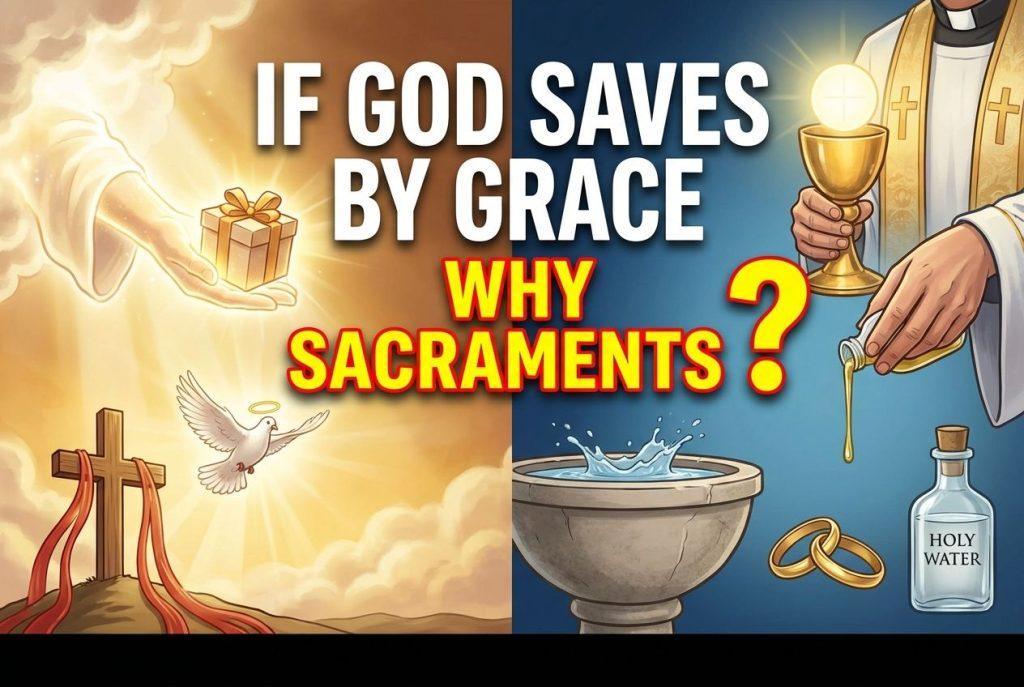
The question “If God saves by grace, why sacraments?” dissolves when one properly understands the nature of both grace and sacraments. Grace is God’s free gift of his own life, entirely unearned and unmerited. Sacraments are the means God has freely chosen to distribute this grace to believers. The two do not compete or contradict each other. The sacraments are grace made visible, tangible, and certain. They embody God’s gracious will to save humanity through the incarnate Word. Christ instituted the sacraments during his earthly ministry and entrusted them to the Church as her most precious treasure. The Church guards these gifts faithfully and distributes them generously to all who seek them. Through the sacraments, believers encounter the living Christ and receive the Holy Spirit. They participate in Christ’s death and resurrection, are fed with his Body and Blood, and receive forgiveness for sins. The sacraments accompany believers from birth to death, providing grace for every stage and challenge of life. They create and express the communion of the Church, binding individuals into one Body animated by one Spirit.
The Catholic vision of salvation holds together divine sovereignty and human response, grace and sacrament, faith and works, invisible reality and visible sign. God saves by grace alone, but this grace comes to believers through concrete channels established by Christ. Faith is necessary for salvation, but faith is awakened, nourished, and strengthened by the sacraments. The Church mediates grace, but only because Christ works through her as his Body. The ordained ministry serves the common priesthood of all believers by providing access to the sacraments. Individual conscience matters, but the communal faith of the Church provides the context and norm for personal belief. These apparent tensions dissolve when one recognizes that Catholic theology does not think in terms of either/or but both/and. Grace and sacrament, faith and ritual, personal relationship and institutional mediation all work together in the unified economy of salvation. This comprehensive vision honors the complexity of human existence and the richness of God’s provision. It refuses to reduce salvation to a single moment or a single method but recognizes that God works in many ways to draw humanity to himself.
The sacramental life offers believers a path of growth in holiness that is both structured and flexible, both demanding and merciful. The sacraments provide objective channels of grace that do not depend on subjective feelings or variable human holiness. This objectivity offers security and certainty. Believers know that when they receive a sacrament validly celebrated by the Church, they truly receive grace, regardless of what they feel. At the same time, the sacraments require human cooperation and proper disposition. They call believers to faith, repentance, and openness to transformation. This requirement prevents the sacraments from becoming mechanical or magical. The interplay between divine action and human response creates space for freedom and personal appropriation. God’s grace is always offered, but humans must freely accept it. The sacraments structure this acceptance by providing specific times, places, and forms for encountering grace. Yet within this structure, infinite variety is possible. No two people receive a sacrament in exactly the same way or with exactly the same effect. The sacraments respect human dignity and individuality while ensuring that everyone has access to the same divine gifts.
Believers who understand the sacramental principle learn to see the world differently. They recognize that matter is not opposed to spirit but can bear spiritual reality. They appreciate that God works through ordinary means, not just through extraordinary mystical experiences. They value the Church as the guardian and dispenser of sacramental grace rather than resenting her as an institutional barrier. They understand that Christianity is not merely an interior disposition or a set of moral principles but a sacramental participation in Christ’s life, death, and resurrection. This sacramental worldview has profound implications for how Christians live. It prevents the reduction of religion to moralism, emotionalism, or intellectualism. It honors the whole person, body and soul, senses and spirit, intellect and will. It builds community by centering Christian life on shared ritual actions rather than private experience. It connects present believers with past generations and future ones who share the same sacraments. It links heaven and earth, making divine grace available through material means. The sacramental vision thus offers a rich, comprehensive, and deeply satisfying understanding of how God saves humanity.
The invitation of the sacraments extends to everyone who seeks God. Baptism welcomes all who believe in Christ and desire to join his Church. The Eucharist nourishes all the baptized who approach in faith and without mortal sin. Penance offers reconciliation to all who repent of their sins. Anointing comforts all who suffer serious illness. Holy Orders calls some to ordained ministry. Matrimony blesses the unions of Christian spouses. Confirmation strengthens all the baptized for witness. No one is excluded from the sacramental life who sincerely seeks it. The Church opens wide her doors and invites all to receive the grace Christ offers. Those who have drifted from the sacraments can return. Those who have never received them can approach. Those who receive them regularly can continue with confidence. The sacraments remain constant, reliable sources of grace in a changing and uncertain world. They connect believers with the eternal God who never changes. They make present the one sacrifice of Christ that was offered once for all but remains perpetually available. They pour out the Holy Spirit who transforms hearts and makes believers holy. In the sacraments, Christians find everything they need for the life of grace and the journey to heaven.
Disclaimer: This article presents Catholic teaching for educational purposes. For official Church teaching, consult the Catechism and magisterial documents. For personal spiritual guidance, consult your parish priest or spiritual director. Questions? Contact editor@catholicshare.com
Sign up for our Exclusive Newsletter
- 📌 Add CatholicShare as a Preferred Source on Google
- 🎁 Join us on Patreon for Premium Content
- 🎧 Check Out These Catholic Audiobooks
- 📿 Get Your FREE Rosary Book
- 📱 Follow Us on Flipboard
-

Recommended Catholic Books
Discover hidden wisdom in Catholic books — invaluable guides enriching faith and satisfying curiosity. #CommissionsEarned
- The Early Church Was the Catholic Church
- The Case for Catholicism - Answers to Classic and Contemporary Protestant Objections
- Meeting the Protestant Challenge: How to Answer 50 Biblical Objections to Catholic Beliefs
As an Amazon Associate, I earn from qualifying purchases. Thank you for your support.