
Brief Overview
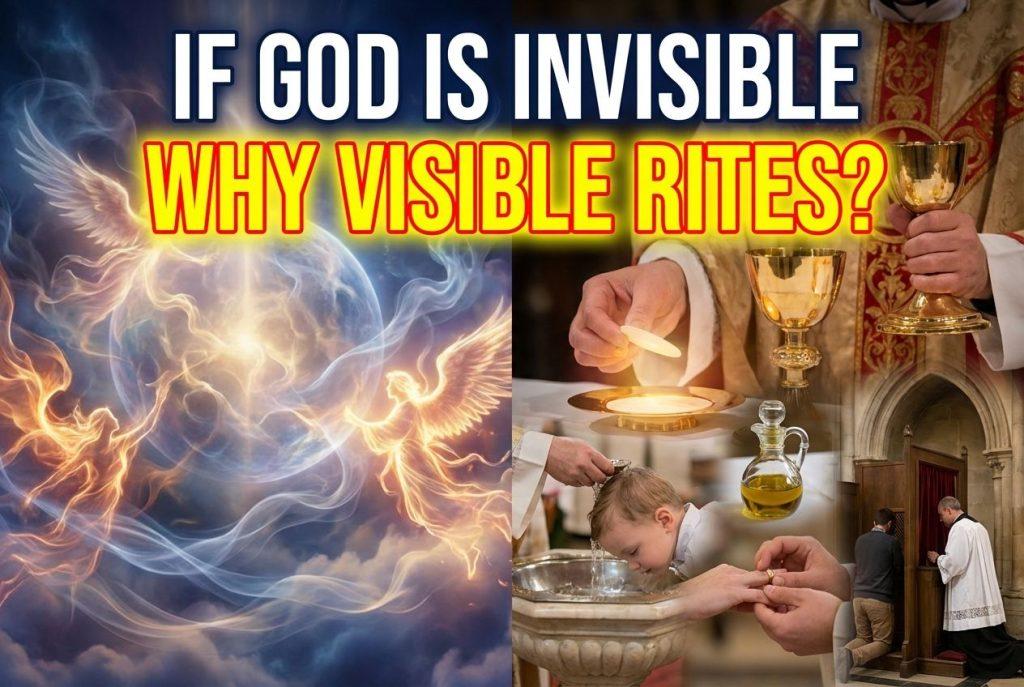
- The Catholic Church teaches that sacraments are visible signs of invisible grace because human beings are both corporeal and spiritual creatures who naturally learn and experience reality through their senses.
- The use of visible rites finds its foundation in the Incarnation of Jesus Christ, who is God made visible in human flesh, establishing the principle that divine realities can be communicated through material means.
- Sacraments continue Christ’s saving work in history by making present the grace of his Paschal mystery through physical elements like water, bread, wine, and oil.
- The visible nature of sacramental rites reflects God’s accommodation to human nature, meeting people where they are as embodied beings who need tangible expressions of spiritual truths.
- Scripture consistently demonstrates God’s use of material signs to communicate grace, from the burning bush to Christ’s healing touch, showing that visible elements have always been part of divine revelation.
- The Church herself functions as a visible sacrament of Christ in the world, making the invisible reality of God’s saving love accessible to humanity through concrete actions and rituals.
The Nature of Human Beings as Bodily and Spiritual
Human persons occupy a unique place in creation as beings who are simultaneously material and spiritual. The Catholic Church teaches that the human person, created in the image of God, exists as both a corporeal and spiritual reality in one unified nature. This fundamental truth about human identity means that people do not encounter the world as pure spirits who happen to inhabit bodies. Rather, every human experience involves both the body and the soul working together as one integrated whole. The body is not a prison for the soul or an unfortunate limitation to overcome. Instead, embodiment represents an essential aspect of what it means to be human. People think, feel, love, learn, and grow through their physical senses and bodily experiences. The eyes see beauty, the ears hear truth spoken in words, the hands touch and are touched by others, and through all these physical experiences, the spiritual dimension of the person is formed and nourished. This integrated understanding of the human person explains why God uses visible, tangible signs to communicate invisible, spiritual realities. Because humans are not disembodied spirits, they cannot relate to purely abstract or invisible truths in the same way angels might. People need to see, hear, touch, taste, and smell in order to fully grasp and internalize spiritual realities.
The Catholic understanding of the human person as a unity of body and soul has important implications for how God relates to humanity. When God communicates with people, he does not bypass their bodily nature or speak only to their souls as if the body were irrelevant. Throughout salvation history, God has consistently used physical signs and material elements to convey spiritual truths and bestow grace. In the Old Testament, God appeared to Moses in a burning bush, gave the law written on stone tablets, established circumcision as a physical sign of the covenant, and commanded elaborate rituals involving specific actions, vestments, and sacrifices. These visible elements were not arbitrary additions to what could have been purely spiritual encounters. Rather, they demonstrated God’s recognition that human beings need tangible signs to grasp invisible realities. The prophets spoke with audible voices, anointed with physical oil, and performed symbolic actions that could be witnessed. The Psalms encouraged people to clap their hands, lift their voices in song, and bow down in worship using their bodies. All of this reflects a consistent pattern in which God meets humanity as they are, as embodied spirits who need physical expressions of spiritual truths. This divine pedagogy continued and reached its fullness in the New Testament when God himself became flesh in Jesus Christ.
The philosophical tradition that informs Catholic teaching recognizes that human knowledge begins with sense experience. People do not have direct, intuitive access to purely spiritual realities the way God or angels do. Instead, human intellects must abstract universal truths from particular, sensible things encountered in the physical world. A child learns what love means by experiencing the embrace of a parent, the patience of a teacher, and the loyalty of a friend. These concrete, visible expressions of love form the foundation for understanding the invisible reality of love itself. In the same way, people come to know God and receive his grace through concrete, sensible signs that can be experienced with the body. The visible rites of the sacraments are not concessions to human weakness or accommodations to primitive thinking that more enlightened ages might outgrow. They represent a permanent feature of how God has chosen to interact with embodied creatures. Because the human person is a unity of body and soul, the transformation that grace works must engage the whole person, not just some isolated spiritual component. Sacraments accomplish this by using material elements and bodily actions to effect spiritual realities, honoring the integrated nature of human existence.
The Foundation in the Incarnation
The deepest reason why the Catholic Church uses visible rites to communicate invisible grace lies in the mystery of the Incarnation. When the Word became flesh and dwelt among us, God himself took on material reality and entered human history as a visible, tangible person. Jesus Christ was not a phantom or an appearance of God that merely seemed to have a body. He was truly God and truly man, with a real human body born of the Virgin Mary. People saw him with their eyes, heard his voice with their ears, and touched his hands. The Apostle John would later emphasize this physicality when he wrote that what was from the beginning, what they had heard, seen with their eyes, looked upon, and touched with their hands concerning the Word of life, they proclaimed. The Incarnation established the fundamental principle that spiritual realities can be made present through material means. God did not redeem humanity by remaining at a distance and issuing decrees from heaven. He entered into creation, assuming flesh and blood, and accomplished salvation through concrete, historical actions performed in a human body. Christ touched lepers, placed mud on blind eyes, allowed a sinful woman to anoint his feet, broke bread with his disciples, and died a physical death on a wooden cross.
The Incarnation reveals that God values matter and uses it as a vehicle for grace. Some religious and philosophical traditions have viewed material reality as inherently inferior to spiritual reality, treating the body as an obstacle to enlightenment that must be transcended or escaped. Christianity rejects this dualism. The fact that God himself took on flesh demonstrates that matter is good and can become a means of encountering the divine. When Christ rose from the dead, he did not shed his body to exist as a pure spirit. He rose bodily, and his resurrected body, though glorified, remained physical enough to be seen, to eat fish, and to invite Thomas to touch his wounds. This continuing embodiment of Christ, now seated at the right hand of the Father, confirms that physical reality has eternal significance. The Incarnation was not a temporary measure that God abandoned once its immediate purpose was accomplished. The Second Person of the Trinity remains incarnate forever, eternally uniting divine and human natures, spiritual and material realities, in his one person. This permanent union of the visible and invisible in Christ provides the foundation and model for the sacramental system of the Church.
The visible rites of the sacraments extend and continue the principle established in the Incarnation. Just as Christ was the visible sacrament of God, making the invisible Father present and accessible to human beings, the Church now serves as the visible sacrament of Christ, continuing his saving work through tangible signs. The sacraments are not human inventions designed to add ceremonial dignity to what could otherwise be accomplished invisibly. They are extensions of the Incarnation itself, ways that Christ continues to act in history through material means. When a person is baptized with water, anointed with oil, or receives the consecrated bread and wine of the Eucharist, Christ himself is acting through these physical elements. The visible rite becomes the instrument through which the invisible reality of grace is communicated. This represents a continuation of the same logic by which God chose to save humanity through the visible, historical person of Jesus rather than through some purely spiritual transaction. The Catechism teaches that the whole liturgy of the Church revolves around the Eucharistic sacrifice and the sacraments, through which Christ makes present and communicates his work of salvation.
Sacraments as Efficacious Signs
The Catholic Church defines sacraments as efficacious signs of grace, instituted by Christ and entrusted to the Church, by which divine life is dispensed to humanity. This definition appears in the Catechism and deserves careful examination of each element. First, sacraments are signs, meaning they point to and represent something beyond themselves. Water signifies cleansing and new life, bread and wine signify nourishment and shared fellowship, and the laying on of hands signifies the conferral of authority or blessing. Like all signs, sacraments have visible forms that can be perceived by the senses and recognized by participants. But sacraments are not merely signs in the way a traffic signal or a corporate logo is a sign. They are efficacious signs, meaning they actually accomplish what they signify. When water is poured in baptism and the proper words are spoken, the person is truly cleansed of sin and reborn as a child of God. The sign does not merely symbolize a spiritual reality that happens separately or invisibly alongside it. The sign itself, when validly performed, effects the grace it represents. This makes sacraments radically different from other religious symbols or ceremonies that may inspire faith or remind people of spiritual truths without actually causing those truths to become present.
The efficacious nature of sacraments reflects the Catholic belief that God has bound himself to act through these visible signs when they are properly administered. This does not limit God’s freedom or mean that he cannot bestow grace in other ways. God can and does work outside the sacramental system when he chooses. However, in the sacraments, the faithful have certainty that grace is being offered because Christ himself has promised to be present and active in these rites. A person receiving baptism does not need to wonder whether God might decide to withhold grace on that particular occasion or doubt whether their subjective experience was adequate to receive grace. The objective action of the sacrament, performed according to the Church’s intention and using the proper matter and form, guarantees that grace is present and available. This provides tremendous comfort and assurance to believers who might otherwise be plagued by doubts about their worthiness or the sufficiency of their faith. The efficacy of sacraments depends primarily on the action of Christ working through the Church, not on the subjective disposition of the minister or the emotional intensity of the recipient, though proper disposition is needed to receive the grace fruitfully.
The visible rites by which sacraments are celebrated both signify and make present the graces proper to each sacrament, as stated in the Catechism’s treatment of the sacramental economy. This means the material elements and bodily actions of each sacrament are carefully chosen to correspond to the spiritual reality being communicated. Baptism uses water because water cleanses physically, and baptism cleanses spiritually from sin. The Eucharist uses bread and wine because these are foods that nourish physical life, and the Eucharist nourishes spiritual life with Christ’s body and blood. Confirmation uses anointing with oil because oil was used to consecrate kings and prophets in ancient Israel, and Confirmation consecrates believers to be witnesses who share in Christ’s prophetic office. The visible elements are not arbitrary or interchangeable. Each sacrament has specific matter, the physical substance used, and specific form, the words that must be spoken, which together constitute the essential sign. These requirements ensure that sacraments remain recognizable and connected to their institution by Christ. They also mean that the visible dimension of each sacrament carries genuine meaning and teaches something true about the invisible grace being conferred. Participants can see, hear, and experience with their senses actions that correspond to and illuminate the spiritual transformation taking place.
Scripture and Sacred Tradition
The use of visible signs to communicate invisible realities has deep roots in both Scripture and the living Tradition of the Church. From the earliest pages of Genesis, God has communicated with humanity through material creation. He walked in the garden in the cool of the day, speaking with Adam and Eve in audible words. He marked Cain with a visible sign to protect him. He set his rainbow in the clouds as a sign of the covenant with Noah. When God established his covenant with Abraham, he commanded the visible sign of circumcision to be performed on every male of Abraham’s household. This physical mark in the flesh served as a constant reminder of the covenant relationship and was required for participation in the covenant community. The Passover ritual, commanded by God through Moses, involved the visible sacrifice of lambs, the marking of doorposts with blood, and the eating of a meal with specific elements in a prescribed manner. These visible rites were not optional additions to an essentially spiritual covenant. They were integral to how God chose to relate to his people and communicate his saving will to them throughout the Old Testament.
The prophets frequently performed symbolic actions involving visible, physical elements to communicate God’s message. Jeremiah buried a linen loincloth, broke a potter’s vessel, and wore a yoke to represent different aspects of God’s judgment and call to repentance. Ezekiel lay on his side for days, shaved his head and beard, and cooked food over a fire made from dung to dramatize the siege of Jerusalem and exile of the people. Hosea married an unfaithful woman as a living sign of God’s faithful love for unfaithful Israel. These prophetic signs were more than illustrations or teaching aids that helped people understand verbal messages. The prophets understood their symbolic actions as participating in the realities they represented and in some sense bringing about what they signified. This concept of a sign that effects what it represents prepared the way for Christian sacraments. When John the Baptist baptized people in the Jordan River, calling them to repentance, he used the visible sign of washing with water to represent and effect spiritual cleansing. Jesus himself validated this practice by submitting to John’s baptism, though he had no sin to wash away, thereby honoring the use of material signs in God’s plan of salvation.
The New Testament records numerous occasions when Jesus used physical means to convey spiritual realities and work miracles. He touched lepers to heal them, placed mud made from his saliva on blind eyes to restore sight, and allowed people to touch the hem of his garment to be cured of their infirmities. When he instituted the Eucharist at the Last Supper, he took bread and wine, blessed them, and gave them to his disciples with the words, “This is my body” and “This is my blood.” He commanded them to repeat this action in memory of him. This was not merely a symbolic gesture or a way of helping the disciples remember him after his death. The early Church understood from the beginning that the Eucharist truly made Christ present under the appearances of bread and wine. Jesus himself prepared for this teaching with his discourse in the synagogue at Capernaum, recorded in the Gospel of John, where he insisted repeatedly and emphatically that his followers must eat his flesh and drink his blood to have life in them. Many found this teaching too difficult and left him, but he did not call them back with an explanation that he was speaking merely symbolically. The Apostle Paul later warned the Corinthians that whoever eats the bread or drinks the cup of the Lord unworthily will be guilty of profaning the body and blood of the Lord, clearly indicating belief in the real presence of Christ in the Eucharistic elements.
After his resurrection, Jesus continued to use visible means to communicate grace and establish the sacramental structure of the Church. He breathed on the apostles and said, “Receive the Holy Spirit,” connecting the invisible gift of the Spirit with a visible action of breathing. He commanded the apostles to baptize all nations in the name of the Father and of the Son and of the Holy Spirit, establishing baptism as the visible sign of entrance into the Christian community. The Acts of the Apostles records the apostles laying hands on believers to confer the Holy Spirit, healing the sick, and baptizing converts. The epistles refer to sacramental practices including baptism, the Eucharist, and the anointing of the sick with oil. These visible rites were understood from apostolic times as essential to Christian life, not as optional ceremonies that might be abandoned in favor of a purely spiritual religion. The consistent testimony of Scripture is that God has always chosen to work through material signs and visible actions to communicate grace and bring about spiritual transformation. This biblical pattern provides the foundation for the Church’s continued use of visible rites in the seven sacraments.
The Sacramental Economy
The Catechism uses the term “sacramental economy” to describe how Christ now lives and acts in and with his Church through the sacraments. The word economy here comes from the Greek oikonomia, meaning household management or the ordering of a household. In theological usage, it refers to God’s plan for organizing and accomplishing salvation. The sacramental economy is the system by which Christ makes present and communicates the fruits of his Paschal mystery through the liturgical and sacramental life of the Church. This concept helps explain why visible rites remain necessary even after Christ’s ascension into heaven. Christ did not complete his saving work and then leave humanity to remember and apply it as best they could using symbolic rituals. Rather, he continues to act in history through the Church, and the sacraments are the primary means by which he does so. When the Church celebrates the Eucharist, Christ himself is offering his sacrifice to the Father. When the Church baptizes, Christ himself is washing away sins. When the Church absolves in confession, Christ himself is forgiving. The visible rites performed by human ministers are instruments through which Christ’s invisible action becomes present and effective.
This sacramental economy represents a new era in salvation history, the age of the Church that began at Pentecost and will continue until Christ returns in glory. During his earthly ministry, Christ was limited to one place at one time, able to teach and heal only those who came into physical contact with him in first-century Palestine. After his ascension and the sending of the Holy Spirit, Christ became present to all times and places through the sacramental life of the Church. The visible rites celebrated in every Catholic church throughout the world make the same grace available that flowed from Christ’s own actions during his earthly life. A person baptized in Rome today receives the same spiritual rebirth as those baptized by Peter in Jerusalem on the day of Pentecost. A sick person anointed in a hospital in modern times receives the same healing grace that Christ offered when he touched lepers and restored sight to the blind. This continuity is possible because the sacraments are not human actions that merely commemorate past events. They are actions of Christ himself, who promised to be with his Church always, even to the end of the age, and who works through the visible ministry of the Church to apply his once-for-all sacrifice to every generation.
The sacramental economy also reveals something important about the nature of time and the way God acts in history. Some Christian traditions view sacraments primarily as acts of remembrance, ways that believers recall what God has done in the past and express their faith in those past events. The Catholic understanding includes remembrance but goes far beyond it to include making present. The Mass does not merely remind Catholics that Jesus died on the cross two thousand years ago. It makes that one sacrifice present here and now, allowing believers to participate in the same saving event. This is possible because God exists outside time and views all moments of history in an eternal present. When Christ offered himself on Calvary, he did so with full knowledge and intention that his sacrifice would be made present in every Mass throughout history. The visible rites of the Eucharist, the words of consecration, the breaking of bread, and the sharing of the cup, serve as the means by which that single sacrifice transcends time and becomes accessible to every generation. This mystery involves the intersection of time and eternity, the visible and the invisible, made possible through the sacramental system that Christ established and entrusted to his Church.
Accommodating Human Nature
The use of visible rites in Catholic worship demonstrates God’s pastoral wisdom in accommodating himself to human capacities and needs. God could have arranged salvation differently, requiring only invisible, purely interior acts of faith without any visible ceremonies or material elements. Some would argue this would be a more spiritual and elevated form of religion, free from the potential for superstition or mechanical ritualism that visible rites might encourage. However, God in his wisdom chose the opposite path, establishing a religion that thoroughly engages the human body and uses material creation as the vehicle for grace. This choice reflects not a divine limitation but rather God’s deep understanding of and respect for human nature as he created it. God knows that human beings need visible, tangible expressions of invisible realities. People need to do something with their bodies, not just assent mentally to abstract truths. They need to see, hear, taste, smell, and touch in order to fully participate in worship and receive grace in a way that engages their whole being. Visible rites meet this fundamental human need without compromising the spiritual nature of what is being communicated.
The visible elements of sacraments also serve an important pedagogical function, teaching the faithful about the invisible realities they represent. When a child sees water poured over her head in baptism, she learns that baptism washes away sin and gives new life. The visible sign provides a concrete reference point for understanding the spiritual truth. As the child grows, her understanding of baptism will deepen, but it will always remain anchored in that visible experience of water and the accompanying words. The same principle applies to all the sacraments. The visible form of each sacrament teaches something essential about the grace it confers. Oil in confirmation teaches that the Holy Spirit strengthens and consecrates. The words of absolution in confession teach that sins are truly forgiven. The exchange of rings in matrimony teaches that marriage creates a permanent bond. These visible signs do not merely illustrate truths that could be learned just as well from books or lectures. They enact the realities in ways that engage memory, emotion, and the whole person, creating a lasting impression that purely verbal instruction cannot match.
Visible rites also create community and make private faith public and communal. When sacraments are celebrated in the presence of the Christian assembly, they build up the Church and strengthen the bonds among believers. A baptism celebrated privately would still be valid and would still confer grace, but the public celebration allows the entire community to welcome the new Christian, renew their own baptismal commitment, and recognize their responsibility to support the newly baptized in living the faith. Similarly, the Eucharist celebrated as a common meal rather than as private spiritual communion emphasizes the unity of the Church as the body of Christ. Visible rites make it possible for believers to witness each other’s faith, pray for one another, and experience themselves as part of a community united by shared practices and not merely by shared ideas. This communal dimension of sacramental celebration reflects the fact that Christianity is not a religion of isolated individuals seeking private spiritual experiences. It is the faith of a people, the Church, whose members are bound together by visible signs of their common participation in Christ’s life.
Meeting the Whole Person
Catholic theology insists that grace does not destroy nature but perfects it. This principle applies to the sacramental system and explains why visible rites are not concessions to human weakness but rather represent the perfect way for grace to engage human nature. God could force people to be good, overriding their wills and intellects to produce holiness mechanically. But this would violate human nature, which is created with freedom and rationality. Instead, God invites human cooperation with grace, proposing salvation in ways that respect human freedom and engage human capacities. The visible rites of the sacraments invite full human participation, engaging the senses, the imagination, the emotions, the body, and the will along with the intellect and spirit. A person being baptized does something, submitting to the washing of water. A person receiving communion does something, approaching the altar, extending hands, eating and drinking. These physical actions involve the whole person in receiving grace rather than bypassing the body to work only on some supposed spiritual core.
The emotional and psychological dimensions of visible rites should not be dismissed as inferior to their spiritual effects. Human beings are emotional creatures whose feelings profoundly influence their thoughts and choices. The visible elements of sacraments engage the emotions in ways that support and strengthen faith. The beauty of a church building, the solemnity of liturgical music, the smell of incense, the taste of wine, and the sight of candles all contribute to creating an atmosphere of reverence and encounter with the sacred. These sensory experiences help lift the mind and heart to God, preparing the person to receive grace fruitfully. Some might object that true worship should not depend on such externals, that genuine faith should be able to function equally well in any setting or without any sensory elements. This objection fails to recognize that human beings are sensory creatures whose faith is embodied, not abstract. A couple could validly marry by simply exchanging consent before witnesses in a bare room with no ceremony. But most couples instinctively recognize that such a wedding would be inadequate to the significance of what they are doing. They want beauty, solemnity, witnesses, celebration, because these visible elements honor the invisible reality of the sacramental bond being created and help them enter more fully into its mystery.
The emphasis on visible rites also protects against various forms of spiritual pride and false piety that can arise when religion becomes too interior and invisible. If salvation depended only on private, invisible faith with no visible practices required, it would be easy for individuals to imagine they had achieved a higher spiritual state than they actually have. They might confuse emotional experiences or intellectual convictions with genuine transformation of life. Visible sacraments impose an objective standard. Either one is baptized or not, either one receives communion or not, either one confesses sins to a priest or not. These visible actions can be witnessed and verified. They also require humility, as the person must admit their need by publicly approaching for the sacrament. Someone who thinks they are too spiritual to need visible rites, who imagines they have direct access to God without any material mediation, may actually be guilty of presumption. The requirement to participate in visible rites keeps believers humble and reminds them that they receive grace as a gift, not as something they generate through their own spiritual prowess. The Catholic insistence on sacraments as necessary means of grace thus serves to keep faith grounded in objective reality rather than subjective experience.
Christ the Primordial Sacrament
Understanding why the Church uses visible rites requires recognizing Christ himself as the primordial sacrament, the original and perfect union of invisible divine reality with visible human form. All subsequent sacramental theology flows from this fundamental truth. When God wanted to reveal himself most fully to humanity, he did not send a book, issue a series of pronouncements, or arrange for mystical visions available to spiritual elites. He sent his Son, who took on flesh and lived a fully human life that could be seen, heard, and touched. In Jesus Christ, the invisible God became visible, the eternal entered time, and divine nature united with human nature in one person. This union of the visible and invisible in Christ is permanent and inseparable. Even now in heaven, Christ retains his human nature with a glorified body. The Incarnation was not a temporary disguise that God assumed for thirty-three years and then discarded. It represents God’s permanent commitment to matter and his definitive statement that material reality can be the vehicle for divine presence and action. Every sacrament extends this principle established in the Incarnation.
Christ’s earthly ministry demonstrated repeatedly that material things and bodily actions can communicate grace and work spiritual transformation. His miracles often involved visible means like touch, saliva, mud, or spoken commands. He could have healed people with a mere thought or willed cures from a distance, and indeed he sometimes did exactly that. But more often he chose to use physical contact and material elements, not because he needed them to work his power, but because humanity needed them to receive his grace in a fully human way. When he touched a leper, he not only cured the disease but also broke through the social isolation that leprosy imposed, communicating acceptance and dignity through physical contact. When he used his own saliva to make mud for healing blind eyes, he used the most intimate of bodily substances, showing that the body is not shameful but can be a vehicle for healing. These visible actions in Christ’s ministry prepared his followers to understand the sacraments he would later institute. The washing of feet at the Last Supper, performed just before the institution of the Eucharist, taught that visible actions done in love convey profound spiritual realities. Jesus explicitly connected his visible action of washing feet with the invisible reality of cleansing and service that should characterize his followers.
The Church, as the body of Christ, continues his incarnational presence in history. Just as Christ was the visible sacrament of the invisible God, the Church is the visible sacrament of Christ. This does not mean the Church is Christ, or that the Church replaces Christ, but rather that Christ has chosen to work through the visible structures, ministries, and sacraments of the Church. When bishops, priests, and deacons act in their official capacity administering sacraments, they act in persona Christi, in the person of Christ. The visible human minister becomes the instrument through which Christ himself acts. This understanding explains how sacraments can be efficacious even when administered by unworthy ministers. The validity and effectiveness of the sacrament do not depend on the holiness of the minister but on the action of Christ working through the Church’s ministry. The visible rite performed by a visible human minister connects the recipient to the invisible action of Christ, who is the true minister of every sacrament. This sacramental structure allows Christ’s saving work to continue throughout history in every part of the world through the visible ministry of the Church.
Signs of Faith
The visible rites of the sacraments are signs not only of grace but also of faith. They express and strengthen the faith of those who receive them and of the Church that celebrates them. The Catechism teaches that the Holy Spirit prepares the faithful for the sacraments by the Word of God and the faith that welcomes that word in well-disposed hearts, and that the sacraments in turn strengthen faith and express it. This reciprocal relationship between sacraments and faith means that visible rites are not mechanical operations that work automatically without any human response. Grace is offered in the sacraments, but it must be received with faith to bear fruit in the life of the recipient. The visible nature of sacramental rites provides a way for faith to express itself in action. When parents bring their infant for baptism, their faith is made visible in that action. When a person kneels in the confessional and audibly confesses sins, faith is made visible. When someone approaches the altar for communion, faith is expressed visibly. These visible expressions of faith are not unnecessary additions to an interior faith that would be sufficient on its own. Rather, faith by its nature seeks to express itself in action, and sacraments provide divinely appointed ways for faith to become visible and active.
The communal celebration of sacraments allows the faith of the Church to be proclaimed and passed on to new generations. When the entire congregation responds “Amen” to the priest’s words “The body of Christ” at communion, this visible and audible expression of faith teaches children and catechumens what the community believes about the Eucharist. When a couple exchanges marriage vows before the assembly, their visible commitment to one another witnesses to the Church’s faith in the sacredness of marriage. The liturgical rites surrounding each sacrament, with their prayers, readings, and ceremonial actions, serve to proclaim and teach the faith. The visible rites thus function as a form of ongoing catechesis, continually instructing the faithful about what the Church believes and how those beliefs should shape life. This teaching function of sacramental rites is particularly important in an age when many Catholics may not study theology formally or read extensively about their faith. The weekly experience of Mass and occasional participation in other sacraments provide regular, repeated instruction through visible signs and ritual actions.
The visible nature of sacraments also protects the objectivity of faith against the danger of reducing Christianity to a purely subjective feeling or personal interpretation. When faith is completely interior and invisible, it becomes difficult to distinguish genuine faith from self-deception, wishful thinking, or emotional enthusiasm that lacks substance. The requirement to participate in visible sacramental rites imposes a certain discipline and objectivity. The rites exist independent of any individual’s feelings or preferences. They have set forms, established by the Church’s authority, that must be followed. This objectivity protects faith from degenerating into individualism where each person defines Christianity however they wish. It also provides assurance that all Catholics, despite differences in temperament, education, or spiritual experience, are receiving the same grace through the same means. The visible unity of Catholics worldwide in celebrating the same sacraments with the same essential forms creates and expresses the visible unity of the Church as one body with one faith, even across vast cultural and linguistic differences.
Anticipating the Eschaton
The use of visible rites in the sacramental life of the Church has an eschatological dimension, pointing forward to the final transformation of all creation when God will be all in all. The Catechism teaches that the liturgy already participates in a foretaste of the heavenly liturgy, joining with the angels and saints in worship of God. When the Church celebrates the Eucharist on earth, she participates in the eternal worship of heaven. This means that visible liturgical rites are not temporary measures that will be discarded when believers finally see God face to face. Rather, the visible dimension of worship will be transformed and perfected, but not eliminated. Catholic theology affirms the resurrection of the body, not just the immortality of the soul. This belief that bodies will rise and be glorified means that human persons will retain their bodily nature in the world to come. Heaven will not consist of disembodied souls floating in an abstract spiritual realm. It will involve glorified bodies in a renewed creation, a new heaven and new earth where God dwells with humanity. In this renewed creation, the material world will be perfectly transparent to spiritual reality, with no contradiction or tension between the visible and the invisible.
The sacramental use of visible elements anticipates and prepares for this final transformation of matter. When bread and wine are consecrated and become the body and blood of Christ while retaining their physical appearances, this represents a kind of preview of how matter will be transformed in the resurrection. The Eucharist demonstrates that physical things can become bearers of divine presence without ceasing to be physical. This mystery points toward the final state when all creation will be transfigured by glory while remaining truly created reality. The bodies of the saints will be real bodies, not phantoms or symbols, yet they will be glorified bodies capable of things impossible for natural bodies, just as Christ’s resurrected body could appear in a locked room yet could also be touched and could eat food. The sacramental system of the Church, which uses visible elements to communicate invisible grace, trains believers to expect this final transfiguration of matter rather than its elimination. It teaches that God’s plan is not to rescue spirits from an evil material world but to transform the material world itself into a fitting dwelling place for divine glory.
The beauty that the Church has traditionally cultivated in her liturgical rites reflects this anticipation of the final glory that will transfigure creation. When churches are adorned with art, when vestments are made of fine materials, when music is composed with care and skill, when incense perfumes the air and candles illuminate the sanctuary, all of this serves to lift the minds of worshippers to the beauty of heaven. Some have criticized such beauty as wasteful, arguing that resources spent on beautiful churches and liturgical appointments would be better directed to feeding the poor. But this criticism misses the point that beauty in worship honors God and teaches worshippers about the transcendent reality they are encountering. The visible beauty of sacred spaces and rites serves as a sign of the invisible beauty of God himself. It also reminds believers that they are destined for glory, that their final home will be the heavenly Jerusalem whose radiance outshines any earthly splendor. The visible rites of the sacraments, celebrated with solemnity and beauty, give believers a foretaste of the wedding feast of the Lamb where all the saints will celebrate in the presence of God forever. Far from being unnecessary ornamentation, the visible elements of liturgy point toward and partially reveal the ultimate purpose of all creation, which is to give glory to God and share in his eternal life.
Formation and Transformation
The visible rites of the sacraments play a crucial role in forming believers in the Christian life and transforming them into the image of Christ. This formation happens not primarily through abstract instruction but through repeated participation in ritual actions that shape the person at a deep level. Philosophers and psychologists recognize that human beings are formed by their habits and practices, not just by their ideas. People become what they repeatedly do. The regular participation in sacramental rites creates habits of prayer, reverence, and obedience that gradually transform the person. When someone kneels for communion every week, the physical posture of kneeling forms the interior disposition of humility and receptivity. When someone makes the sign of the cross numerous times each day, this visible gesture reinforces consciousness of living in God’s presence and protection. When married couples renew their wedding vows or recall their wedding day, the memory of that visible ritual ceremony strengthens their commitment. These visible practices work on the person through repetition over time, gradually forming Christian character in ways that lectures or reading alone could not accomplish.
The public nature of sacramental celebration also contributes to formation by creating accountability and modeling proper practice. When children see adults approaching the altar with reverence for communion, they learn how to behave and what attitude to have toward the Eucharist. When converts preparing for baptism witness the baptism of others, they see what will be expected of them and understand more fully what they are preparing to receive. When the sick see others anointed, they learn not to fear this sacrament but to see it as a source of grace and comfort. This formation through observation and imitation is a natural human way of learning that complements verbal instruction. The visible rites of the sacraments provide models that can be observed and imitated, creating a living tradition that is passed down not just in words but in actions, gestures, and the whole embodied experience of worship. This living tradition of practice has preserved the faith through centuries when books were rare and literacy limited. The visible rites themselves, consistently performed generation after generation, have transmitted the faith more reliably than any written text.
The transformative power of sacraments extends beyond the individual to transform communities and cultures. When an entire society participates in common sacramental practices, these visible rites shape the culture in significant ways. The Christian practice of baptizing infants created a culture that values every human life from the beginning, recognizing even newborns as persons with dignity and eternal destiny. The sacramental understanding of marriage as permanent and indissoluble has shaped Western culture’s understanding of family and social stability. The practice of going to confession has formed a culture that values honesty about sin, takes moral responsibility seriously, and believes in the possibility of forgiveness and new beginnings. The Eucharist celebrated as a common meal has formed a culture that values hospitality, equality in the body of Christ, and the sharing of resources. These cultural effects of sacramental practice demonstrate that visible rites have power to shape not just individual spiritual lives but entire civilizations. The decline of sacramental practice in formerly Christian societies corresponds to a decline in the values and practices that sacramental culture had formed and sustained. This correlation suggests that visible rites do more than symbolize invisible realities; they actually create and sustain those realities in human life and society.
The Specific Nature of Each Sacrament
Each of the seven sacraments uses particular visible elements chosen for their natural correspondence to the grace being conferred, demonstrating the wisdom of God’s plan in accommodating spiritual realities to human understanding through appropriate material signs. Baptism uses water, the most universal element needed for physical life, to signify the spiritual rebirth by which a person enters into divine life. Water cleanses, refreshes, and makes things grow, and all these natural properties of water correspond to what happens spiritually in baptism. The triple immersion or triple pouring of water corresponds to death and resurrection with Christ, burial with him in death and rising to new life. The visible washing with water provides a tangible experience of what is happening invisibly, allowing the baptized person and witnesses to grasp through their senses the spiritual cleansing that is occurring. The newly baptized emerges from the water visibly wet, smelling of the sacred chrism that has been applied, clothed in a white garment, carrying a lit candle, all visible signs that teach about the invisible transformation that has taken place. These visible elements make baptism a memorable and significant event rather than an invisible transaction that might pass unnoticed.
Confirmation uses the visible sign of anointing with sacred chrism, perfumed oil blessed by the bishop, accompanied by the laying on of hands. Oil was used in ancient Israel to anoint kings, priests, and prophets, consecrating them for special service to God and marking them as chosen and set apart. In confirmation, the baptized person is anointed and sealed with the Holy Spirit, consecrated to witness to Christ and share in his prophetic mission. The visible anointing with fragrant oil creates a lasting sensory memory of this moment of commitment and empowerment. The sweet smell of the chrism, the feel of the bishop’s hand on one’s head, the sight of others being confirmed in the same ceremony, all contribute to making confirmation a significant event that marks a stage of growth in Christian life. The slap or tap on the cheek that historically accompanied confirmation, a visible gesture meant to remind the newly confirmed to be ready to suffer for Christ, shows how visible signs can communicate spiritual truths powerfully without words. Though this particular gesture is no longer universally practiced, it illustrates how the Church has used visible elements to teach and form believers in concrete, memorable ways.
The Eucharist uses bread and wine, the most basic elements of a meal, to become the body and blood of Christ. The choice of food and drink as the visible signs of Christ’s presence reflects the truth that he is spiritual nourishment, the bread of life without whom believers cannot live. The communal sharing of a meal around a table has always been a sign of friendship, family bonds, and fellowship. By making a meal the sacrament of his continuing presence, Christ ensures that his followers will experience communion with him and with each other in the most fundamental and universal human activity of eating together. The taste of bread and wine, the act of chewing and swallowing, the physical satisfaction of eating, all engage the body in receiving Christ and make the spiritual reality tangible. The visual appearance of the priest breaking the bread corresponds to Christ’s body broken on the cross and also to the unity of the Church, many grains of wheat ground together to make one loaf. The pouring of wine into the chalice represents Christ’s blood poured out in sacrifice. Every visible element of the Eucharistic liturgy has meaning that teaches and forms believers while also effecting the grace it signifies. The centrality of the Eucharist in Catholic life demonstrates that the most important sacrament is also the most thoroughly embodied, engaging all the senses and occurring in the context of a full liturgical celebration with visible rituals, audible prayers, and tangible elements.
The sacrament of Penance or Reconciliation requires the visible, audible confession of sins to a priest who then visibly pronounces absolution. The penitent must speak the sins aloud, not merely think about them or silently regret them. This verbal confession is difficult and humbling, but it serves important purposes in the process of reconciliation. Speaking sins aloud makes them concrete and specific rather than vague feelings of guilt. It requires the penitent to take responsibility by acknowledging what they have done wrong. The visible presence of the priest reminds the penitent that sin affects the community and requires reconciliation with the Church, not just with God privately. The audible words of absolution, “I absolve you from your sins in the name of the Father, and of the Son, and of the Holy Spirit,” provide certainty that forgiveness has been granted. The penitent hears with their own ears the pronouncement of forgiveness and can be confident they have been reconciled. This visible, audible sacramental form of reconciliation provides assurance that internal feelings of guilt or subjective conviction about being forgiven cannot match. The visible rite protects against both presumption, assuming forgiveness without genuine repentance, and despair, refusing to believe that sins can be forgiven. The objective, visible sacrament provides the certainty that human subjectivity cannot achieve alone.
The sacrament of Anointing of the Sick uses oil applied to the forehead and hands of those who are seriously ill, elderly, or facing major surgery. This visible anointing with blessed oil signifies the healing grace of Christ touching the sick person. The visible presence of the priest at the bedside, the sight and smell of the sacred oil, the laying on of hands, and the prayers spoken aloud all serve to comfort the sick person and assure them of God’s presence in their suffering. For those too ill to speak or perhaps unconscious, the visible rite can be witnessed by family members and caregivers who are also suffering and need reassurance that their loved one is being cared for spiritually. The communal form of this sacrament, sometimes celebrated during Mass with all the sick and elderly of a parish coming forward for anointing, creates a powerful witness to the Church’s care for the vulnerable and reminds healthy members of the congregation about their own mortality and need for God’s grace. The visible nature of this sacrament prevents the sick from being forgotten or marginalized, keeping them visibly present in the life of the community even when they cannot participate fully in parish activities.
Holy Orders and Matrimony are sometimes called the sacraments at the service of communion because they confer grace not primarily for personal sanctification but for building up the Church and serving others. Both use highly visible public ceremonies that involve the entire community as witnesses. In ordination, the bishop lays hands on the head of the ordinand, a gesture that goes back to the apostles and signifies the transmission of authority and the bestowal of the Holy Spirit for ministry. The newly ordained priest or deacon stands before the congregation in new vestments, visibly set apart for sacred ministry. This public ceremony ensures that everyone knows who has been authorized to act in persona Christi in administering sacraments. In Matrimony, the couple themselves are the ministers of the sacrament, exchanging consent before witnesses in a public ceremony that creates a new relationship not just between the couple but between two families and the entire community. The exchange of rings provides a visible, permanent sign of the marriage bond that the couple will wear every day as a reminder of their commitment. The public nature of both these sacraments reflects their communal significance and creates accountability, as the entire Church witnesses and promises to support those being ordained or married in living out their vocations.
The Role of Matter in Salvation History
Understanding why visible rites are necessary requires recognizing the consistent pattern throughout salvation history of God using material creation to communicate grace and accomplish his purposes. The creation accounts in Genesis establish that God created the material world and declared it good. Human beings were formed from the dust of the ground and given dominion over physical creation. This original blessing of materiality has never been revoked despite the entrance of sin into the world. God did not respond to human sin by abandoning material creation or declaring it evil and irredeemable. Rather, his plan of salvation has always involved working through material means to restore and perfect creation. The flood did not destroy the earth but cleansed it, and God set his rainbow in the physical sky as a sign of his covenant with all flesh. He chose a particular people, Israel, with specific genetic lineage through Abraham, making salvation history a matter of physical descent and biological family. He gave Israel a physical land, established rituals involving physical actions and material elements, and commanded the construction of a physical temple where his presence would dwell. All of this demonstrates that God’s plan involves matter, not just spirit, from beginning to end.
The Incarnation represents the culmination of this material dimension of salvation history. When the Word became flesh, God united himself permanently with matter in the most intimate way possible. The doctrine of the Incarnation asserts not merely that God appeared to be human or temporarily inhabited a human body, but that he truly assumed human nature including a real human body with all its material properties. This body was born from a woman’s womb after nine months of pregnancy, grew through childhood and adolescence, needed food and water, experienced tiredness and physical pain, and could bleed and die. The resurrected and glorified body of Christ, though transformed, remained material enough to be touched, to eat food, and to bear the marks of crucifixion. This continuing embodiment of the Son of God reveals that matter has been permanently dignified and made capable of expressing divine reality. The Ascension did not involve Christ shedding his body to return to pure spirit. He ascended in his body and will return in his body at the end of time. Even now he is present body and blood, soul and divinity in the consecrated bread and wine of the Eucharist in every Catholic church throughout the world. This pervasive material dimension of Christ’s existence and continuing presence grounds the Church’s sacramental use of visible rites and material elements.
The Holy Spirit’s role in salvation history also involves material elements and visible signs. At Pentecost, the Spirit descended in the form of wind and fire, both physical phenomena that could be heard and seen by those present. Throughout Acts, the Spirit’s presence is manifested in visible ways like tongues, prophecy, and healings that others can witness. The Spirit is given through the visible action of laying on of hands. The Spirit inspires the writing of Scripture, which consists of words written on physical materials. The Spirit dwells in the Church, which is a visible, institutional reality, not merely an invisible fellowship of believers. The Spirit works through the visible sacraments to sanctify believers and through the visible ministries of the Church to guide the people of God. This consistent pattern of the Spirit working through material means corresponds to the biblical understanding that humans are not souls trapped in bodies but embodied beings whose spiritual life must engage their physical nature. The doctrine of the resurrection of the body at the end of time confirms that God’s plan includes the redemption and transformation of matter, not its abandonment. Believers do not hope to escape from their bodies into some disembodied spiritual existence but to receive glorified bodies in a renewed creation where God dwells with humanity forever.
Disclaimer: This article presents Catholic teaching for educational purposes. For official Church teaching, consult the Catechism and magisterial documents. For personal spiritual guidance, consult your parish priest or spiritual director. Questions? Contact editor@catholicshare.com
Sign up for our Exclusive Newsletter
- 📌 Add CatholicShare as a Preferred Source on Google
- 🎁 Join us on Patreon for Premium Content
- 🎧 Check Out These Catholic Audiobooks
- 📿 Get Your FREE Rosary Book
- 📱 Follow Us on Flipboard
-

Recommended Catholic Books
Discover hidden wisdom in Catholic books — invaluable guides enriching faith and satisfying curiosity. #CommissionsEarned
- The Early Church Was the Catholic Church
- The Case for Catholicism - Answers to Classic and Contemporary Protestant Objections
- Meeting the Protestant Challenge: How to Answer 50 Biblical Objections to Catholic Beliefs
As an Amazon Associate, I earn from qualifying purchases. Thank you for your support.