
Brief Overview
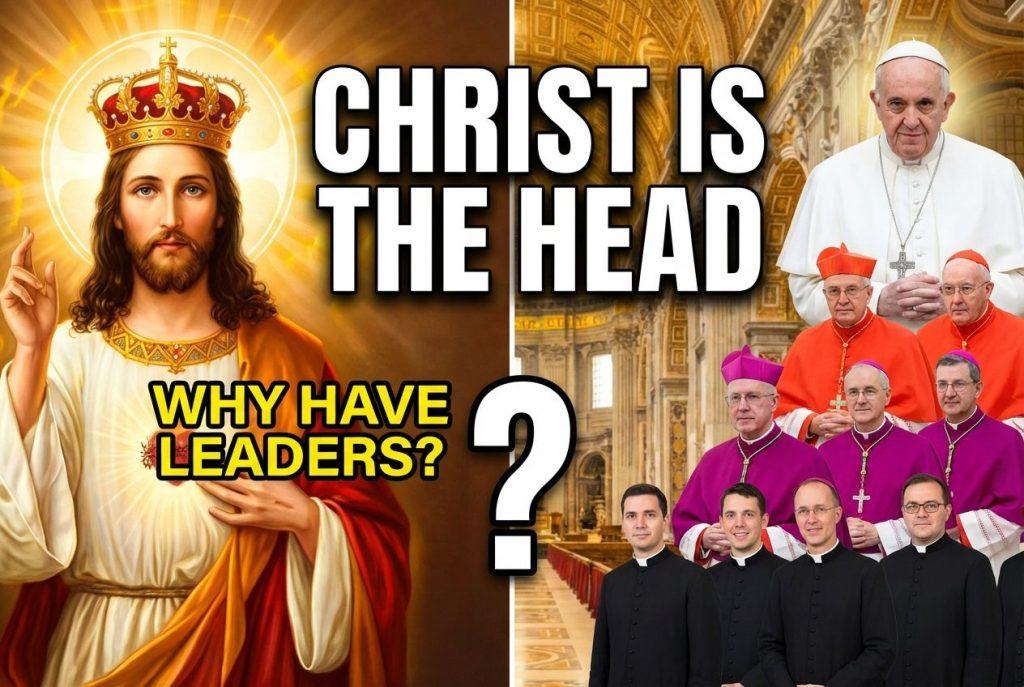
- Christ established the Church with a visible structure that includes human leaders to continue his mission on earth until his return.
- The appointment of leaders does not diminish Christ’s headship but rather serves as the means by which he exercises his authority in the world.
- Bishops and priests act as instruments through which Christ himself teaches, sanctifies, and governs his people in every age.
- The apostolic ministry originated with Christ’s direct commission to the Twelve and continues through apostolic succession to the present day.
- Human leadership in the Church reflects the sacramental principle that God works through visible signs and human agents to communicate divine grace.
- The hierarchical structure protects the unity of the Church and ensures the authentic transmission of Christian faith across generations.
The Foundation of Christ’s Headship
Christ remains the one true head of his Church in every age, exercising supreme authority over all creation. The Letter to the Ephesians makes this truth abundantly clear when it describes how God placed all things beneath Christ’s feet and gave him as head over all things to the Church, which is his body. This headship means that Christ possesses complete power and sovereignty over the community he founded. His authority derives from his divine nature as the eternal Son of God and from his redemptive work on the cross. No human leader can claim the unique position that Christ holds as the source of all life and grace within the Church. The relationship between Christ and his Church mirrors that of a head to a body, with Christ providing direction, vitality, and purpose to every member. This fundamental truth forms the basis for understanding why the Church needs visible leaders, because these leaders serve as Christ’s chosen instruments for exercising his ongoing headship. The visible structure of leadership does not replace Christ’s authority but makes it present and active in specific times and places. Christ works through human agents precisely because he chose to establish his Church as a visible community in history.
The doctrine of Christ’s headship appears throughout the New Testament writings, particularly in the Pauline letters. Saint Paul consistently emphasizes that Christ alone holds the position of head, while all believers form the body that receives life from him. In the Letter to the Colossians, Paul writes that Christ is the head of the body, the Church, and that in him all things hold together. This teaching reveals that Christ’s headship involves both authority and life-giving power. He governs the Church not as a distant ruler but as one intimately connected to every member, sustaining each person through his continued presence. The image of head and body illustrates the organic unity between Christ and his people, a unity that transcends mere organizational structure. Christ’s headship operates through the Holy Spirit, whom he sent at Pentecost to animate the Church and guide it into all truth. The Spirit proceeds from Christ and works in cooperation with human ministers to accomplish the Church’s mission. This means that when the Church speaks and acts through its legitimate leaders, Christ himself speaks and acts through them.
The question of why Christ would appoint human leaders when he himself serves as head stems from a misunderstanding of how divine authority operates in the world. God consistently chooses to work through created means rather than bypassing the natural order entirely. Throughout salvation history, God raised up prophets, judges, and kings to lead his people, even though he himself remained their true shepherd and king. The incarnation itself demonstrates this principle most clearly, as God took on human flesh to accomplish the work of redemption. Christ did not consider it beneath his dignity to use human instruments for divine purposes. Instead, he elevated human nature by choosing to associate human beings with his own mission and authority. The appointment of leaders in the Church follows this same pattern of divine condescension. Christ shares his mission with chosen individuals not because he needs their help but because he desires to include them in his work. This inclusion ennobles human nature and reveals God’s intention to save people not merely as isolated individuals but as members of a visible community with a recognizable structure.
The Institution of Apostolic Ministry
Christ’s public ministry included the deliberate selection and formation of twelve apostles who would continue his work after his ascension. The Gospels record that Jesus called these men individually, gave them special instruction, and sent them out to preach with his own authority. This calling represents the beginning of the hierarchical structure that characterizes the Catholic Church. Jesus did not establish a formless community where everyone possessed equal authority and responsibility. Rather, he created a definite structure with designated leaders who received specific powers from him. The number twelve holds symbolic significance, representing the twelve tribes of Israel and indicating that Jesus was establishing a new Israel, the Church. These apostles accompanied Jesus throughout his ministry, witnessed his miracles, received his teaching, and were present at crucial moments in his life. Their unique position as eyewitnesses of the resurrection gave them special authority to testify about Christ and establish doctrine for the whole Church.
The apostles received their commission directly from the risen Christ in the days following his resurrection. In the Gospel of John, Jesus appears to his disciples and tells them that as the Father sent him, so he sends them. This statement establishes a clear line of authority flowing from the Father through the Son to the apostles. The mission of the apostles derives from and participates in Christ’s own mission. Jesus then breathes on them and gives them the Holy Spirit, along with the power to forgive sins. This dramatic gesture recalls the creation of Adam when God breathed life into him, suggesting that Jesus was creating a new humanity through his chosen apostles. The gift of the Holy Spirit empowers the apostles to carry out the ministry entrusted to them. In the Gospel of Matthew, Jesus declares that all authority in heaven and on earth has been given to him, and on the basis of this authority, he commands the apostles to make disciples of all nations. The Great Commission expresses the universal scope of the apostolic mission and places upon these men the responsibility for spreading the Gospel to every corner of the earth.
Christ equipped the apostles with specific powers necessary for leading the Church. He gave them authority to teach in his name, promising that whoever listens to them listens to him. This teaching authority extends beyond merely repeating words Jesus spoke during his earthly ministry; it includes the ability to explain and apply his teaching to new situations under the guidance of the Holy Spirit. Jesus also gave the apostles the power to sanctify through the administration of sacraments. The command to baptize in the name of the Father, Son, and Holy Spirit entrusts to them the means of initiating new members into the Church. Similarly, the institution of the Eucharist at the Last Supper when Jesus told the apostles to “do this in memory of me” gives them the authority to celebrate the sacred mysteries. The power to forgive sins, explicitly granted in John 20:23, constitutes another essential element of apostolic ministry. Finally, Jesus gave the apostles governing authority to make decisions binding on the whole Church, as illustrated by the promise that whatever they bind on earth will be bound in heaven.
The apostles understood their ministry as a sacred trust to be passed on to successors. The Acts of the Apostles records how the Eleven moved quickly to replace Judas, demonstrating their conviction that the apostolic college needed to remain intact. Throughout the New Testament letters, we see the apostles appointing other men to continue the work of leading local churches. Paul speaks of appointing elders in every town and instructs Timothy and Titus regarding the qualifications for bishops and deacons. These appointments involved a formal ritual of laying on of hands, signifying the transmission of spiritual authority. The apostles recognized that their eyewitness role could not be passed on, since only they had seen the risen Lord, but the ministry of teaching, sanctifying, and governing the Church necessarily continued beyond their lifetimes. This need for ongoing leadership arose from Christ’s promise to remain with his Church until the end of the age. If the Church was to endure until Christ’s return, it required a stable structure of authority to maintain unity and preserve authentic teaching.
The Nature of Apostolic Succession
The Catholic Church teaches that the bishops stand as successors to the apostles, inheriting their mission and authority through an unbroken chain of ordinations extending back to apostolic times. This doctrine of apostolic succession preserves the continuity between the Church of the apostles and the Church of every subsequent generation. Each validly ordained bishop can trace his ordination through a series of bishops back to one of the Twelve. This historical connection ensures that the ministry exercised in the Church today remains the same ministry established by Christ. Apostolic succession involves more than merely a historical chain of ordinations; it includes the transmission of authentic doctrine and the preservation of the sacramental life of the Church. The bishops teach the same faith that the apostles received from Christ, guard the deposit of revelation from corruption, and celebrate the same sacraments instituted by the Lord.
The Catechism of the Catholic Church explains that the Church was built on the foundation of the apostles and remains so built (CCC 857). This foundation includes both the once-for-all testimony of the apostles as eyewitnesses of Christ and the ongoing ministry of teaching and governing exercised by their successors. The bishops do not receive new revelations or add to the deposit of faith; rather, they faithfully transmit what they have received. Their authority derives entirely from Christ, who continues to act through them by the power of the Holy Spirit. The Second Vatican Council taught that bishops, by divine institution, have succeeded to the place of the apostles as shepherds of the Church. This succession occurs through the sacrament of Holy Orders, which configures the recipient to Christ and grants the grace necessary for carrying out episcopal ministry. The laying on of hands by other bishops in apostolic succession transmits the gift of the Holy Spirit that comes down from the apostles.
The episcopal college, with the Pope as its head, possesses supreme authority over the universal Church, but this authority exists in dependence on Christ the true head (CCC 880-883). The Pope, as successor of Peter, serves as the visible principle of unity for the whole Church and possesses a unique role in confirming his brother bishops in the faith. The college of bishops together with the Pope exercises the highest teaching authority when defining matters of faith and morals. This collegial structure reflects the relationship among the apostles themselves, who formed a body under Peter’s leadership. Individual bishops hold authority over their particular dioceses but remain in communion with the whole episcopal college and with the Bishop of Rome. This communion ensures that the local church truly forms part of the one, holy, catholic, and apostolic Church. The necessity of maintaining communion with the successor of Peter distinguishes the Catholic understanding of apostolic succession from that of some other Christian communities.
The doctrine of apostolic succession answers the question of how the Church can maintain unity and authentic teaching across twenty centuries. Without a clear line of authority connecting each generation to the apostles, the Church would fragment into countless competing interpretations of Christian faith. The bishops, as successors of the apostles, provide stability and continuity in an otherwise chaotic world. Their ministry ensures that the Church today teaches the same truths that Christ entrusted to the Twelve. This continuity does not mean that the Church’s understanding of doctrine never develops or deepens. The Holy Spirit continues to lead the Church into fuller understanding of the mysteries of faith. However, such development occurs under the guidance of the magisterium, which prevents innovation that would contradict previous teaching. The apostolic succession thus serves as a safeguard for the integrity of Christian revelation and a guarantee that the Church remains faithful to its apostolic foundation.
Christ’s Presence Through His Ministers
The Catholic Church teaches that ordained ministers act “in the person of Christ the Head” when exercising their sacred ministry. This teaching appears throughout the documents of the Second Vatican Council and receives detailed treatment in the Catechism (CCC 1548-1551). The phrase “in the person of Christ” means that the priest or bishop serves as more than a mere delegate of the community or a representative elected by the people. Rather, Christ himself acts through the ordained minister, making his own presence visible and effective in the community. When a priest celebrates the Eucharist, Christ offers himself to the Father through the priest’s words and actions. When a bishop teaches authoritatively on matters of faith, Christ speaks through him. When a priest absolves sins in the sacrament of Reconciliation, Christ forgives through the priest’s ministry. This identification between Christ and his ministers does not erase their human personality or make them sinless, but it means that the validity and effectiveness of the sacraments does not depend on the personal holiness of the minister.
This sacramental principle resolves the apparent tension between Christ’s unique headship and the existence of human leaders in the Church. The leaders do not replace Christ or diminish his authority; they make his authority present and active in concrete historical situations. Christ chose to exercise his headship through visible human instruments, just as he chose to accomplish redemption through the visible humanity he assumed in the incarnation. The Church continues the incarnation in a certain sense by making Christ’s invisible presence visible through human ministers. This visibility serves the needs of human nature, which requires tangible signs and sensible realities to encounter the divine. If Christ had established an invisible church with no definite structure or leadership, individuals would have no way to distinguish authentic Christian teaching from personal opinions. The hierarchical structure, with bishops and priests acting in the person of Christ, provides certainty and stability for believers seeking truth.
The ordained minister exercises his ministry not for personal gain or glory but in service to the Church. The Catechism emphasizes that ministerial priesthood exists to serve the common priesthood of all the faithful (CCC 1547). This means that bishops and priests use their authority to build up the body of Christ, not to dominate or control the laity. Christ’s example of washing the disciples’ feet at the Last Supper provides the model for all Christian leadership. Those who hold positions of authority in the Church must see themselves as servants of their brothers and sisters. The temptation to abuse authority or to seek worldly power contradicts the essential nature of ministry in Christ’s name. When scandals occur involving Church leaders, they represent failures to live up to the demands of their vocation rather than defects in the structure itself. The possibility of human failure does not invalidate the principle that Christ works through ordained ministers.
The relationship between Christ and his ministers resembles the relationship between an artist and his instruments. A skilled musician plays through a violin, making beautiful music that the instrument could never produce on its own. Similarly, Christ acts through ordained ministers to accomplish works that exceed human capacity. The minister becomes transparent to Christ when he humbly submits his will and gifts to divine service. This transparency allows others to encounter Christ himself in the ministry of the Church. The ordained minister does not draw attention to himself but points beyond himself to the one who sends him. This self-effacing quality characterizes authentic Christian ministry at its best. The faithful come to Mass not to see the priest but to encounter Christ in the Eucharist. They approach the sacrament of Reconciliation not to confess to a man but to receive forgiveness from God through the ministry of the Church.
The Practical Necessity of Leadership
The Church requires visible leadership for purely practical reasons related to human nature and social organization. Any community of significant size needs some form of governance to maintain order and coordinate activities toward common goals. The Church, as a society of millions of believers spread across every nation, obviously requires leaders to make decisions, resolve disputes, and ensure that the mission of evangelization proceeds effectively. Christ understood human nature perfectly, having created it, and he structured the Church in a way suited to human needs and capacities. The appointment of leaders prevents the chaos that would result from every individual claiming equal authority to interpret Scripture and define doctrine. History demonstrates the multiplication of Christian denominations that occurs when communities reject apostolic authority and attempt to base everything on private interpretation of the Bible.
Leaders in the Church serve essential functions that cannot be fulfilled by the community as a whole. They provide authoritative teaching that settles doctrinal disputes and prevents the spread of false ideas. The magisterium exercises this teaching authority on behalf of the whole Church, not by inventing new doctrines but by clarifying the authentic meaning of revelation. Without such authority, endless arguments would arise over every aspect of Christian belief and practice. The bishops also coordinate the missionary activity of the Church, sending priests and religious to evangelize new territories and establishing new dioceses as the faith spreads. They ordain new priests to celebrate the sacraments and care for the faithful. They confirm young people in their faith and bless marriages. These specific functions require the sacramental powers that come through Holy Orders. The community cannot simply elect someone to perform these roles; valid ordination requires the laying on of hands by a bishop in apostolic succession.
The need for leadership becomes especially evident in times of crisis or controversy. Throughout Church history, heresies have arisen that threatened to corrupt the faith and divide the community. The bishops, gathering in councils or teaching individually in their dioceses, have responded to these threats by defining orthodox belief more precisely. The Council of Nicaea addressed the Arian heresy by declaring the Son consubstantial with the Father. The Council of Chalcedon defined the relationship between Christ’s divine and human natures. The Council of Trent responded to the Protestant Reformation by clarifying Catholic teaching on justification, the sacraments, and Scripture. These conciliar definitions protected the faith of ordinary believers who lacked the theological training to evaluate complex arguments. The faithful could trust that the bishops, guided by the Holy Spirit, would preserve the authentic teaching of Christ. This trust remains essential today when Catholics face new challenges from secularism, relativism, and various ideologies incompatible with Christian truth.
Leadership also serves the crucial function of maintaining unity within the Church. Christ prayed that his disciples might be one, just as he and the Father are one. This unity requires more than good will or shared sentiment; it demands a visible bond of communion centered on legitimate authority. The Pope, as universal shepherd, serves as the focal point for Catholic unity worldwide. Catholics in Asia, Africa, Europe, and the Americas all recognize the same leader and profess the same faith. This remarkable unity across diverse cultures and nations testifies to the effectiveness of the hierarchical structure. When local churches remain in communion with the Bishop of Rome and with each other, they manifest the catholicity that characterizes the true Church of Christ. The alternative, seen in the fragmentation of Protestant Christianity, demonstrates what happens when communities reject the authority of apostolic succession. Without a recognized teaching authority to settle disputes, disagreements lead inevitably to division and the formation of new denominations.
The Sacramental Dimension of Leadership
The Church’s leaders receive their authority not through election or appointment by human power but through the sacrament of Holy Orders. This sacrament confers a sacred character that permanently configures the recipient to Christ the priest, prophet, and king (CCC 1581-1584). The ordained man receives supernatural grace that enables him to fulfill the responsibilities of his ministry. This sacramental dimension distinguishes Catholic leadership from purely human forms of governance. A bishop or priest does not simply occupy an office or hold a position; he has been ontologically changed by the sacrament. The character imprinted by ordination remains forever and cannot be removed or repeated. Even if a man is removed from ministry due to misconduct or other reasons, he retains the priestly character. The permanent nature of this character reflects the permanence of Christ’s own priesthood.
The rite of ordination itself reveals the sacred nature of ministerial authority. The central action consists of the laying on of hands by the ordaining bishop while he prays for the outpouring of the Holy Spirit upon the candidate. This gesture recalls similar actions throughout Scripture, from Moses laying hands on Joshua to the apostles laying hands on the Seven in Acts. The laying on of hands signifies the transmission of authority and the gift of the Spirit. The consecratory prayer specifies the particular grace being requested for each order. For bishops, the prayer asks that God grant the grace to govern, teach, and sanctify the Church. For priests, it asks for the grace to offer sacrifice and preach the Gospel. The visible action of laying on hands makes clear that ordination involves the conferral of real spiritual power, not merely a community’s recognition of someone’s gifts. The sacrament transforms the man and equips him for a ministry he could not perform by natural ability alone.
The sacramental nature of leadership protects the Church from dependence on human merit or talent. God can work through weak instruments just as effectively as through strong ones. The validity of the sacraments celebrated by a priest does not depend on his personal sanctity but on his possession of valid orders and his intention to do what the Church does. This principle, established definitively by Augustine during the Donatist controversy, provides great security for the faithful. They need not worry whether their confessor is holy enough to forgive sins or whether their parish priest celebrates the Eucharist worthily enough to make Christ present. Christ himself acts through the sacraments, using the minister as his instrument regardless of the minister’s personal worthiness. This does not excuse sinful behavior by clergy or suggest that personal holiness is unimportant. Ministers should strive for sanctity and serve as models of Christian living. However, the effectiveness of their ministry does not depend entirely on their virtue.
The three degrees of Holy Orders correspond to different levels of participation in Christ’s ministry. The episcopate represents the fullness of the sacrament, incorporating the bishop into the apostolic college and making him the visible head of a particular church. Bishops possess the complete power to teach, sanctify, and govern, and they alone can ordain new bishops, priests, and deacons (CCC 1555-1561). The presbyterate unites priests with the episcopal order in sacerdotal dignity, making them cooperators with the bishops in the care of souls. Priests depend on their bishop for the exercise of their authority, but they share in the one priesthood of Christ and can celebrate most sacraments. The diaconate constitutes the lowest degree of Holy Orders, ordained not to priesthood but to service. Deacons assist bishops and priests in liturgical functions, preach the Gospel, and dedicate themselves to works of charity. This threefold structure has existed in the Church since ancient times and reflects the diversity of ministries necessary for the Church’s life and mission.
The Unity of the Mystical Body
The image of the Church as the Body of Christ, with Christ as the head and all believers as members, illuminates the relationship between divine headship and human leadership. This Pauline image appears frequently in the New Testament and forms a central element of Catholic teaching (CCC 787-795). In a human body, the head governs and directs the other members, but it does not act independently of them. Rather, the head and body function as one organic whole. Similarly, Christ and the Church form one mystical person, with Christ exercising his headship through the members of his body. The ordained ministers serve as particular instruments of Christ’s headship, but all members contribute to the body’s life and mission according to their respective vocations. The unity of head and body means that what Christ does, the Church does, and what the Church does, Christ does.
This unity does not eliminate distinction of roles and functions within the body. Saint Paul emphasizes that the body has many members with different gifts and ministries. The eye cannot say to the hand that it has no need of it, nor can the head say to the feet that they are unnecessary. Each member contributes uniquely to the whole, and none can claim superiority over the others. Within this diverse body, ordained ministers exercise specific functions that other members cannot perform. They represent Christ the head in a special way by possessing the sacramental power to teach authoritatively, celebrate the Eucharist, forgive sins, and govern the Church. The laity exercise the common priesthood received in baptism by offering spiritual sacrifices, evangelizing in their daily lives, and sanctifying the temporal order. Religious men and women witness to the eschatological nature of the kingdom through their vows of poverty, chastity, and obedience.
The hierarchical structure of the Church serves the unity and communion of the mystical body. The bishops, in communion with the Pope, ensure that all local churches remain united in faith and charity. They prevent divisions that would fragment the body and weaken its witness to the world. The authority exercised by Church leaders aims always at building up the body, never at tearing it down. When the magisterium defines a doctrine or establishes a disciplinary norm, it acts for the good of the whole Church. Individual members may not always understand or appreciate particular decisions, but trust in the guidance of the Holy Spirit enables them to accept authoritative teaching with docility. This obedience to legitimate authority forms part of the virtue of faith, recognizing that God guides his Church through visible pastors. Resistance to Church authority often stems from pride or from an exaggerated sense of personal autonomy incompatible with membership in a body.
The mystery of the Church as Christ’s body reveals that human leaders do not come between Christ and individual believers. Rather, they unite believers more closely to Christ by incorporating them into his body. Through baptism administered by a minister of the Church, a person becomes a member of Christ. Through the Eucharist celebrated by an ordained priest, believers receive the body and blood of Christ and are transformed into what they receive. Through the ministry of teaching, bishops proclaim Christ’s truth and lead people to deeper faith. Far from separating Christ from his people, the hierarchical structure serves as the means by which Christ remains present and active among his followers. To reject the authority of the Church’s pastors is, in effect, to reject Christ who sent them. To accept their ministry with faith is to encounter Christ himself in the sacraments and teaching of the Church.
Responding to Objections
Some Christians question whether a hierarchical structure agrees with the Gospel’s emphasis on equality and service. They point to Jesus’s words about not lording it over others as the Gentiles do and about being servants of all. These passages do indeed establish important principles for Christian leadership, but they do not eliminate the need for authority and structure. Jesus spoke these words to the apostles themselves, the very men he was establishing as leaders of the Church. The point is not that no one should lead but that Christian leaders must exercise authority differently from worldly rulers. They lead by serving, they teach by example, and they govern with love rather than coercion. The hierarchical structure exists to facilitate service, not to create a privileged class. The pope traditionally refers to himself as “servant of the servants of God,” indicating that even the highest authority is exercised for the benefit of others.
Another objection holds that the institution of leaders conflicts with the priesthood of all believers mentioned in the New Testament. Saint Peter writes that Christians form a royal priesthood, a holy nation, and that they offer spiritual sacrifices acceptable to God. These texts refer to the common priesthood that all believers receive through baptism. The Catechism teaches that this common priesthood and the ministerial priesthood, while ordered to each other, differ in essence and not only in degree (CCC 1547). All Christians participate in Christ’s priesthood through baptism, but this participation takes different forms. The laity exercise their priesthood by offering their lives as living sacrifices and by sharing in the Church’s mission of evangelization. The ordained exercise the ministerial priesthood by acting in the person of Christ to serve the common priesthood. Far from contradicting the universal priesthood, ordained ministry supports and enables it by providing the sacraments and teaching necessary for Christian life.
Some argue that the appointment of leaders represents a later development not intended by Christ, who supposedly envisioned a more egalitarian community. Historical evidence contradicts this claim. The New Testament clearly describes the apostles exercising authority, appointing successors, and establishing leaders in local churches. The earliest Christian writings outside the New Testament, such as the letters of Ignatius of Antioch from around 110 AD, refer to a threefold ministry of bishops, priests, and deacons. The structure of ordained leadership appears as early as we can trace the Church’s organization. Claims that a leaderless or democratic church existed in apostolic times and only later gave way to hierarchy lack any solid historical foundation. The consistent witness of tradition supports the Catholic understanding that Christ himself established the Church’s hierarchical structure.
The existence of unworthy leaders throughout Church history raises questions about whether Christ truly works through such flawed instruments. Scandals involving clergy can shake people’s faith and lead them to question the divine origin of Church authority. However, the unworthiness of some ministers does not invalidate the principle that Christ acts through his Church. Jesus himself chose Judas as one of the Twelve, knowing he would betray him. Peter denied Christ three times yet became the leader of the apostles. Human weakness and sin have always existed among Church leaders because ordination does not remove free will or guarantee virtue. The sacraments remain valid even when celebrated by sinful priests because their efficacy comes from Christ, not from the minister. The Church’s teaching remains true even when some bishops fail to live up to it. Believers should pray for their pastors, call them to holiness, and support those who lead faithfully, while recognizing that the treasure of faith is carried in earthen vessels.
The Distinction Between Kinds of Authority
Catholic teaching carefully distinguishes between different types of authority exercised in the Church. Christ possesses supreme and universal authority as head, extending over every aspect of creation. His authority is absolute, requiring no confirmation or validation from any other source. The Pope exercises supreme authority over the Church as Christ’s vicar on earth, but this authority is ministerial rather than absolute. He serves the truth rather than creating it and remains bound by revelation and tradition. The bishops possess ordinary authority in their dioceses, teaching, sanctifying, and governing the particular churches entrusted to them. Their authority exists in subordination to the Pope and in communion with the whole episcopal college. Priests exercise authority delegated by their bishops in specific pastoral assignments. These distinctions prevent confusion about the nature and limits of ecclesial authority.
All legitimate authority in the Church flows from Christ and participates in his authority. When the magisterium teaches definitively on faith and morals, it does so with Christ’s own authority, guaranteed from error by the Holy Spirit. The faithful owe religious submission of will and intellect to such teaching, recognizing it as the voice of Christ speaking through his Church. Non-definitive teaching requires respectful attention and a presumption in its favor, though it does not demand the absolute assent owed to defined doctrine. Disciplinary authority governs matters of Church law and practice, which can change over time according to pastoral needs. The faithful should obey legitimate disciplinary norms out of respect for authority and concern for order, even when they might prefer different policies. The distinction between doctrinal and disciplinary authority helps believers understand how the Church can maintain unchanging truth while adapting pastoral practices to new situations.
The scope of Church authority extends only to matters related to faith, morals, and the Church’s internal governance. Bishops and popes do not possess competence to make authoritative pronouncements about scientific theories, political systems, or other purely temporal matters. When Church leaders address such topics, they do so as thoughtful observers applying moral principles to complex situations, not as infallible teachers. Catholics remain free to hold different political views or scientific theories as long as these do not contradict defined doctrine or moral teaching. The Church respects the proper autonomy of temporal realities and does not seek to dominate secular affairs. This limitation on ecclesiastical authority protects both the Church and civil society from inappropriate mixing of distinct domains.
The authority of Church leaders ultimately serves the freedom of God’s children rather than restricting it. Authentic freedom consists in knowing and choosing the truth, not in having unlimited options. Church teaching frees believers from the burden of having to figure out everything for themselves and from the danger of falling into serious error. The definitive teachings of the magisterium provide firm ground on which to stand in a world of shifting opinions. Believers can trust these teachings and build their lives on them without constant anxiety about whether they have understood correctly. Far from imposing arbitrary restrictions, Church authority guides people toward the truth that will set them free. The commandments and moral norms taught by the Church protect human dignity and promote genuine flourishing. When people experience these teachings as burdensome, it often reflects the distortion of sin rather than any defect in the teachings themselves.
Living Under Church Authority
Catholics approach Church authority with an attitude of faith, trust, and docility. This stance does not require blind obedience or the suppression of questions and doubts. Mature faith includes the capacity to ask questions, seek understanding, and even struggle with difficult teachings. However, the faithful recognize that their personal judgment does not override the teaching authority of the bishops in communion with the Pope. When Church teaching conflicts with personal opinion or current cultural assumptions, the appropriate response involves carefully studying the teaching, praying for understanding, and humbly accepting what the Church proposes for belief. This humility acknowledges that two thousand years of collective wisdom and the guidance of the Holy Spirit provide a more reliable guide than individual insight.
Respect for authority includes presuming good will on the part of Church leaders and giving them the benefit of the doubt in ambiguous situations. While maintaining appropriate vigilance against abuse of power, Catholics should avoid the cynicism and suspicion that characterize contemporary attitudes toward all authority. The presumption should be that bishops and priests act from sincere concern for souls, even when their decisions seem questionable. Public criticism of Church leaders should be measured and charitable, focusing on substantive issues rather than personal attacks. Disagreement with prudential judgments or disciplinary policies does not justify schismatic attitudes or public dissent that scandalizes others. Those who believe that particular leaders err in judgment should pray for them, offer charitable counsel when possible, and appeal to higher authority when appropriate.
The relationship between clergy and laity in the Church ideally reflects mutual respect, cooperation, and genuine partnership in mission. Ordained ministers depend on the laity for support, both material and spiritual, and benefit from their expertise in temporal affairs. The laity depend on priests and bishops for the sacraments, authentic teaching, and pastoral guidance. This interdependence creates a healthy dynamic when both parties fulfill their proper roles. Problems arise when clergy adopt an authoritarian style that excludes lay participation in appropriate areas or when laity reject legitimate authority and demand control over matters reserved to ordained ministry. The Second Vatican Council called for greater lay involvement in the Church’s mission, but this involvement occurs within the framework of the Church’s hierarchical structure rather than replacing it.
Catholics witness to the world by demonstrating how authority can be exercised in a manner consistent with human dignity and freedom. In an age characterized by suspicion of all hierarchy and authority, the Church’s faithful adherence to apostolic structure offers an alternative vision. This alternative shows that authority need not corrupt or oppress when it is exercised in service and in submission to objective truth. The example of Christ-like leadership challenges both secular society’s rejection of authority and its tendency toward authoritarianism. Church leaders who genuinely serve their people rather than dominating them reveal what authority ought to be. Believers who freely accept this authority without servility demonstrate that obedience to truth enhances rather than diminishes human freedom. Together, pastors and faithful manifest the mystery of the Church as a communion of persons united in love under Christ’s headship, mediated through human instruments chosen and consecrated for this sacred task.
Disclaimer: This article presents Catholic teaching for educational purposes. For official Church teaching, consult the Catechism and magisterial documents. For personal spiritual guidance, consult your parish priest or spiritual director. Questions? Contact editor@catholicshare.com
Sign up for our Exclusive Newsletter
- 📌 Add CatholicShare as a Preferred Source on Google
- 🎁 Join us on Patreon for Premium Content
- 🎧 Check Out These Catholic Audiobooks
- 📿 Get Your FREE Rosary Book
- 📱 Follow Us on Flipboard
-

Recommended Catholic Books
Discover hidden wisdom in Catholic books — invaluable guides enriching faith and satisfying curiosity. #CommissionsEarned
- The Early Church Was the Catholic Church
- The Case for Catholicism - Answers to Classic and Contemporary Protestant Objections
- Meeting the Protestant Challenge: How to Answer 50 Biblical Objections to Catholic Beliefs
As an Amazon Associate, I earn from qualifying purchases. Thank you for your support.