
Brief Overview
- Christ possesses divine omnipresence as the Second Person of the Trinity, making Him present everywhere by His divine nature.
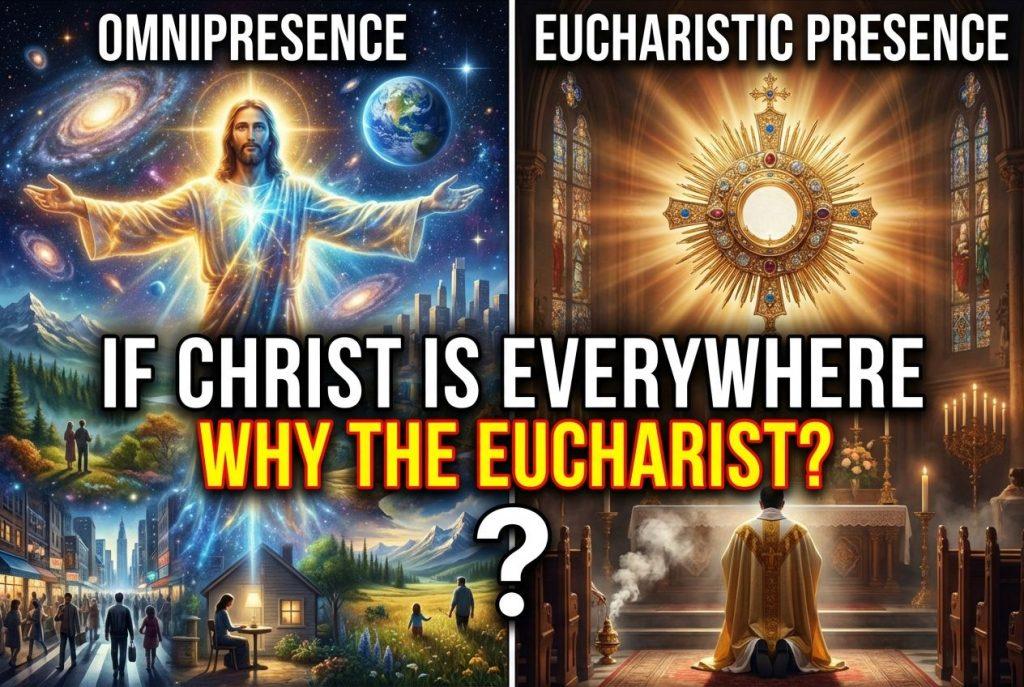
- The Eucharistic presence represents a unique mode of Christ’s presence that differs fundamentally from His general omnipresence throughout creation.
- In the Eucharist, Christ becomes present substantially with His Body, Blood, Soul, and Divinity under the appearances of bread and wine.
- This substantial presence fulfills Christ’s specific promise to remain with His Church in a sacramental way after His visible departure from earth.
- The Eucharist serves as the source and summit of Christian life, providing a concrete encounter with the Risen Lord that nourishes spiritual growth.
- God’s choice to be present in this particular way demonstrates His accommodation to human nature, which requires physical signs to encounter divine realities.
Understanding Different Modes of Presence
The question of why Catholics need the Eucharist when Christ is already present everywhere touches on a fundamental truth about God’s relationship with His creation. God exists beyond the limitations of space and time. His divine nature means He sustains all things in existence at every moment. Nothing exists apart from God’s creative and sustaining power. The Second Person of the Trinity, Jesus Christ, shares this divine omnipresence in His divine nature. As the Catechism teaches, Christ is present in many ways to His Church, including in His word, in the Church’s prayer, in the poor and suffering, and in the sacraments (CCC 1373). However, the real presence of Christ in the Eucharist represents something qualitatively different from His general presence throughout creation. This unique mode of presence addresses the human need for tangible encounters with the divine and fulfills specific promises Christ made to His disciples before His Ascension.
The Catholic understanding recognizes that not all forms of presence carry the same depth or character. When we say God is present everywhere, we mean He exists as the source and sustainer of all being. Every molecule, every atom, every quantum particle exists only because God continuously wills it into existence. This providential presence reflects God’s power and creative action. Yet this universal presence differs from the way God chose to be present in particular places and times throughout salvation history. God manifested His presence in special ways in the Old Testament, dwelling above the Ark of the Covenant in the Holy of Holies. He appeared to Moses in the burning bush, led Israel as a pillar of cloud and fire, and filled the Temple with His glory. These specific manifestations did not negate God’s omnipresence but rather represented His choice to reveal Himself in particular ways for the sake of His people. The Incarnation itself demonstrates this principle most fully, as the eternal Word became flesh and dwelt among us in a specific time and place.
The Eucharistic presence continues this pattern of God’s self-revelation through particular means. Christ’s divine nature remains omnipresent, but in the Eucharist, He makes Himself present according to both His divine and human natures. The Council of Trent definitively taught that the whole Christ is truly, really, and substantially contained in the Eucharist (CCC 1374). This means the glorified body that rose from the tomb, ascended into heaven, and sits at the right hand of the Father becomes present on our altars. His human nature, which is not omnipresent, becomes locally present in each validly consecrated host. This substantial presence goes beyond Christ’s spiritual presence in prayer or His presence through grace in the soul. It constitutes a real, physical presence of Christ’s body and blood, even though this presence exists under sacramental signs that hide His glory from our physical senses.
Understanding this distinction helps answer why the Eucharist matters when Christ is already everywhere. The difference lies not in Christ’s willingness to be with us but in the mode and purpose of His presence. His omnipresence sustains our existence moment by moment. His presence in Scripture speaks to our minds and hearts. His presence in the poor challenges us to see Him in the least among us. His presence in the gathered assembly manifests wherever two or three gather in His name, as He promised in Matthew 18:20. Yet the Eucharistic presence offers something these other modes cannot provide: the substantial presence of Christ’s humanity united with His divinity. In receiving Holy Communion, we do not simply encounter Christ spiritually or symbolically. We receive into our very bodies the Body, Blood, Soul, and Divinity of Jesus Christ. This intimate union surpasses all other forms of Christ’s presence in its depth and transformative power.
The mode of Christ’s presence in the Eucharist also differs in its permanence and purpose. The consecrated elements remain the Body and Blood of Christ as long as the appearances of bread and wine remain, which is why Catholics reserve the Blessed Sacrament in tabernacles and practice Eucharistic adoration (CCC 1377). Christ remains truly present in the consecrated hosts even outside of Mass, available for adoration and for bringing to the sick and homebound. This enduring presence allows the faithful to return again and again to spend time in the Lord’s company. The Eucharistic presence specifically serves the purpose of nourishing the faithful with the bread of eternal life. As Christ taught in the Bread of Life discourse recorded in John 6, those who eat His flesh and drink His blood have eternal life and will be raised on the last day. This spiritual nourishment requires the real, substantial presence of Christ’s body and blood, not merely His spiritual presence or the memory of His sacrifice.
The Church has always recognized that Christ’s various modes of presence work together harmoniously rather than competing with one another. His omnipresence as God does not make the Incarnation unnecessary, and the Incarnation does not make the Eucharist redundant. Each reveals something essential about God’s desire for communion with humanity. The Incarnation shows that God chose to enter fully into human existence, taking on flesh to redeem us from within our own nature. The Eucharist extends this intimate presence throughout time and space, making the fruits of the Incarnation and Paschal Mystery available to every generation. Through the Eucharist, Christ remains with His Church in a tangible way until He comes again in glory. This sacramental presence bridges the time between Christ’s Ascension and His Second Coming, ensuring that no generation lacks access to His saving presence.
Biblical Foundations of the Eucharistic Presence
Scripture provides the foundation for understanding why Christ established the Eucharist as a unique mode of His presence among His people. The Gospel of John presents Christ’s teaching about the Eucharist most extensively in what scholars call the Bread of Life discourse. This extended teaching, found in John 6, begins after Jesus feeds the multitude with five loaves and two fish. The crowds follow Jesus seeking more bread, and He takes this opportunity to teach them about the true bread from heaven. Christ declares that He Himself is the living bread that came down from heaven and that whoever eats this bread will live forever. He then makes the stunning statement that the bread He will give is His flesh for the life of the world. This claim provokes intense debate among His listeners, who ask how He can give them His flesh to eat.
Rather than softening His language or clarifying that He spoke only symbolically, Jesus intensifies His teaching. He solemnly declares that unless people eat the flesh of the Son of Man and drink His blood, they have no life in them. Those who eat His flesh and drink His blood have eternal life, and He will raise them up on the last day. The Greek word Jesus uses for “eat” in these verses is particularly strong and graphic, suggesting the action of chewing or gnawing. This choice of language emphasizes the concrete, physical reality of what He promises to give His followers. Many disciples find this teaching too difficult to accept and abandon Jesus as a result. Significantly, Jesus allows them to leave rather than calling them back to explain that He meant something merely symbolic. He turns to the Twelve and asks if they too will leave, and Peter responds with his famous confession that Jesus has the words of eternal life.
The institution of the Eucharist at the Last Supper fulfills what Jesus promised in the Bread of Life discourse. The synoptic Gospels and Paul’s First Letter to the Corinthians all record how Jesus took bread, blessed it, broke it, and gave it to His disciples with the words “This is my body.” He similarly took the cup of wine and said “This is my blood of the covenant, which is poured out for many.” The straightforward language Jesus uses admits no obvious symbolic interpretation. He does not say the bread represents His body or symbolizes His sacrifice. He identifies the bread and wine as His body and blood. The Church has understood these words literally from the beginning, seeing in them the moment when Christ transformed ordinary bread and wine into His own flesh and blood and gave His apostles the power to do the same in His memory.
Paul’s teaching in 1 Corinthians 11 reinforces the real presence of Christ in the Eucharist. Paul warns that whoever eats the bread or drinks the cup of the Lord unworthily will be guilty of profaning the body and blood of the Lord. This warning only makes sense if the consecrated elements truly are Christ’s body and blood. If they were mere symbols, eating them unworthily might show disrespect but could not constitute guilt against Christ’s actual body and blood. Paul further states that anyone who eats and drinks without discerning the body eats and drinks judgment upon himself. The gravity of Paul’s warning demonstrates the early Christian understanding that something real and substantial happens in the Eucharistic celebration. The consecrated elements become what they signify, requiring proper reverence and worthy reception.
The Old Testament prefigures the Eucharist in multiple ways that help explain its necessity and meaning. The Passover lamb, whose blood protected the Israelites from death and whose flesh they consumed in preparation for the Exodus, points forward to Christ as the true Passover lamb. Just as eating the Passover lamb was essential for Israel’s liberation and journey to the Promised Land, consuming the Eucharistic body and blood of Christ is essential for spiritual liberation and the journey to eternal life. The manna that fell from heaven to sustain Israel in the wilderness also foreshadows the Eucharist. Jesus explicitly connects Himself to the manna when He teaches about the bread from heaven. However, He emphasizes that the manna was imperfect because those who ate it eventually died. The true bread from heaven, Christ’s own flesh, gives eternal life to those who consume it.
The priesthood of Melchizedek provides another crucial Old Testament type for understanding the Eucharist. Melchizedek, king of Salem, offered bread and wine when he blessed Abraham after his victory in battle. The Letter to the Hebrews identifies Jesus as a priest forever according to the order of Melchizedek, not according to the Levitical priesthood that offered animal sacrifices. Christ’s priesthood differs because He offers Himself, and the elements of His offering are bread and wine that become His body and blood. This connection shows that the Eucharist was not a last-minute innovation but rather the fulfillment of ancient patterns woven throughout salvation history. God prepared His people gradually to receive the gift of the Eucharist through these types and foreshadowings.
The prophets also spoke of a future time when God would establish a new covenant different from the one made at Sinai. Jeremiah prophesied that God would make a new covenant, writing His law on people’s hearts rather than on stone tablets. At the Last Supper, Jesus explicitly states that His blood establishes this new covenant. The Eucharist thus serves as the sacramental sign and means of the new covenant between God and humanity. Through the Eucharist, Christ writes His law not on stone but in our very flesh by becoming one with us in Holy Communion. This intimate union transforms believers from within, conforming them more closely to Christ. The necessity of the Eucharist flows from God’s covenant faithfulness. Having promised to dwell with His people and make them His own, God provides the Eucharist as the means by which this promised intimacy becomes reality in the Church age.
The Nature of Substantial Presence
Catholic theology uses precise language to describe exactly how Christ is present in the Eucharist, and this precision helps explain why this presence differs from His omnipresence. The Church teaches that Christ’s presence in the Eucharist is “substantial,” meaning it involves the very substance of Christ Himself, not just His power or influence. Philosophy distinguishes between accidents and substance, with accidents being the properties we can perceive through our senses and substance being what something truly is in its deepest reality. In the Eucharist, the substance of bread and wine are changed entirely into the substance of Christ’s body and blood while the accidents of bread and wine remain. This change, called transubstantiation, means that what appears to our senses as bread and wine has become in its deepest reality the body and blood of Christ.
This substantial presence includes the whole Christ, body and blood, soul and divinity (CCC 1374). We do not receive only Christ’s body in the consecrated bread and only His blood in the consecrated wine. Because Christ cannot be divided, wherever His body is, there also is His blood, soul, and divinity. When we receive Holy Communion under either species, we receive the whole Christ. This completeness distinguishes Eucharistic presence from other forms of Christ’s presence. When Christ dwells in a soul through sanctifying grace, He is present spiritually but not substantially. When Christ is present where two or three gather in His name, He is present through His power and activity but not in His body and blood. The Eucharistic presence alone brings Christ’s humanity, His physical body and blood, into direct contact with the faithful.
The substantial presence begins at the moment of consecration when the priest speaks Christ’s words over the bread and wine. The Church teaches that this change happens through the power of the Holy Spirit working through the words of institution. It is not the priest’s holiness or power that accomplishes transubstantiation but Christ Himself working through His ordained minister. The consecration represents a creative act comparable to creation itself, as Christ’s words bring about a change in the deepest nature of reality. What was ordinary bread and wine becomes the body and blood of the Risen Lord. This miraculous transformation occurs silently and invisibly, perceptible only to the eyes of faith. Yet the reality of the change is no less true for being hidden from our senses.
The Eucharistic presence endures as long as the appearances of bread and wine remain intact. Christ does not come and go from the consecrated elements based on people’s faith or attention. He remains truly present in every particle of the consecrated host and every drop of the consecrated wine. This permanence explains why Catholics genuflect before the tabernacle and practice Eucharistic adoration. We acknowledge Christ’s real presence in the reserved Sacrament, honoring Him with the worship due to God alone. The Eucharistic presence is not temporary or dependent on the act of receiving Communion. It exists independently, making Christ available for adoration and contemplation by the faithful at any time.
Understanding the substantial nature of the Eucharistic presence helps clarify why this presence is necessary despite Christ’s omnipresence. Omnipresence describes God’s relation to all of creation as its source and sustainer. Substantial presence describes Christ’s relation to the consecrated elements specifically. In His omnipresence, Christ is everywhere but nowhere locally present in His humanity. In the Eucharist, Christ makes His glorified humanity present at specific locations on earth. This local presence of Christ’s humanity complements rather than contradicts His divine omnipresence. His divine nature remains present everywhere while His human nature becomes present on our altars. Both modes of presence are real, but they serve different purposes in God’s plan for salvation.
The substantial presence also explains the Church’s teaching about worthy reception of Holy Communion. Because we truly receive Christ’s body and blood into our own bodies, the state of our souls matters tremendously. To receive Christ while in a state of mortal sin would be to embrace Him physically while rejecting Him spiritually. This contradiction profanes the sacrament and brings judgment rather than blessing, as Paul warns in 1 Corinthians 11. The requirement of being in a state of grace to receive Communion flows directly from the substantial nature of Christ’s presence. We prepare to receive not merely a symbol or spiritual blessing but the Lord Himself. This preparation includes confession of mortal sins, fasting before Mass, and cultivating proper reverence and devotion.
The transformation that occurs in the Eucharist also points to the transformation Christ desires to work in those who receive Him. Just as bread and wine are changed into Christ’s body and blood, those who receive Communion are gradually transformed into Christ’s likeness. The Eucharist serves as spiritual food precisely because it nourishes this process of transformation. As physical food is absorbed into our bodies and becomes part of us, the Eucharist is meant to be absorbed into our spiritual being, making us more fully members of Christ’s body. However, unlike physical food which becomes part of us, in Holy Communion we are taken up into Christ. The greater reality absorbs the lesser, conforming us more and more to the pattern of His death and resurrection.
The Purpose of Sacramental Presence
God chose to establish the Eucharist for specific reasons related to human nature and the divine plan of salvation. Human beings are not purely spiritual creatures like angels but rather embodied souls or ensouled bodies. We experience reality through our senses and need physical signs to grasp spiritual truths. God accommodates this aspect of human nature throughout Scripture by using physical elements to convey grace and blessing. Water cleanses in baptism, oil anoints in confirmation and holy orders, bread and wine become Christ’s body and blood in the Eucharist. God works through matter because He created matter good and because we are material beings who need material means to encounter Him fully.
The Incarnation itself demonstrates God’s commitment to working through physical reality to accomplish spiritual purposes. The eternal Word did not simply appear to humanity or communicate with us from a distance. He became flesh and dwelt among us, taking on a human body with all its limitations and vulnerabilities. This choice reveals something essential about God’s character and His plan for salvation. God redeems us from within our own nature, using physical means to heal what sin has damaged. The Eucharist extends the logic of the Incarnation forward through time. Just as God once walked the earth in visible form, He continues to make Himself available in physical form through the consecrated elements. This sacramental presence allows every generation to encounter Christ in His humanity, not just His divinity.
The Eucharist specifically fulfills Christ’s promise to remain with His Church until the end of the age. After His resurrection, Jesus appeared to His disciples for forty days before ascending to heaven. His visible departure left the disciples facing a challenging question: How would they maintain contact with their Lord now that He had returned to the Father? Christ answered this question by establishing the Eucharist before His death and by promising to send the Holy Spirit after His ascension. The Spirit would guide the Church and make Christ’s presence real in the sacraments. The Eucharist thus serves as the primary means by which Christ remains with His people between His ascension and His second coming. It bridges the gap between His visible presence in first-century Palestine and His visible presence when He returns in glory.
The Eucharist also serves to unite believers with Christ and with one another in the most intimate way possible. Paul teaches that we who are many are one body because we all partake of the one bread. The Eucharist creates and strengthens the communion that defines the Church. By consuming the same body and blood of Christ, believers become more fully incorporated into His mystical body. This union transcends mere social bonding or shared beliefs. It constitutes a real, ontological connection established by the substantial presence of Christ in each communicant. The Eucharist makes the Church because it unites all who receive it to Christ and therefore to one another in Him.
This sacramental presence serves a pedagogical purpose as well, teaching us about the nature of God’s love. God’s love is not abstract or distant but concrete and immediate. He gives Himself to us without reserve, holding nothing back. In the Eucharist, Christ literally gives us His body to eat and His blood to drink. This total self-gift demonstrates the extent of divine love and teaches us how we should love others. We learn to become Eucharistic people, giving ourselves away in service and love just as Christ gives Himself to us in Holy Communion. The physical reality of the Eucharist reinforces this lesson in a way that mere teaching or symbolism cannot match. We do not just learn about Christ’s love; we consume it, making it part of our very being.
The Eucharistic presence also sustains hope for the resurrection and eternal life. Christ promises in John 6 that those who eat His flesh and drink His blood will be raised on the last day. By receiving His glorified, risen body in Holy Communion, we receive a pledge and foretaste of our own future resurrection. The Eucharist connects us physically to the Risen Lord, whose body has passed through death to glory. This connection plants in us the seed of immortality, preparing us for the transformation that will occur when Christ returns. The substantial presence of Christ’s body and blood in the Eucharist thus has an eschatological dimension, pointing forward to the fulfillment of all God’s promises in the age to come.
The Eucharist also provides the spiritual nourishment necessary for the Christian life. Christ calls His followers to love as He loved, to forgive as they have been forgiven, to lay down their lives for others. These demands exceed natural human capacity and require supernatural grace to fulfill. The Eucharist supplies this grace in abundance, strengthening believers for the challenges of discipleship. Just as physical food provides energy for bodily activities, the Eucharist provides spiritual energy for the work of holiness. Regular reception of Holy Communion gradually transforms character, heals spiritual wounds, and deepens union with God. This transformative power flows from the substantial presence of Christ, who brings His divine life into intimate contact with ours.
Historical Understanding and Development
The Church’s understanding of the Eucharistic presence did not develop from nothing but rather represents the consistent interpretation of Christ’s words and actions from the apostolic age forward. The earliest Christian writings outside the New Testament already testify to belief in the real presence. Ignatius of Antioch, writing around 107 AD, refers to the Eucharist as “the flesh of our Savior Jesus Christ” and condemns those who deny this truth. Justin Martyr, around 150 AD, explains that Christians receive not common bread and drink but the flesh and blood of Jesus through the prayer of consecration. These early witnesses show that the doctrine of real presence was not a medieval innovation but rather the belief of Christians closest to the apostolic age.
The Church Fathers consistently taught the real presence even as they struggled to explain the mystery adequately. Cyril of Jerusalem instructed candidates for baptism not to regard the Eucharistic elements as mere bread and wine but as the body and blood of Christ. Ambrose of Milan taught that Christ’s creative word accomplishes in the Eucharist what it accomplished in creation, bringing into existence what was not there before. John Chrysostom emphasized that the same Christ who sat at table with His disciples is present on the altar. These patristic witnesses demonstrate remarkable unanimity across different centuries and geographical regions. The real presence was not one theological opinion among many but rather the consistent teaching of the universal Church.
Theological reflection on how the bread and wine become Christ’s body and blood developed gradually over centuries. The term “transubstantiation” emerged in the medieval period as theologians sought precise language to describe the Eucharistic change. The Fourth Lateran Council in 1215 officially adopted this terminology, teaching that the substance of bread and wine are changed into Christ’s body and blood. The Council of Trent in the sixteenth century reaffirmed and elaborated this teaching in response to Protestant challenges. Trent emphasized that the whole Christ is present under each species and that the Eucharistic presence begins at consecration and endures as long as the species remain (CCC 1376-1377).
This historical development does not represent a change in what the Church believes but rather increasingly precise articulation of the same faith. The Church always believed that the consecrated elements truly are Christ’s body and blood. The question was how to explain this transformation philosophically and theologically. Transubstantiation provided a framework for understanding, using categories from Aristotelian philosophy that distinguished between substance and accidents. However, the doctrine itself does not depend on this particular philosophical system. The essential teaching is that a real, substantial change occurs through the consecration, transforming bread and wine into Christ’s body and blood. Various philosophical systems might explain this change differently, but the reality of the change remains constant.
The practice of reserving the Blessed Sacrament and Eucharistic adoration flowed naturally from belief in the real presence. If Christ truly remains present in the consecrated elements, then those elements deserve the same worship and adoration we would offer to Christ in person. Early Christians reserved the Eucharist primarily for taking to the sick and dying, but as faith in the real presence deepened, the practice of silent adoration before the tabernacle developed. By the medieval period, exposition of the Blessed Sacrament for public adoration had become common. The feast of Corpus Christi, established in the thirteenth century, celebrated the real presence specifically. These devotional practices both expressed and reinforced belief in Christ’s substantial presence in the Eucharist.
Different theological traditions within Christianity have interpreted Christ’s Eucharistic presence in various ways, but Catholic teaching has remained consistent. Some Protestant Reformers denied the real presence entirely, viewing the Eucharist as merely symbolic. Others, like Martin Luther, affirmed Christ’s real presence but rejected transubstantiation. The Eastern Orthodox churches maintain belief in the real presence without using the term transubstantiation, preferring to speak of the “holy mysteries” without extensive philosophical explanation. Despite these differences, Catholic doctrine holds firmly to the teaching that the bread and wine become truly, really, and substantially the body and blood of Christ through the consecration. This constancy of faith across two millennia testifies to the Church’s conviction that she teaches not human opinion but divine revelation.
The Second Vatican Council reaffirmed traditional Eucharistic doctrine while also emphasizing other dimensions of the sacrament. The council fathers taught that the Eucharist is the source and summit of Christian life, highlighting its centrality to Catholic faith and practice. They also emphasized active participation in the liturgy and the importance of Scripture in the Mass. These emphases did not diminish belief in the real presence but rather situated that belief within the fuller context of liturgy and ecclesiology. The post-conciliar period has seen renewed emphasis on Eucharistic adoration and reverent celebration of Mass, demonstrating that proper understanding of the real presence necessarily affects how Catholics approach this great mystery.
Practical Implications for Faith
Understanding why the Eucharist is necessary when Christ is omnipresent should transform how Catholics approach Mass and receive Holy Communion. The real, substantial presence of Christ in the Eucharist demands reverent participation in the liturgy. Catholics genuflect before entering a pew, recognizing Christ’s presence in the tabernacle. They maintain prayerful silence before Mass begins, acknowledging that they stand in the presence of the Lord. During the consecration, they watch with faith as bread and wine are transformed into Christ’s body and blood. These external signs of reverence express interior faith and help cultivate deeper awareness of the mystery being celebrated.
Preparation for receiving Holy Communion should reflect the magnitude of what occurs in this sacrament. The Church requires Catholics to be in a state of grace, having confessed any mortal sins before receiving Communion. This requirement recognizes that we receive not a thing but a person, the Lord Jesus Christ Himself. We must be rightly disposed to welcome Him into our hearts and bodies. The practice of fasting for at least one hour before Mass helps us focus attention and express hunger for the bread of life. Examining our conscience before Mass allows us to identify areas where we need conversion and to approach the Eucharist with humility. These preparations transform reception of Communion from routine to encounter, from habit to choice.
The period of thanksgiving after receiving Communion offers crucial time for prayer and contemplation. Christ is present not only on the altar but now within each communicant. This intimate presence invites conversation, praise, petition, and silent adoration. Many saints spent extended time in thanksgiving after Mass, cherishing these moments of union with their Lord. Modern Catholics often rush from church immediately after Mass ends, missing this opportunity for communion with Christ. Taking time to remain in prayer after receiving the Eucharist demonstrates both faith in Christ’s presence and desire to grow in relationship with Him. This practice of thanksgiving helps the fruits of Communion take deeper root in our lives.
Regular reception of Holy Communion nourishes spiritual growth and strengthens resistance to sin. The Eucharist is meant to be food for the journey, not a reward for spiritual perfection. Catholics should strive to receive Communion at every Mass they attend when properly disposed. Some approach Communion rarely, feeling unworthy to receive the Lord. While reverence is appropriate, excessive scrupulosity can deprive us of the very nourishment Christ provides to help us overcome sin and grow in holiness. The Church recommends receiving Communion frequently and requires it at least once per year during the Easter season. This frequency ensures that believers maintain regular contact with the source and summit of Christian life.
Eucharistic adoration provides another way to encounter Christ’s sacramental presence outside of Mass. Many parishes offer times for adoration, exposing the Blessed Sacrament in a monstrance for the faithful to adore. Others maintain perpetual adoration chapels where the Eucharist is exposed continuously. Spending time before the Blessed Sacrament allows for quiet prayer, spiritual reading, and simply being in the Lord’s presence. This practice has produced remarkable fruit in the lives of countless saints and ordinary believers. It trains us to recognize Christ’s presence, deepens our love for the Eucharist, and provides a refuge of peace in the midst of busy lives. The availability of Christ’s substantial presence in the tabernacle means we can visit Him at any time, bringing our joys, sorrows, questions, and needs.
The real presence of Christ in the Eucharist should also shape how Catholics think about church architecture and liturgical space. The tabernacle, containing the reserved Sacrament, should occupy a place of honor in the church. Many traditional churches position the tabernacle at the center of the high altar, making it the visual focal point. Modern churches sometimes place the tabernacle in a separate Eucharistic chapel, allowing for quiet adoration apart from other parish activities. Regardless of location, the tabernacle should be clearly marked with a sanctuary lamp, indicating Christ’s presence to all who enter. The altar where Mass is celebrated deserves similar reverence, as the place where the sacrifice of Calvary is made present sacramentally.
The Eucharist fundamentally shapes Catholic identity and distinguishes Catholic worship from Protestant services. While many Christian traditions emphasize preaching and praise, the Catholic Mass centers on the Eucharistic sacrifice and reception of Holy Communion. Catholics attend Mass not primarily to hear a sermon or sing hymns, though these elements have their place. They come to offer worship to God through Christ’s sacrifice and to receive Christ Himself in Holy Communion. This Eucharistic focus gives Catholic worship its particular character and explains practices that might seem strange to non-Catholics. The centrality of the Eucharist also explains why Catholics cannot simply attend any Christian worship service in place of Mass. Other services may be edifying, but they lack the substantial presence of Christ available only through validly consecrated elements.
Responding to Common Objections
Some people question whether the Eucharistic presence is necessary, arguing that focusing on Christ’s presence in the Eucharist diminishes attention to His presence in other forms. This objection misunderstands the relationship between different modes of Christ’s presence. The Church teaches that Christ is present in multiple ways, including in the Word proclaimed, in the assembly gathered, in the priest celebrating, and most especially in the Eucharistic species (CCC 1373). These modes of presence complement rather than compete with one another. Recognizing Christ’s substantial presence in the Eucharist should heighten rather than diminish our awareness of His other forms of presence. The Catholic who adores Christ in the tabernacle should also recognize Him in Scripture, in the poor, in the community, and in personal prayer.
Others struggle with how Christ’s body can be present in multiple locations simultaneously, seeing this as logically impossible. This objection applies earthly categories to a supernatural mystery. Christ’s risen, glorified body does not follow the same rules as ordinary physical bodies. The resurrection transformed Christ’s humanity, giving it new properties while maintaining its essential reality. The Gospels show the risen Christ appearing and disappearing, passing through locked doors, yet still able to be touched and to eat food. His glorified body exists in a different mode than our present bodies. The Eucharistic presence represents another aspect of this glorified existence. Through the sacramental change, Christ makes His body and blood present under the appearances of bread and wine at multiple locations simultaneously. This multiplied presence does not divide Christ but rather manifests the power of His resurrection life.
Some ask why God would choose such an unusual way to remain present rather than simply dwelling spiritually in believers’ hearts. This question reveals a tendency to think we can determine how God should act rather than accepting His actual choices. God chose to work through physical means throughout salvation history. He created a material universe, took on human flesh, used water and oil and bread and wine to convey grace. These choices reflect God’s respect for the nature He created and His determination to redeem all aspects of human existence, including our physicality. The Eucharist fits perfectly within this pattern of divine action. God provides not just spiritual presence but substantial presence because we are not just spiritual beings but embodied souls who need physical encounters with the divine.
The symbolic interpretation of Christ’s Eucharistic teaching faces serious difficulties when examined carefully. Proponents argue that Jesus spoke figuratively when He called Himself the bread of life and commanded His followers to eat His flesh. However, John 6 shows Jesus intensifying rather than softening His language when people object. He allows disciples to leave rather than clarifying that He meant something symbolic. The Last Supper accounts in the synoptic Gospels use straightforward language of identity, not representation. Paul’s warnings about unworthy reception in 1 Corinthians 11 make no sense if the Eucharist is merely symbolic. The consistent teaching of the early Church Fathers affirms the real presence. A purely symbolic interpretation requires dismissing or reinterpreting extensive biblical and historical evidence.
Questions about how accidents can remain without their natural substance sometimes arise, particularly among those familiar with philosophy. In normal experience, the properties of bread exist because bread substance exists, and when bread is consumed, both substance and accidents cease to exist. Transubstantiation posits that the accidents of bread remain after the substance of bread has been replaced by Christ’s body. This seems to violate natural law. However, what occurs in transubstantiation is precisely a miracle, a supernatural intervention in the normal order. God who established natural laws can suspend or modify them for divine purposes. The accidents of bread and wine remain by divine power to serve as sacramental signs, veiling Christ’s presence while making it available for consumption. This miraculous preservation of accidents without their natural substance demonstrates divine power and accommodation to human needs.
Some wonder whether belief in the real presence leads to superstition or magical thinking. Properly understood, the real presence is neither superstitious nor magical but rather the fulfillment of Christ’s promise and the expression of divine love. Superstition treats religious objects as possessing power independent of God. Catholic doctrine teaches that the Eucharist has power only because Christ Himself is present, not because the elements themselves possess some inherent quality. Magic attempts to manipulate divine or spiritual forces through human techniques. The Eucharistic consecration is not magic but rather Christ’s action through His ordained ministers. The priest does not manipulate God but rather, acting in persona Christi, allows Christ to accomplish what He promised. Distinguishing authentic faith from superstition requires proper catechesis and spiritual formation.
The question of why some people experience no apparent effects from receiving Communion raises pastoral concerns. If Christ is truly present, why does receiving Him not always produce dramatic spiritual experiences or immediate transformation? The Eucharist works according to God’s wisdom and timing, not according to our expectations. Grace operates quietly and gradually, transforming us over time rather than all at once. The effects of Holy Communion depend partly on our disposition and receptivity. Those who receive with faith, reverence, and openness receive more fully than those who receive mechanically or out of mere habit. Additionally, spiritual dryness and the absence of felt consolation do not indicate the absence of grace. God sometimes withdraws sensible consolation to deepen faith and trust. The objective reality of Christ’s presence and the grace He offers remain constant regardless of subjective experience.
Living the Eucharistic Mystery
Catholics are called not simply to believe in the Eucharistic presence but to become Eucharistic people, allowing the reality of Christ’s self-gift to transform how we live. The pattern of Christ’s total self-offering should shape all our relationships and activities. As Christ gives Himself without reserve in the Eucharist, we learn to give ourselves to others in love and service. The Eucharist calls us to die to selfishness and to live for the good of others. This connection between Eucharist and ethics flows naturally from the sacrament’s meaning. We cannot authentically say “Amen” to receiving Christ’s body if we refuse to see and serve Christ in our neighbor.
The social implications of Eucharistic theology are profound and challenging. The same Christ present in the Eucharist is present in the hungry, the homeless, the imprisoned, and the oppressed. Recognition of Christ’s Eucharistic presence should sharpen rather than dull our awareness of His presence in the suffering. Those who receive the body of Christ at Mass must work to feed the hungry, shelter the homeless, and bring justice to the oppressed. The Eucharist thus drives Catholics into the world on mission, not away from the world into private piety. This integration of worship and justice, sacrament and service, constitutes authentic Catholic spirituality.
Family life provides the primary context where most Catholics live out their Eucharistic calling. Parents who receive Christ in Holy Communion learn to give themselves unreservedly to their children, sacrificing time, comfort, and ambition for their children’s good. Spouses who share the one bread learn to become one flesh, not through their own efforts alone but through participation in Christ’s self-gift. Children who receive their First Communion begin learning the pattern of receiving and giving that should characterize their entire lives. The domestic church, the family, becomes a school of love shaped by the Eucharistic mystery. Regular participation in Sunday Mass and reception of Holy Communion form families into communities of faith, hope, and charity.
Work and professional life also offer opportunities to live Eucharistically. Catholics bring Christ into their workplaces not by overt proselytizing but by embodying the values of the Gospel in their professional conduct. Honesty, integrity, service to others, and respect for human dignity should characterize Christian work. The Eucharist transforms our understanding of work itself. Work is not merely earning a living but contributing to the common good and participating in God’s creative activity. Even routine tasks can become offerings when united to Christ’s sacrifice. The Monday morning meeting, the afternoon sales call, the evening shift, all these can be occasions for living out Sunday’s Eucharistic celebration.
Difficult situations and suffering test whether we genuinely live the Eucharistic mystery or merely observe it externally. When faced with illness, loss, betrayal, or failure, Catholics have the opportunity to unite their suffering to Christ’s passion. The Eucharist makes present not just the risen Christ but Christ in His paschal mystery, His passage through death to life. Those who receive the Eucharist are called to share in this paschal mystery by dying to sin and rising to new life. Suffering accepted in union with Christ’s suffering becomes redemptive, bearing fruit in ways we may never see. This theology of redemptive suffering flows directly from Eucharistic faith and provides meaning and purpose in the midst of pain.
The Eucharist also shapes Catholic engagement with culture and society. Catholics work to build a civilization of love, recognizing the dignity of every human person from conception to natural death. This commitment to human dignity flows from Eucharistic faith. If Christ gives Himself to us in such intimate union, we must recognize His image in every person and work to protect and promote human flourishing. Social justice, care for creation, defense of the vulnerable, all these concerns connect to Eucharistic theology. The body of Christ we receive at Mass is the same body present in the mystical body of the Church and reflected in every human being. Authentic Eucharistic faith cannot remain isolated in the sanctuary but must transform public life.
Ultimately, the Eucharist prepares us for the wedding feast of the Lamb, the eternal communion with God that awaits the faithful. Every Mass offers a foretaste of heaven, a glimpse of the worship that never ends. The Eucharist is both food for the journey and pledge of future glory. In receiving Christ now under the veil of sacramental signs, we prepare for seeing Him face to face in the age to come. This eschatological dimension gives urgency and hope to Eucharistic faith. We do not live for this world alone but for the kingdom that is coming. The Eucharist sustains us on the pilgrimage and ensures we will reach our destination. Christ present in the Eucharist is the same Christ who will come again in glory to judge the living and the dead and establish His kingdom without end.
Disclaimer: This article presents Catholic teaching for educational purposes. For official Church teaching, consult the Catechism and magisterial documents. For personal spiritual guidance, consult your parish priest or spiritual director. Questions? Contact editor@catholicshare.com
Sign up for our Exclusive Newsletter
- 📌 Add CatholicShare as a Preferred Source on Google
- 🎁 Join us on Patreon for Premium Content
- 🎧 Check Out These Catholic Audiobooks
- 📿 Get Your FREE Rosary Book
- 📱 Follow Us on Flipboard
-

Recommended Catholic Books
Discover hidden wisdom in Catholic books — invaluable guides enriching faith and satisfying curiosity. #CommissionsEarned
- The Early Church Was the Catholic Church
- The Case for Catholicism - Answers to Classic and Contemporary Protestant Objections
- Meeting the Protestant Challenge: How to Answer 50 Biblical Objections to Catholic Beliefs
As an Amazon Associate, I earn from qualifying purchases. Thank you for your support.