
Brief Overview
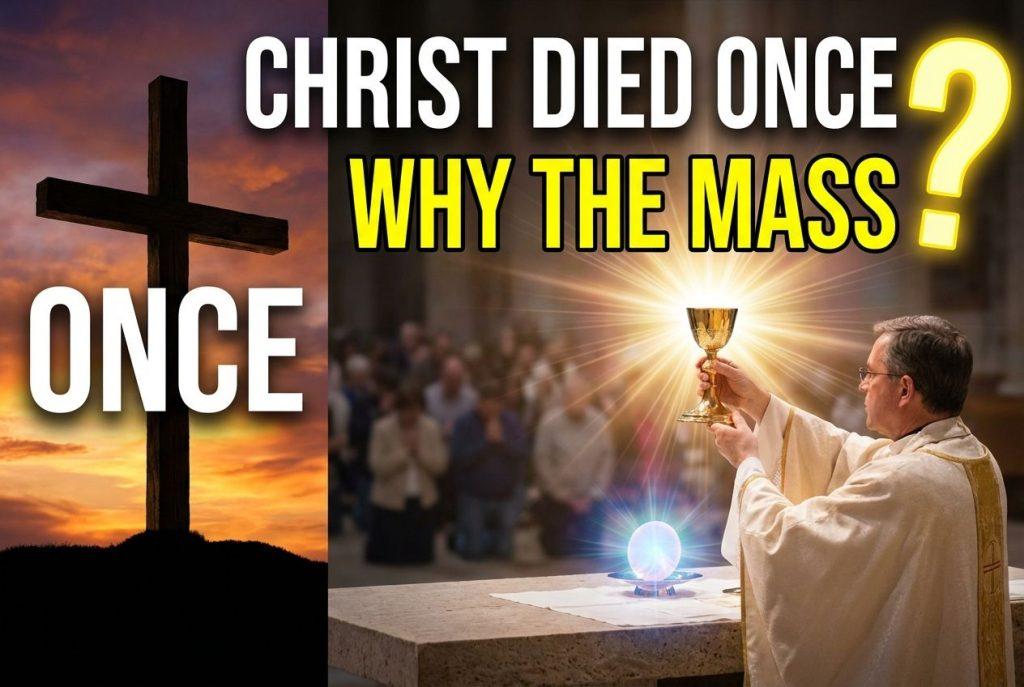
- The Eucharist makes present the one sacrifice of Christ on Calvary in a sacramental manner rather than repeating it.
- Scripture teaches that Christ’s sacrifice was offered once for all and remains eternally present before God.
- The Mass is not a new sacrifice but the same sacrifice of Christ offered through the ministerial priesthood.
- Jesus instituted the Eucharist at the Last Supper as a memorial that makes his Paschal mystery present to each generation.
- The biblical concept of memorial means more than remembering past events because it makes those events present and real.
- The Eucharist applies the fruits of Christ’s once-for-all sacrifice to believers throughout time until his return.
Understanding the Once-for-All Sacrifice
The Letter to the Hebrews clearly teaches that Christ offered himself once for all as the perfect sacrifice for sins. The author writes that unlike the old covenant priests who offered sacrifices daily, Christ “has no need, like those high priests, to offer sacrifices daily, first for his own sins and then for those of the people; he did this once for all when he offered up himself” in Hebrews 7:27. This teaching runs throughout the letter and emphasizes the complete sufficiency of Christ’s sacrifice on the cross. The Book of Hebrews stresses that Christ “entered once for all into the Holy Place, taking not the blood of goats and calves but his own blood, thus securing an eternal redemption” in Hebrews 9:12. These passages make clear that Christ’s sacrifice was singular, complete, and eternal in its effects. The sacrifice on Calvary was not incomplete or insufficient in any way. Christ accomplished everything necessary for human salvation through his death and resurrection. His offering on the cross was perfect and needs no repetition or supplementation. The Catholic Church affirms this biblical teaching completely and without reservation. The Catechism teaches that Christ “was once and for all to offer himself to God the Father by his death on the altar of the cross, to accomplish there an everlasting redemption” (CCC 1366). The question then becomes how the Eucharist relates to this once-for-all sacrifice without contradicting or diminishing it.
The answer lies in understanding what the Mass actually is according to Catholic teaching. The Mass does not repeat Christ’s sacrifice or add anything to what he accomplished on Calvary. Rather, the Eucharist makes present the same sacrifice that occurred once in history. The Catholic Church teaches that “the sacrifice of Christ and the sacrifice of the Eucharist are one single sacrifice” (CCC 1367). This means there is only one sacrifice of Christ, not multiple sacrifices. The cross and the Mass are the same sacrifice presented in different modes. On Calvary, Christ offered himself in a bloody manner, dying physically on the wood of the cross. In the Mass, Christ offers himself in an unbloody, sacramental manner through the ministry of priests. The victim is the same in both cases, and the priest is the same in both cases. Christ himself is both priest and victim on Calvary and in the Eucharist. The only difference is the manner of offering, which changes from bloody to unbloody. The Council of Trent explained this by teaching that in the Mass “the same Christ who offered himself once in a bloody manner on the altar of the cross is contained and is offered in an unbloody manner” (CCC 1367). This distinction between the mode of offering and the sacrifice itself resolves the apparent tension between the once-for-all nature of Calvary and the repeated celebration of the Eucharist.
The Biblical Foundation for Making Present
Scripture itself provides the foundation for understanding how a past event can be made present in a liturgical celebration. The Jewish celebration of Passover offers an important precedent that helps explain the Catholic understanding of the Eucharist. When Israel celebrated Passover each year, they did not merely remember the exodus from Egypt as a past historical event. Rather, the liturgical celebration made the exodus present to each generation so that believers could participate in it. Every Jewish person was to understand themselves as personally liberated from Egypt through the Passover celebration. The liturgical memorial brought the saving events of the past into the present moment for each generation. This is how Israel understood its liberation throughout its history. The Book of Deuteronomy teaches this principle when Moses tells the people about the covenant God made with their fathers, emphasizing that God makes the covenant present to each generation. Sacred Scripture thus establishes that a memorial in the biblical sense is not just a recollection but a making present of past saving events. The Catechism teaches that “in the sense of Sacred Scripture the memorial is not merely the recollection of past events but the proclamation of the mighty works wrought by God for men” (CCC 1363). When the Church celebrates these events liturgically, they become in a certain way present and real for believers today.
Jesus instituted the Eucharist within this Jewish understanding of memorial and gave it new and deeper meaning. At the Last Supper, Jesus celebrated the Passover meal with his disciples and transformed it by giving it definitive meaning. He took bread and wine and declared them to be his body and blood, given and poured out for the forgiveness of sins. Then he commanded his disciples to “do this in remembrance of me” as recorded in Luke 22:19 and 1 Corinthians 11:24-25. This command to repeat his actions was not merely an instruction to remember him fondly after his death. Rather, Jesus was instituting a liturgical memorial that would make his sacrifice present throughout history until his return. Saint Paul understood this when he wrote that “as often as you eat this bread and drink the cup, you proclaim the Lord’s death until he comes” in 1 Corinthians 11:26. The Eucharist is thus the New Covenant memorial that Jesus established to perpetuate his sacrifice through the ages. Just as the Jewish Passover made the exodus present to each generation, the Eucharistic celebration makes Christ’s Passover present to believers in every time and place. The difference is that the Eucharist contains what it represents because Christ himself is truly present in the consecrated bread and wine. The Catechism states that “when the Church celebrates the Eucharist, she commemorates Christ’s Passover, and it is made present: the sacrifice Christ offered once for all on the cross remains ever present” (CCC 1364). This teaching shows how the Eucharist relates to Christ’s once-for-all sacrifice without contradicting the biblical witness.
The Eternal Presence of Christ’s Sacrifice
Catholic theology teaches that Christ’s sacrifice on Calvary, though it occurred at a specific moment in history, possesses an eternal dimension that transcends time. Because Christ is both divine and human, his actions have a quality that goes beyond the merely temporal. His sacrifice was offered in time but also exists outside of time in God’s eternal presence. The Letter to the Hebrews teaches that Christ “entered once for all into the Holy Place” and now appears “in the presence of God on our behalf” as stated in Hebrews 9:12 and 9:24. Christ brought his sacrifice into the heavenly sanctuary where it remains eternally present before the Father. His offering on Calvary was completed in time but its reality and efficacy perdure forever in the heavenly realm. This eternal dimension of Christ’s sacrifice makes possible its sacramental presence in the Eucharist. The Mass does not bring Christ down from heaven or recreate Calvary; rather, it lifts believers up into the eternal now of Christ’s sacrifice. Through the Eucharistic celebration, the Church on earth participates in the heavenly liturgy where Christ’s offering is always present. The earthly celebration of the Mass and the heavenly reality of Christ’s sacrifice are mysteriously joined so that what happens on the altar participates in what Christ accomplished on the cross. Time and eternity meet in the Eucharistic mystery. This is why the Church can say that Christ’s sacrifice is made present without being repeated.
The concept of making present must be distinguished from repetition or reenactment. The Mass is not a dramatic portrayal of the Last Supper or a symbolic reminder of what happened on Good Friday. Neither is it a new sacrifice that adds to or completes what Christ did on Calvary. Rather, the Eucharist makes present the same sacrifice through sacramental signs instituted by Christ himself. The power to make this sacrifice present comes from Christ’s own words and actions at the Last Supper. When Jesus said “this is my body” and “this is my blood,” he was not speaking metaphorically but was truly giving himself to his disciples. He commanded them to repeat these words and actions, promising that when they did so, he would be truly present. The Church has faithfully carried out this command from the beginning, believing that Christ himself acts through the priest to consecrate the bread and wine. The Catechism explains that in the Eucharist “the power of the words and the action of Christ, and the power of the Holy Spirit, make sacramentally present under the species of bread and wine Christ’s body and blood, his sacrifice offered on the cross once for all” (CCC 1353). This sacramental making present is unique to the Eucharist and depends entirely on Christ’s institution and promise. The sacrifice is made present through signs and under sacramental veils, but what is made present is the reality itself, not a representation or symbol.
The Sacrificial Character of the Eucharist
The sacrificial nature of the Eucharist appears clearly in the words Jesus spoke at the Last Supper. He gave his disciples bread with the words “this is my body which is given for you” according to Luke 22:19. He gave them wine saying “this cup which is poured out for you is the new covenant in my blood” as recorded in Luke 22:20. These words explicitly indicate sacrifice; the body is given and the blood is poured out. Jesus speaks of his body and blood in sacrificial terms, pointing forward to what would happen on Calvary the next day. In the Eucharist, Christ gives us the very body he gave up for us on the cross and the very blood he poured out for the forgiveness of sins. The words of institution themselves demonstrate the sacrificial character of what Jesus was establishing. The Catechism teaches that “the sacrificial character of the Eucharist is manifested in the very words of institution” (CCC 1365). These words show that the Eucharist is intrinsically connected to Christ’s sacrifice on the cross. The Last Supper anticipated Calvary and the Mass makes Calvary present; both involve the same sacrificial offering of Christ’s body and blood.
The Church’s understanding of the Eucharist as sacrifice developed from apostolic times through careful reflection on Scripture and Tradition. The early Christians recognized that when they gathered to break bread and celebrate the Lord’s Supper, they were doing more than sharing a meal together. They were offering sacrifice to God through Christ. The Church Fathers wrote extensively about the Eucharist as the Christian sacrifice that fulfills and supersedes the sacrifices of the Old Covenant. The Letter to the Hebrews itself suggests this by contrasting the repeated sacrifices of the old covenant with Christ’s once-for-all sacrifice. The old sacrifices could never take away sins but had to be repeated continually; Christ’s sacrifice accomplished complete redemption and needs no repetition. Yet the Letter to the Hebrews also speaks of Christians having an altar from which those who serve the tent have no right to eat in Hebrews 13:10. This reference to an altar indicates a sacrificial context for Christian worship. The Church has always understood that Christians have an altar because they have a sacrifice, namely the Eucharistic sacrifice which makes present Christ’s offering on the cross. This is not a new sacrifice alongside or in addition to Calvary; it is the sacramental making present of the one sacrifice of Christ. The distinction is critical for maintaining both the once-for-all nature of Calvary and the reality of the Eucharistic sacrifice.
How the Mass Relates to Calvary
Understanding the relationship between the Mass and Calvary requires grasping several key theological points that the Catholic Church has clarified over centuries. First, the Mass is not merely a symbol or reminder of Christ’s sacrifice. Many Christians hold that the bread and wine are symbols that help believers remember what Jesus did, but Catholic teaching affirms something much stronger. The Eucharist truly contains what it represents because Christ himself is truly present in the consecrated elements. This real presence of Christ is what makes possible the real presence of his sacrifice. Where Christ is, there also is his sacrificial offering because he cannot be separated from what he accomplished. His identity as victim and priest goes with him wherever he is present. When the bread and wine become the body and blood of Christ through transubstantiation, Christ’s sacrifice becomes sacramentally present as well. The Catechism teaches that Christ “is present whole and entire in each of the species” (CCC 1377). This means the living Christ, who offered himself on Calvary, is present under the Eucharistic species with his whole person and work. His presence necessarily includes his sacrificial self-offering.
Second, Christ himself is the primary priest in every Mass, acting through the ministerial priest who consecrates the elements. The ordained priest does not offer a sacrifice independently or on his own authority. Rather, he acts “in the person of Christ” when he speaks the words of consecration and offers the Eucharistic sacrifice. Christ works through the priest to make his own sacrifice present and to offer it anew to the Father. The priest is Christ’s instrument, lending his voice and hands so that Christ can continue his priestly work in the Church. This is why the Mass has infinite value despite being celebrated by sinful human beings. The efficacy and worth of the Mass come from Christ, not from the human priest who celebrates it. The victim offered is Christ and the priest who offers is Christ, working through his ministerial priesthood. The Catechism states that “the victim is one and the same: the same now offers through the ministry of priests, who then offered himself on the cross” (CCC 1367). This identity of victim and priest between Calvary and the Mass establishes their unity as one sacrifice. Christ did not cease being priest after ascending to heaven; he continues his priestly intercession at the Father’s right hand. In the Mass, his heavenly intercession becomes present on earth through the Eucharistic celebration. The faithful on earth join their prayers and lives to Christ’s eternal offering when they participate in the Mass.
Third, each celebration of the Eucharist does not multiply Christ’s sacrifice or create new sacrifices. There is only one sacrifice of Christ, offered once on Calvary and made present repeatedly in the Mass. The repetition belongs to the celebration, not to the sacrifice itself. Just as the sun rises once each day but its light reaches different places at different times, so Christ’s sacrifice was offered once but is made present to different generations through the Eucharistic celebration. The number of Masses celebrated throughout history does not create multiple sacrifices; each Mass makes present the same singular sacrifice of Calvary. This distinction protects the once-for-all character of Christ’s sacrifice while explaining how it becomes available to believers in every age. The repeated celebration serves to apply the fruits of Christ’s sacrifice to believers across time and space. Every person who has ever lived needs to receive the benefits of Christ’s redemption. The Eucharist is the primary means by which those benefits reach individual believers. When the Mass is celebrated, the graces won by Christ on Calvary flow out to those who participate. The Catechism teaches that the Eucharist “re-presents (makes present) the sacrifice of the cross” and “applies its fruit” (CCC 1366). Making present and applying are two aspects of what the Mass accomplishes in relation to Calvary.
The Biblical Theology of Memorial
The Greek word used in the New Testament for remembrance or memorial is anamnesis, which carries a deeper meaning than simple mental recollection. When Jesus said “do this in remembrance of me,” he used language that Jewish people understood to mean liturgical memorial that makes past events present. The Passover celebration was precisely such an anamnesis of the exodus. Jews did not merely think about the exodus when celebrating Passover; they participated in it through the liturgical meal. Each generation understood itself as personally delivered from Egypt through the Passover memorial. This participatory understanding of memorial comes from Scripture itself and shapes how Christians should understand the Eucharist. When the Church celebrates the Eucharistic memorial, believers do not simply remember Christ; they participate in his sacrifice and receive its benefits. The memorial makes Christ’s Passover present so that believers can enter into it personally. The Catechism explains that “the Eucharist is the memorial of Christ’s Passover, the making present and the sacramental offering of his unique sacrifice” (CCC 1362). The term memorial thus means much more than psychological remembering; it means liturgical making present.
Saint Paul’s teaching about the Eucharist in First Corinthians supports this understanding of memorial. He recounts how Jesus instituted the Eucharist and then explains its ongoing celebration in the Church. After quoting Jesus’s words “do this in remembrance of me,” Paul adds his own interpretation by stating that “as often as you eat this bread and drink the cup, you proclaim the Lord’s death until he comes” in 1 Corinthians 11:26. This proclamation is not merely verbal announcement but liturgical enactment. The Eucharistic celebration proclaims Christ’s death by making it present and allowing believers to participate in it. The phrase “until he comes” indicates that this memorial will continue throughout the entire period between Christ’s first and second comings. Every generation of Christians must have access to Christ’s sacrifice through the Eucharistic memorial. This is why the Church has celebrated the Eucharist continually from apostolic times until now. The command to “do this” was not given only to the apostles for their own generation but to the Church for all time. The apostles passed on this command and the power to fulfill it through apostolic succession. The ordained priesthood exists precisely to continue celebrating the Eucharistic memorial in every generation until Christ returns.
The memorial character of the Eucharist also explains how believers separated from Calvary by centuries can receive the benefits of Christ’s sacrifice. Time does not diminish the power of what Christ accomplished, and distance does not prevent believers from accessing his redemption. The Eucharistic memorial bridges time and space, bringing Calvary’s saving power to believers in every age and place. A person living in the twenty-first century can receive the same graces from Christ’s sacrifice as someone living in the first century because the memorial makes the sacrifice present. The passage of centuries does not put Calvary further away or make it less accessible. Through the Eucharist, every generation stands at the foot of the cross and receives the blood and water flowing from Christ’s side. This is the practical importance of the Eucharist being a true memorial rather than just a symbol. If the Eucharist were merely symbolic, it would not actually convey the reality of Christ’s sacrifice to believers. But because the Eucharist is a true memorial that makes present what it commemorates, believers really participate in Christ’s sacrifice when they receive communion. The Catechism teaches that “in the liturgical celebration of these events, they become in a certain way present and real” (CCC 1363). This making present is not natural but supernatural, accomplished by God’s power through the sacramental signs.
The Bread of Life Discourse
Jesus’s teaching about the Eucharist in the Gospel of John provides crucial biblical foundation for Catholic doctrine about this sacrament. After multiplying loaves and fishes to feed thousands, Jesus gave a lengthy discourse about himself as the bread of life. He began by identifying himself as the true bread from heaven, contrasting himself with the manna God gave Israel in the desert. Jesus said “I am the bread of life; he who comes to me shall not hunger, and he who believes in me shall never thirst” in John 6:35. This opening statement uses metaphorical language about coming to Jesus and believing in him. However, Jesus then moved beyond metaphor to literal teaching about eating his flesh and drinking his blood. He stated emphatically that “unless you eat the flesh of the Son of man and drink his blood, you have no life in you” according to John 6:53. This caused many disciples to object, calling his teaching a “hard saying” that was difficult to accept. Rather than softening his language or explaining that he spoke metaphorically, Jesus intensified his teaching. He insisted that his flesh is “food indeed” and his blood is “drink indeed” as recorded in John 6:55. Many disciples left him at this point because they could not accept such teaching. Jesus let them go rather than compromise or clarify that he spoke only symbolically.
The Catholic Church has always read this discourse as Jesus’s teaching about the Eucharist, given nearly a year before he instituted the sacrament at the Last Supper. Jesus was preparing his disciples to understand what he would give them when he offered his body and blood under the appearances of bread and wine. The strong language about eating flesh and drinking blood makes sense only if Jesus truly meant that believers would consume his body and blood sacramentally. If he merely meant that people should believe in him, his language would be needlessly confusing and offensive. Jewish law strictly forbade consuming blood, so Jesus’s words would have been especially shocking to his audience. He was deliberately using shocking language to communicate something shocking but true about the sacrament he would institute. The Eucharist involves truly eating Christ’s flesh and drinking his blood, though under the sacramental forms of bread and wine. This is what the Catholic doctrine of transubstantiation affirms: the substance of bread and wine changes into the substance of Christ’s body and blood while the appearances remain. Jesus’s discourse in John 6 prepares believers to accept this mystery of faith. The Catechism teaches that “Christ calls himself the bread of life, come down from heaven” and later gives his disciples his actual body and blood in the Eucharist (CCC 1338).
The connection between the bread of life discourse and the Last Supper is strengthened by John’s Gospel structure. John does not include an account of the institution of the Eucharist in his narrative of the Last Supper; instead, he records Jesus washing the disciples’ feet and gives the farewell discourse. However, John has already provided Jesus’s teaching about the Eucharist through the bread of life discourse in chapter 6. John assumes his readers know about the institution of the Eucharist from the other Gospels or from Church tradition, so he supplements that account with Jesus’s earlier teaching about eating his flesh and drinking his blood. This literary structure shows that the bread of life discourse and the Last Supper belong together as Jesus’s teaching and institution of the Eucharist. Reading them together, believers understand that in the Eucharist they truly receive the flesh and blood of Christ, as he taught in John 6, under the forms of bread and wine, as he instituted at the Last Supper. This unified biblical witness supports the Catholic understanding of the Eucharist as Christ’s real presence and his sacrifice made present. The Eucharist is not merely bread that symbolizes Christ’s body; it is Christ’s body under the appearance of bread.
The Priesthood and the Eucharistic Sacrifice
The Letter to the Hebrews teaches that Christ is the eternal high priest who offered the perfect sacrifice for sins and now intercedes for believers at God’s right hand. His priesthood is superior to the Levitical priesthood of the Old Covenant because his sacrifice was perfect and accomplished complete redemption. The old priests had to offer sacrifices repeatedly because those sacrifices could not truly remove sins; Christ offered himself once and accomplished eternal redemption. Hebrews states that Christ “holds his priesthood permanently, because he continues for ever” according to Hebrews 7:24. His priesthood did not end with his death and resurrection but continues eternally. This eternal priesthood of Christ is exercised in heaven where he intercedes for believers, and it is also exercised on earth through the Eucharistic sacrifice. Catholic theology teaches that Christ’s priesthood operates through the ministerial priesthood he established. When he ordained the apostles at the Last Supper by commanding them to “do this in remembrance of me,” he shared his priesthood with them so they could continue offering the Eucharistic sacrifice. The ministerial priesthood is not independent of Christ’s priesthood but is a participation in it and a means for its exercise. Ordained priests can consecrate the Eucharist only because Christ works through them, lending them his priestly authority and power.
The relationship between Christ’s eternal priesthood and the ministerial priesthood of the Church resolves an important question about the Eucharist. If Christ offered himself once for all and now sits at God’s right hand, who offers the Eucharistic sacrifice in the Mass? The answer is that Christ himself offers it through his ministerial priests. The human priest who celebrates Mass does not offer a sacrifice on his own authority or in his own person. He acts as an instrument of Christ, speaking Christ’s words and performing Christ’s actions. The consecration occurs through Christ’s power, not through the priest’s personal holiness or power. This is why even a sinful priest can validly consecrate the Eucharist; he acts as Christ’s instrument regardless of his personal state. The sacrifice offered is Christ’s sacrifice, not the priest’s sacrifice. The Catechism explains that in the Eucharist “the same now offers through the ministry of priests, who then offered himself on the cross” (CCC 1367). This teaching protects both Christ’s unique priesthood and the reality of the ministerial priesthood. Christ remains the one priest and the one victim; human priests simply provide the human agency through which Christ continues his priestly work on earth. Their role is essential but instrumental, allowing Christ to act visibly in the Church through human ministers.
The ordained priesthood thus exists primarily for celebrating the Eucharist. While priests have other responsibilities like preaching and pastoral care, their essential and distinctive role is offering the Eucharistic sacrifice. This is why ordination to the priesthood confers the power to consecrate the Eucharist and absolve sins; these are the specific priestly functions that continue Christ’s work of redemption. The priesthood is not primarily about leadership or teaching, though priests exercise those roles too. Rather, the priesthood is fundamentally about continuing Christ’s priestly sacrifice through the Eucharist. This understanding of priesthood comes directly from the institution of the Eucharist at the Last Supper. When Jesus gave the apostles his body and blood and commanded them to repeat his actions, he was ordaining them as priests of the New Covenant. Their ordination consisted in receiving the commission and power to offer the Eucharistic sacrifice. They passed this power on to their successors through the laying on of hands, establishing the sacramental succession that continues in the Church today. Every validly ordained priest stands in succession from the apostles and has received the power to act in Christ’s person at the altar. This is why the Catholic Church maintains that only ordained priests can validly consecrate the Eucharist. The power to make Christ’s sacrifice present comes from Christ through apostolic succession, not from the community or from personal piety.
The Church’s Participation in Christ’s Sacrifice
When the Church celebrates the Eucharist, she does not merely observe Christ’s sacrifice being made present; she actively participates in offering it. The Catechism teaches that “the Eucharist is also the sacrifice of the Church” because “the Church which is the Body of Christ participates in the offering of her Head” (CCC 1368). Christ and the Church together offer the Eucharistic sacrifice, though in very different ways. Christ offers himself as both priest and victim; the Church offers herself in union with Christ her head. The faithful who participate in Mass unite their lives, prayers, sufferings, and works to Christ’s offering. Their personal sacrifice of praise and self-gift becomes joined to Christ’s perfect sacrifice, gaining value and efficacy from that union. This is one of the most important fruits of participating in the Eucharist; believers can offer their whole lives to God through Christ in the Mass. Every joy and sorrow, every work and prayer, every success and failure can be united to Christ’s sacrifice and offered to the Father. This transforms the ordinary circumstances of daily life into spiritual sacrifice acceptable to God. Through the Eucharist, believers exercise their baptismal priesthood by offering spiritual sacrifices through Christ the high priest.
The participatory nature of the Eucharist means that believers should not be passive observers at Mass. They should actively join their prayers and intentions to the sacrifice being offered. When the priest offers the bread and wine that will become Christ’s body and blood, the faithful should offer themselves together with these gifts. When the consecration makes Christ’s sacrifice present, believers should unite themselves to that sacrifice by offering their own lives. When Christ is offered to the Father, the Church and all her members are offered with him because they form one body with Christ. The Catechism states that the Church “unites herself to his intercession with the Father for all men” and that “the lives of the faithful, their praise, sufferings, prayer, and work, are united with those of Christ and with his total offering, and so acquire a new value” (CCC 1368). This teaching shows that the Mass is not something done by the priest while the congregation watches. Rather, the Mass is the action of the whole Church, head and members together, offering the one sacrifice of Christ to the Father. The ministerial priest acts in Christ’s person to make the sacrifice present, while the faithful exercise their baptismal priesthood by uniting themselves to Christ’s offering.
The communal nature of the Eucharistic sacrifice has important implications for Christian spirituality. Believers should prepare for Mass by examining their lives and bringing all their concerns and needs to be offered with Christ. They should participate attentively in the prayers and responses, especially the acclamations of the Eucharistic Prayer. After communion, they should spend time thanking God for the gift of Christ’s body and blood and renewing their commitment to live as sacrificial offerings. The grace received in the Eucharist should flow out into daily life, transforming how believers work, love, suffer, and serve. This is what Saint Paul meant when he urged believers to “present your bodies as a living sacrifice, holy and acceptable to God” in Romans 12:1. The spiritual sacrifice of life that Paul describes is made possible and acceptable through union with Christ’s perfect sacrifice in the Eucharist. Believers can offer nothing acceptable to God on their own merit, but united to Christ’s offering, their lives become a pleasing sacrifice. The Catechism teaches that “Christ’s sacrifice present on the altar makes it possible for all generations of Christians to be united with his offering” (CCC 1368). This is the practical purpose of the Eucharist being a true sacrifice; it allows believers to participate in Christ’s redemptive work and offer their lives to God through him.
Addressing Common Misunderstandings
Some Christians object to Catholic teaching about the Eucharist by arguing that it compromises the sufficiency of Christ’s sacrifice. They reason that if Christ’s sacrifice was complete and perfect, then the Church should not continue offering sacrifice. This objection misunderstands what Catholic doctrine actually teaches about the relationship between Calvary and the Mass. The Catholic Church does not teach that the Mass adds anything to Christ’s sacrifice or supplements its incomplete effects. Rather, the Church teaches that the Mass makes present the same complete and perfect sacrifice that Christ offered once on Calvary. Nothing is added to Christ’s work and nothing is repeated. The one sacrifice of the cross is made present through sacramental signs so that believers can participate in it. Those who object to this teaching often fail to grasp the distinction between the sacrifice itself and its sacramental representation. The sacrifice happened once in history on Calvary; the sacramental making present of that sacrifice occurs repeatedly in the Mass. These are not two different sacrifices but one sacrifice made present in two different modes. The bloody offering on the cross and the unbloody offering on the altar are the same sacrifice of Christ, presented differently.
Another common misunderstanding concerns the relationship between the Eucharist and faith. Some Christians argue that faith in Christ’s sacrifice is sufficient for salvation, making the Eucharist unnecessary. However, this sets up a false opposition between faith and sacrament. Catholic teaching affirms that faith is absolutely necessary for salvation and for fruitful reception of the sacraments. The Eucharist does not replace faith but nourishes and strengthens it. Jesus himself taught that receiving the Eucharist requires faith when he said in the bread of life discourse that believers must come to him in faith and also eat his flesh and drink his blood. Both elements are necessary according to Jesus’s teaching in John 6. Faith leads believers to receive the Eucharist, and receiving the Eucharist deepens faith. The two work together rather than competing. Saint Paul emphasized this when he wrote that “whoever eats the bread or drinks the cup of the Lord in an unworthy manner will be guilty of profaning the body and blood of the Lord” in 1 Corinthians 11:27. Receiving the Eucharist without proper faith and disposition does not benefit the receiver and may even harm them. The Eucharist presupposes faith and builds upon it; it does not substitute for faith.
A third misunderstanding involves the nature of the real presence. Some Christians accept that Christ is present spiritually when believers gather in his name but deny his bodily presence in the Eucharist. They argue that Christ’s body is in heaven at God’s right hand and therefore cannot be present on earth in the sacrament. However, this objection fails to account for Christ’s divine power and for the unique nature of sacramental presence. Christ’s body is indeed in heaven in a local, spatial manner; the Eucharist does not deny or contradict this. However, through transubstantiation, Christ makes himself present in a different way under the sacramental species. He becomes present not locally or spatially but sacramentally and substantially. His body does not leave heaven to come to the altar; rather, his one body becomes present in multiple places through sacramental signs. This is a mystery that exceeds natural understanding, but it is not impossible for God. The Catechism explains that Christ’s presence under the Eucharistic species is unique and raises the Eucharist above all other sacraments (CCC 1374). This presence is called real not to suggest that other modes of Christ’s presence are unreal but to emphasize that it is substantial presence of Christ’s actual body and blood, not merely spiritual presence or symbolic representation. The same Christ who died on Calvary and rose from the tomb is truly present in the Eucharist, body, blood, soul, and divinity.
The Eschatological Dimension
The Eucharist points forward to the future fulfillment of God’s kingdom as well as making present Christ’s past sacrifice. Saint Paul teaches that believers proclaim the Lord’s death in the Eucharist “until he comes” according to 1 Corinthians 11:26. This indicates that the Eucharistic celebration will continue throughout the Church’s earthly existence until Christ returns in glory. At that point, the sacramental presence will give way to immediate presence, and faith will be replaced by vision. Believers will see Christ face to face and will no longer need the sacramental veils of bread and wine. The Eucharist thus has a temporary character relative to eternity, serving as the form of Christ’s presence with his Church during the time between his ascension and return. However, this temporary character does not diminish the Eucharist’s importance. During the Church’s earthly pilgrimage, the Eucharist is the primary way Christ remains present with his people and nourishes them for their journey. The Catechism teaches that the Eucharist is “viaticum,” which means food for the journey toward the heavenly homeland (CCC 1331). It sustains believers on their pilgrimage through this life toward eternal life with God. When Christ returns, there will be no more need for the Eucharist because believers will possess directly what they now receive sacramentally.
The Eucharist also anticipates the heavenly banquet that Jesus promised his disciples. At the Last Supper, Jesus told his disciples that he would not drink wine again until he drank it new with them in his Father’s kingdom according to Matthew 26:29. This statement points to the future messianic banquet when Christ and his followers will feast together in the eternal kingdom. Every celebration of the Eucharist anticipates and participates in that future banquet. Believers receive a foretaste of heavenly glory when they receive Christ in communion. The Catechism states that “by the Eucharistic celebration we already unite ourselves with the heavenly liturgy and anticipate eternal life” (CCC 1326). This means that the Mass is not only a memorial of the past and a making present of Christ’s sacrifice; it is also a preview of the future. The Church on earth joins with the angels and saints in heaven to worship God through the Eucharistic liturgy. Time breaks open in the Mass, connecting past, present, and future in the eternal now of Christ’s sacrifice. Believers stand at Calvary receiving the fruits of Christ’s death; they stand in the heavenly Jerusalem participating in eternal worship; they stand in their present moment receiving grace for their daily lives. All three dimensions converge in the Eucharistic mystery.
This eschatological dimension gives urgency and hope to the Eucharistic celebration. Believers should participate in the Mass with awareness that they are preparing for their eternal destiny. The grace received in the Eucharist transforms them gradually into Christ’s likeness so they can share his glory forever. The Eucharist is not just spiritual food for this life; it is “the medicine of immortality” as the early Church Fathers called it. It preserves believers from eternal death and raises them to eternal life with God. Jesus himself taught this when he said “he who eats my flesh and drinks my blood has eternal life, and I will raise him up at the last day” according to John 6:54. The Eucharist thus contains the pledge and promise of resurrection. Those who receive Christ’s body and blood will be raised by him on the last day to share in his risen life forever. The Catechism teaches that in the Eucharist believers receive “a pledge of future glory” (CCC 1323). This forward-looking aspect of the Eucharist should fill believers with hope and motivate them to live faithfully while awaiting Christ’s return. The same Christ they receive in communion will come again in glory to gather his faithful people into his eternal kingdom.
Practical Implications for Faith
Understanding the Eucharist as the sacrifice of Christ made present has profound implications for how Catholics approach the Mass. First, it means that participating in Mass is participating in the most important event in human history. Calvary was the moment when God accomplished the salvation of the world, and the Mass makes that moment present. Believers who attend Mass are not merely attending a worship service; they are standing at the foot of the cross. This reality should transform how Catholics prepare for and participate in the Mass. Proper preparation includes examining one’s conscience and seeking reconciliation for serious sins before receiving communion. The Church requires that anyone conscious of mortal sin receive the sacrament of reconciliation before receiving the Eucharist, because receiving communion unworthily profanes Christ’s body and blood. Catholics should also prepare by fasting for at least one hour before receiving communion, observing the Eucharistic fast that the Church prescribes. Mental and spiritual preparation are equally important; believers should come to Mass ready to encounter Christ and offer themselves with him to the Father.
Second, understanding the sacrificial nature of the Eucharist should affect how Catholics receive communion. They approach not merely to receive spiritual food, though the Eucharist is that; they approach to receive the victim of the sacrifice and unite themselves to his offering. Receiving communion is an act of worship and sacrifice as well as spiritual nourishment. Catholics should approach with faith in Christ’s real presence and with willingness to be offered with him to the Father. After communion, believers should spend time in prayer and thanksgiving, speaking to Christ present within them and renewing their commitment to live as his disciples. The encounter with Christ in communion should not end when Mass is over; it should influence every aspect of life. The Catechism teaches that “what material food produces in our bodily life, Holy Communion wonderfully achieves in our spiritual life” (CCC 1392). Just as food strengthens the body and sustains physical life, communion strengthens the soul and sustains spiritual life. This effect depends partly on the disposition of the receiver; those who receive worthily with faith and love benefit most from communion’s transforming power.
Third, Catholics should recognize their obligation to participate in the Eucharistic sacrifice regularly. The Church requires that Catholics attend Mass every Sunday and on certain holy days, unless prevented by serious reason. This obligation flows from the nature of the Eucharist as the sacrifice of the Church and the source of Christian life. Believers need regular participation in the Eucharist to maintain their spiritual life and grow in holiness. Sunday Mass is not optional for Catholics who are physically able to attend; it is a serious obligation rooted in the third commandment to keep holy the Lord’s day. Many Catholics also choose to attend Mass more frequently than required, even daily when possible. This practice has great spiritual value because it allows believers to unite themselves to Christ’s sacrifice and receive communion more often. The Catechism states that while the Church requires minimum participation, “she strongly encourages the faithful to receive the holy Eucharist on Sundays and feast days, or more often still, even daily” (CCC 1389). Those who develop the practice of attending daily Mass find it becomes the center and source of their spiritual life. They carry the grace of the Eucharist into their daily activities and relationships, living as sacrificial offerings united to Christ.
The Unity of the Sacrifice
The fundamental principle for understanding the relationship between Christ’s once-for-all sacrifice and the Eucharist is their essential unity. They are not two different sacrifices but one sacrifice made present in different ways. Calvary and the Mass are different expressions of the same sacrificial offering. Christ offered himself once to the Father on the cross, accomplishing redemption completely and perfectly. That sacrifice exists eternally in God’s presence because Christ is eternal. The Mass does not create a new sacrifice but makes present the eternal sacrifice of Christ through sacramental signs. The sacrifice is one; the modes of offering differ. On Calvary, Christ offered himself in his natural body through bloody death. In the Mass, Christ offers himself in his sacramental body through the unbloody consecration of bread and wine. These are not separate offerings but one offering presented differently. The victim is the same in both cases, and the priest is the same in both cases. Christ is victim and priest at Calvary and in the Eucharist. Human priests participate in Christ’s priesthood and act as his instruments, but Christ himself is the principal priest in every Mass. This identity of victim and priest establishes the unity between Calvary and the Mass.
The unity of the sacrifice also means that every Mass has the same infinite value as Calvary itself. Because the Mass makes present Christ’s sacrifice, which is of infinite worth, each Mass is infinitely pleasing to God. The value does not diminish through repetition, and no number of Masses could exhaust the treasury of grace that flows from Christ’s sacrifice. This is why the Church continues to celebrate Mass daily in parishes and communities throughout the world. Each celebration gives glory to God and obtains grace for the Church and the world. Catholics may request that Mass be offered for specific intentions, such as for deceased loved ones or for special needs. The practice of Mass intentions recognizes that while the Mass always benefits the whole Church, particular graces can be directed toward specific persons or purposes according to the intention of the celebrating priest and the offering of the faithful. This does not mean that people purchase grace or that salvation can be bought. Rather, it acknowledges that prayer has power and that the Eucharistic sacrifice is the most powerful prayer the Church can offer. When Mass is celebrated for a particular intention, that intention is united to Christ’s perfect offering to the Father. The effectiveness comes entirely from Christ’s sacrifice, but the application of grace follows the intention offered.
The Catechism summarizes this unity by teaching that “the sacrifice of Christ and the sacrifice of the Eucharist are one single sacrifice” (CCC 1367). This statement captures the heart of Catholic teaching on this issue. There is no contradiction between affirming that Christ died once for all and affirming that the Church offers the Eucharistic sacrifice. The once-for-all sacrifice of Calvary and the repeated celebration of the Mass are one sacrifice, not two. Christ’s death on the cross was complete and perfect, accomplishing everything necessary for salvation. The Mass adds nothing to that accomplishment but makes it present and available to believers across time and space. Through the Eucharist, the saving power of Calvary reaches every generation from the apostles until Christ’s return. This is why Jesus commanded his disciples to “do this in remembrance of me.” He established the Eucharistic memorial so that his sacrifice would be perpetually present in the Church, nourishing believers and uniting them to his offering. The Eucharist is thus essential to Catholic faith and life precisely because it makes present the source of salvation itself, the sacrifice of Christ offered once for all on Calvary.
Disclaimer: This article presents Catholic teaching for educational purposes. For official Church teaching, consult the Catechism and magisterial documents. For personal spiritual guidance, consult your parish priest or spiritual director. Questions? Contact editor@catholicshare.com
Sign up for our Exclusive Newsletter
- 📌 Add CatholicShare as a Preferred Source on Google
- 🎁 Join us on Patreon for Premium Content
- 🎧 Check Out These Catholic Audiobooks
- 📿 Get Your FREE Rosary Book
- 📱 Follow Us on Flipboard
-

Recommended Catholic Books
Discover hidden wisdom in Catholic books — invaluable guides enriching faith and satisfying curiosity. #CommissionsEarned
- The Early Church Was the Catholic Church
- The Case for Catholicism - Answers to Classic and Contemporary Protestant Objections
- Meeting the Protestant Challenge: How to Answer 50 Biblical Objections to Catholic Beliefs
As an Amazon Associate, I earn from qualifying purchases. Thank you for your support.