
Brief Overview
- False prophecy can be identified through careful examination of its consistency with established Catholic doctrine and Sacred Scripture.
- The Catholic Church provides specific guidelines for discerning alleged supernatural phenomena and private revelations.
- Genuine prophecy always leads people closer to Christ and builds up the Church rather than causing division or confusion.
- The fruits produced by a prophecy, including conversions, increased prayer, and growth in holiness, serve as important indicators of authenticity.
- False prophets often exhibit warning signs such as seeking personal gain, promoting immoral behavior, or making predictions that fail to materialize.
- The authority of the local bishop and the Dicastery for the Doctrine of the Faith plays a central role in evaluating alleged prophecies.
Understanding Prophecy in Catholic Teaching
The Catholic Church maintains a clear distinction between public revelation and private revelation, which provides the foundation for understanding how to evaluate prophecy. Public revelation refers to God’s definitive Word given through Jesus Christ and transmitted through Sacred Scripture and Sacred Tradition. The Catechism teaches that no new public revelation is expected before the glorious return of our Lord Jesus Christ (CCC 66). This means that everything necessary for salvation has already been revealed by God through His Son. Private revelations, which include prophecies, visions, and other supernatural experiences, do not belong to the deposit of faith. Rather, they serve to help the faithful live more fully by the complete revelation already given in a particular period of history (CCC 67). Understanding this distinction helps Catholics recognize that even authentic private revelations cannot improve or complete Christ’s definitive revelation but instead illuminate and deepen our understanding of what has already been revealed.
The Church recognizes that God can reveal the future to His prophets or other saints, but a sound Christian attitude consists in placing oneself confidently into the hands of Divine Providence for whatever concerns the future (CCC 2115). This teaching cautions against unhealthy curiosity about future events while affirming God’s sovereignty in revealing what He wills to whom He wills. Throughout history, the Holy Spirit has granted certain individuals distinct experiences of faith, including prophetic gifts, for the building up of the Church. These gifts are not given to elevate the individual but to serve the common good of the faithful. When prophecy appears in the life of the Church, it must always be examined carefully through the lens of established doctrine, scripture, and the teaching authority of the Church. The presence of alleged prophecy in itself does not automatically indicate divine origin, as Scripture warns that false prophets will arise and attempt to lead even the elect astray.
The nature of authentic prophecy in Catholic tradition always serves to strengthen faith in Jesus Christ and deepen communion with the Church. Genuine prophetic messages do not introduce novel doctrines or contradict the established teachings that have been handed down through the apostles. Rather, true prophecy calls people to conversion, repentance, prayer, and greater fidelity to the Gospel. The prophetic gift, when genuine, operates under the guidance of the Holy Spirit and bears the characteristic fruits of the Spirit including love, joy, peace, patience, kindness, goodness, faithfulness, gentleness, and self-control as described in Galatians 5:22-23. Any alleged prophecy that produces contrary fruits such as fear, confusion, division, or pride should be regarded with serious suspicion. The Church’s experience over two millennia has demonstrated that authentic prophecy strengthens the bonds of charity among believers while false prophecy invariably sows seeds of discord.
The Holy Spirit guides believers into all truth as promised in John 16:13, and this ongoing work of the Spirit includes helping the Church recognize authentic prophetic voices. However, this same Spirit also equips the Church with the gift of discernment to identify false prophets and protect the faithful from deception. Saint Paul instructs the Thessalonians to test everything and hold fast to what is good in 1 Thessalonians 5:21, establishing the biblical principle that not all spiritual experiences or prophetic claims should be accepted uncritically. Similarly, Saint John exhorts believers not to believe every spirit but to test the spirits to see whether they are from God, because many false prophets have gone out into the world according to 1 John 4:1. These scriptural injunctions form the foundation for the Church’s careful approach to evaluating alleged prophecies and other supernatural phenomena. The responsibility to test and discern belongs not only to Church authorities but to all the faithful according to their capacity and vocation.
Biblical Criteria for Testing Prophecy
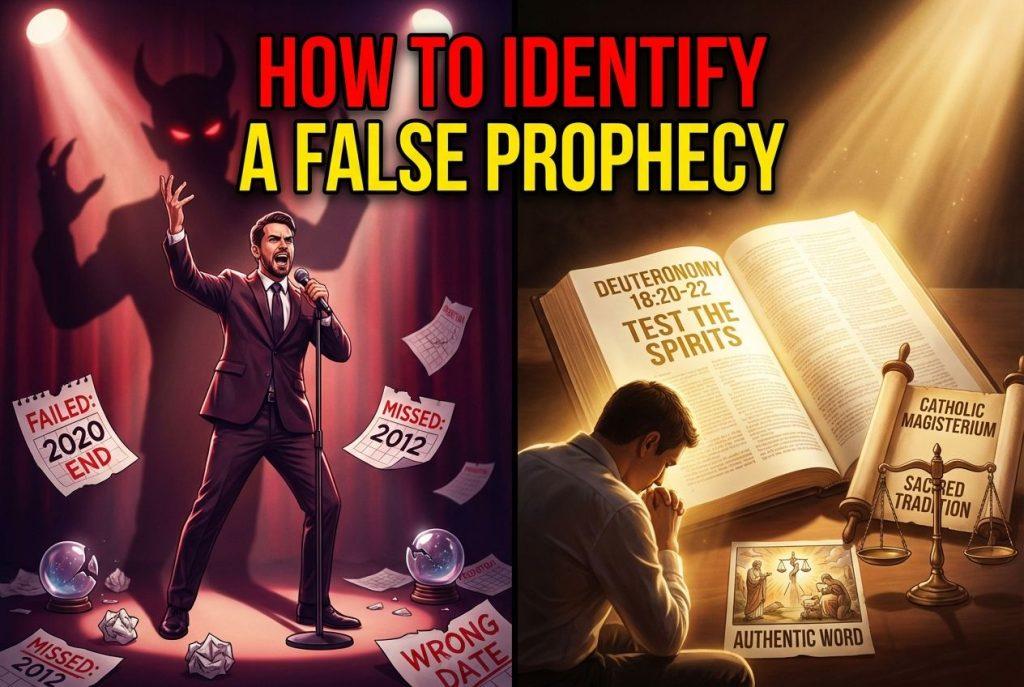
The Old Testament provides concrete criteria for identifying false prophets that remain relevant for Catholic discernment today. In Deuteronomy 18:20-22, Moses teaches that a prophet who speaks in the name of the Lord but whose prediction does not come to pass has spoken presumptuously and should not be feared. This test of fulfillment establishes a clear principle that authentic prophecy from God will prove true in its predictions. When someone claims to speak for God but their words fail to materialize, this demonstrates that they were not truly sent by God. However, this criterion must be applied with wisdom, recognizing that some prophecies are conditional and depend on human response, as seen in the book of Jonah where Nineveh’s repentance averted the prophesied destruction. The key issue is not simply failed predictions but whether someone habitually makes false claims while asserting divine authority for their words.
Deuteronomy 13:1-5 provides another essential test for prophecy, focusing on doctrinal content rather than miraculous signs. Moses warns that if a prophet or dreamer arises and gives a sign or wonder, and the sign or wonder comes to pass, but then says to follow other gods and serve them, the people must not listen to that prophet. This passage reveals that even accurate predictions or miraculous manifestations do not automatically validate a prophet if their message leads people away from the true God. The test of orthodoxy takes precedence over the test of signs and wonders. For Catholics, this means that any alleged prophecy must be evaluated first and foremost according to its conformity with established Catholic doctrine and its tendency to lead people toward or away from authentic faith. A message that contradicts the teachings of Scripture, Tradition, or the Magisterium cannot be from God regardless of any accompanying supernatural phenomena.
Jesus Himself provides guidance for identifying false prophets in the Sermon on the Mount. In Matthew 7:15-20, He warns His disciples to beware of false prophets who come in sheep’s clothing but inwardly are ravenous wolves. Christ teaches that these false prophets will be recognized by their fruits, using the analogy that good trees bear good fruit while bad trees bear bad fruit. This principle of discernment by fruits has become central to Catholic evaluation of prophecy. The fruits to be examined include not only the immediate effects of the prophecy but also the long-term impact on individuals and communities. Do people grow in holiness, charity, and humility? Does prayer increase and deepen? Are conversions authentic and lasting? Do vocations to priesthood and religious life flourish? These questions help reveal the true nature of alleged prophetic activity.
The apostles continued Christ’s teaching on discernment in their own writings and ministry. Saint Paul warns Timothy about false teachers who will arise in the last days, having the appearance of godliness but denying its power, and instructs him to avoid such people according to 2 Timothy 3:1-5. He also tells the Galatians that even if an angel from heaven should preach a gospel contrary to what they received, that angel should be accursed as stated in Galatians 1:8-9. This strong language underscores the seriousness with which the early Church regarded doctrinal purity. Saint Peter warns in 2 Peter 2:1-3 that false prophets will secretly bring in destructive heresies and exploit believers with false words. These biblical warnings establish that false prophecy is not merely a theoretical concern but a real danger that requires active vigilance from Church leaders and faithful alike. The New Testament consistently emphasizes that authentic prophecy builds up the body of Christ and strengthens faith while false prophecy tears down and destroys.
The Church’s Authority in Discernment
The Catholic Church exercises the God-given authority to discern and evaluate alleged supernatural phenomena including prophecies, apparitions, and locutions. This authority derives from Christ’s promise to Peter and the apostles that He would build His Church and the gates of hell would not prevail against it as recorded in Matthew 16:18. The bishops, as successors of the apostles, bear the primary responsibility for protecting the faithful from deception while also recognizing authentic movements of the Holy Spirit. The local diocesan bishop has the first obligation to investigate phenomena occurring within his territory and to form a judgment about their supernatural character. This local discernment takes place in dialogue with the national episcopal conference and ultimately with the Dicastery for the Doctrine of the Faith in Rome. The collaborative nature of this process ensures that no single bishop acts in isolation while respecting the principle of subsidiarity that places initial responsibility at the local level.
In May 2024, the Dicastery for the Doctrine of the Faith promulgated new norms for proceeding in the discernment of alleged supernatural phenomena, updating procedures that had been in place since 1978. These updated norms reflect the reality that alleged supernatural events now spread rapidly across diocesan and national boundaries through modern communications and increased travel. The new guidelines establish that the Dicastery must always be consulted and give final approval to what the bishop decides before he announces a determination on an event of alleged supernatural origin. This ensures consistency in the Church’s approach and prevents confusion among the faithful. The norms provide six possible prudential conclusions ranging from nihil obstat, which permits devotion, to a declaration of non-supernaturalness when evidence proves fabrication. Most significantly, the new norms clarify that as a general rule, the Church will not declare an event to be of supernatural origin but will evaluate whether signs of the Holy Spirit’s action can be recognized in the midst of the phenomenon.
The investigatory process established by the Church involves constituting a commission of experts including at least one theologian, one canonist, and others chosen based on the nature of the phenomenon. These commission members must be of unquestionable reputation, sure faith, certain doctrine, and proven prudence with no direct or indirect involvement in the persons or events being discerned. The commission conducts thorough examinations of witnesses under oath, reviews written materials and media produced by those involved, and engages appropriate scientific or technical experts when physical evidence requires analysis. All members of the commission are required to maintain confidentiality under oath. This structured approach ensures that evaluation of alleged prophecy rests on careful investigation rather than subjective impressions or popular enthusiasm. The Church recognizes that supernatural claims require extraordinary evidence and that protecting the faithful from deception takes priority over hasty approval of doubtful phenomena.
The evaluation phase applies both positive and negative criteria established through centuries of experience. Positive criteria include the credibility and good reputation of those involved, their mental equilibrium, honesty, humility, and docility toward ecclesiastical authority. The doctrinal orthodoxy of messages, the unpredictable nature of phenomena, and abundant spiritual fruits all weigh in favor of authenticity. Negative criteria include manifest errors about events, doctrinal errors, sectarian spirit breeding division, pursuit of profit or power, gravely immoral actions, and psychological alterations or pathological tendencies. The use of alleged supernatural experiences to exert control over people or carry out abuses is considered particularly grave. These criteria are applied cumulatively rather than individually, recognizing that complex situations may involve both authentic spiritual elements and problematic human factors mixed together. The goal is not to achieve absolute certainty but to reach a prudential judgment that serves the good of souls and protects the integrity of faith.
Doctrinal Conformity as the Primary Test
The most fundamental test for any alleged prophecy is its conformity with established Catholic doctrine. No genuine prophecy from God will ever contradict the truths He has already revealed through Sacred Scripture and Sacred Tradition as preserved and interpreted by the Magisterium. The Catechism is clear that private revelations do not belong to the deposit of faith, meaning they cannot add to or alter the definitive revelation given in Jesus Christ. Any message that claims to reveal new doctrines, contradicts existing teachings, or suggests that previous Church teaching was in error must be rejected as false regardless of any accompanying signs or wonders. This principle flows from the understanding that God does not contradict Himself, and the Holy Spirit who inspired Sacred Scripture and guides the Church’s Magisterium does not now inspire messages that oppose that same teaching. Catholics have the right and duty to measure all alleged prophecy against the unchanging truth of the faith.
False prophecy often introduces doctrinal errors subtly, mixing truth with falsehood in ways that can deceive even sincere believers. A message might contain many orthodox statements but include one or two departures from Catholic teaching on matters such as the nature of salvation, the role of Mary, the Real Presence in the Eucharist, or moral issues. Some alleged prophecies have claimed that certain souls are guaranteed salvation regardless of their response to grace, contradicting the Church’s teaching on the necessity of perseverance. Others have suggested alternative paths to salvation apart from Christ, opposing the clear biblical and magisterial teaching that Jesus is the only mediator between God and humanity as stated in 1 Timothy 2:5. Still others have promoted a false understanding of Divine Mercy that minimizes the reality of sin and the need for repentance. These doctrinal deviations, even when embedded in otherwise pious-sounding messages, mark prophecy as false. The faithful must develop sufficient knowledge of authentic Catholic teaching to recognize when something presented as prophecy actually contradicts the faith.
The theological content of alleged prophecy must also be evaluated for its depth and substance. Authentic prophecy typically demonstrates theological coherence and richness that reflects divine wisdom rather than merely human thinking. Messages that are theologically shallow, filled with platitudes, or focused primarily on sensational predictions rather than spiritual growth should raise concerns. True prophecy calls people to conversion, repentance, prayer, and greater love of God and neighbor. It strengthens faith, hope, and charity while pointing always toward Christ. False prophecy often emphasizes extraordinary claims about future events, secret knowledge unavailable to others, or the privileged status of the recipient. When the focus shifts from God and His truth to the prophet and their experiences, the authenticity of the message becomes suspect. Similarly, prophecies that foster fear rather than trust in God’s Providence, or that create anxiety about disasters and punishments without emphasizing God’s merciful love, bear the marks of false prophecy.
The relationship between alleged prophecy and the Church’s liturgical and sacramental life provides another crucial test of doctrinal conformity. Genuine prophecy always directs people toward fuller participation in the sacraments, especially the Eucharist and Reconciliation. Messages that encourage private devotions while diminishing the importance of Mass and the sacraments cannot be from God. Similarly, prophecy that suggests special revelations or experiences can substitute for the ordinary means of grace provided through the Church’s sacramental life contradicts Catholic teaching. The Church has consistently taught that the summit and source of Christian life is the Eucharist (CCC 1324), and authentic prophecy will always lead people more deeply into eucharistic communion. When alleged prophets claim that their messages or the devotions associated with them are more important than regular Mass attendance or reception of the sacraments, this reveals the false nature of their claims. True prophecy serves the Church’s sacramental life rather than competing with it or offering alternatives to it.
Examining the Fruits of Prophecy
The principle of discernment by fruits, established by Jesus in Matthew 7:16-20, remains the most practical and accessible way for ordinary Catholics to evaluate alleged prophecy. Good trees bear good fruit, and bad trees bear bad fruit. When examining prophecy, the Church looks for evidence of genuine spiritual fruit including conversions from sin, growth in prayer and holiness, increased devotion to the sacraments, vocations to priesthood and religious life, and acts of charity toward others. These fruits should be abundant, consistent over time, and clearly attributable to the prophetic message or phenomenon. Isolated cases or temporary enthusiasm do not constitute adequate evidence of authenticity. Rather, the Church seeks to identify patterns of genuine spiritual growth that transform lives and strengthen communities. False prophecy may produce initial excitement or emotional responses but fails to generate lasting conversion and sanctification. The absence of good fruit or the presence of bad fruit indicates that whatever supernatural forces may be involved, they are not divine in origin.
The examination of fruits must consider not only positive outcomes but also negative consequences that may indicate false prophecy. Division and discord within the Church or family relationships represent serious bad fruit. Authentic prophecy builds up the body of Christ and strengthens communion among believers while false prophecy invariably creates factions and separates people into insiders and outsiders. When those who accept a particular prophecy begin to view themselves as specially chosen or more enlightened than ordinary Catholics, this pride reveals spiritual poison rather than divine blessing. Similarly, when devotion to an alleged prophet or message becomes more important to followers than basic Christian discipleship, the situation has clearly deviated from authentic spirituality. Other forms of bad fruit include obsessive preoccupation with extraordinary phenomena at the expense of ordinary Christian living, neglect of family or work responsibilities in order to follow a prophet, and financial exploitation of believers through the sale of materials or solicitation of donations for the alleged work of God.
The character and behavior of those claiming prophetic gifts must also be evaluated as part of examining fruits. Scripture teaches that the fruit of the Spirit includes love, joy, peace, patience, kindness, goodness, faithfulness, gentleness, and self-control. Those who genuinely operate under the influence of the Holy Spirit will manifest these qualities in their lives. Conversely, characteristics such as pride, disobedience to Church authority, deception, manipulation, anger, or moral compromise indicate the absence of authentic spiritual gifts. The Church has encountered numerous cases where individuals claiming prophetic abilities have been shown to lead double lives, engaging in secret sins while presenting a holy exterior to followers. The discovery of such hypocrisy definitively proves the falseness of claimed prophecy. Even when no grave immorality is proven, patterns of behavior that contradict Christian virtue raise serious doubts about supernatural claims. True prophets consistently demonstrate humility, obedience to the Church, honesty, and transparent lives that can withstand scrutiny.
Long-term observation provides the most reliable assessment of fruits. Initial enthusiasm surrounding alleged prophecy may appear positive, but only time reveals whether the phenomenon produces lasting spiritual growth or merely temporary excitement. The Church deliberately proceeds with caution in evaluating supernatural claims, often waiting years or even decades before rendering judgment. This patience allows patterns to emerge that might not be visible in the early stages. Phenomena that begin with apparently good fruits sometimes reveal problems later when the prophet becomes proud, when financial improprieties surface, or when predicted events fail to occur. Conversely, some phenomena that initially seem problematic may produce unexpectedly abundant good fruits as time passes and questionable elements are clarified or corrected. The Church’s wisdom in this area reflects the recognition that human perception can be deceived by appearances while genuine spiritual fruit becomes increasingly obvious over time. Catholics should exercise similar patience rather than rushing to embrace or reject alleged prophecy based on limited information.
Warning Signs of False Prophets
Scripture and Church teaching identify specific warning signs that indicate false prophets. The pursuit of personal gain, whether financial, social, or psychological, represents a major red flag. Jesus warned that false prophets come in sheep’s clothing but inwardly are ravenous wolves, suggesting predatory intent hidden behind religious appearance. When individuals use alleged prophecy to enrich themselves, build personal followings, or gain power over others, their true motives become apparent. The new Vatican norms specifically identify “an overt pursuit of profit, power, fame, social recognition, or other personal interest closely linked to the event” as a negative criterion in evaluation. Authentic prophets typically resist publicity and attention, viewing their gifts as burdens to be carried rather than privileges to be exploited. They direct glory and honor to God rather than accepting it for themselves. False prophets, by contrast, cultivate their own celebrity and create dependence of followers upon their person rather than pointing people to Christ and His Church.
Another significant warning sign involves claims to have secret or privileged knowledge unavailable to the Church or to ordinary believers. False prophets often position themselves as unique channels of divine communication, suggesting that God speaks to them in ways He does not speak to Church leaders or through the ordinary teaching office. This attitude implicitly challenges the Church’s authority and creates an alternative magisterium based on private revelation. Some false prophets claim to have received new interpretations of Scripture that correct or supersede traditional Catholic understanding. Others assert that their messages contain information about future events that God has not revealed to the pope or bishops. These claims betray a fundamental misunderstanding of how God works through His Church. While the Holy Spirit does grant charisms to individuals throughout the body of Christ, these gifts always operate within the communion of the Church and under the authority of the hierarchy. Prophecy that claims to transcend or bypass ecclesial authority cannot be genuine.
Disobedience to legitimate Church authority constitutes clear evidence of false prophecy. When diocesan bishops or the Holy See raise concerns about alleged supernatural phenomena and request that certain activities cease or that messages not be disseminated, authentic prophets respond with humble obedience. False prophets resist correction, claiming that their divine mandate supersedes human authority or that Church officials are persecuting them. This pattern of disobedience often escalates over time, with alleged prophets becoming increasingly strident in their claims and increasingly hostile toward the hierarchy. Some false prophets have gone so far as to declare themselves under direct obedience to heaven rather than to earthly superiors, revealing a fundamental rupture with Catholic ecclesiology. The Church’s evaluation process includes observing how alleged prophets and their followers respond to ecclesial guidance. Willingness to cooperate with investigation and to accept correction marks authentic spiritual gifts while resistance and defiance indicate the opposite.
False prophets frequently make failed predictions while offering excuses or reinterpreting their words when events do not occur as foretold. While acknowledging that some prophecy is conditional and that human interpretation can err, a pattern of inaccurate predictions undermines claims to divine inspiration. When prophets habitually predict specific disasters, dates, or events that fail to materialize, they demonstrate that they are not speaking for God. Some false prophets have predicted the end of the world, the imminent coming of the Antichrist, global economic collapses, or massive natural disasters on specific dates, only to see those dates pass uneventfully. Rather than admitting error and ceasing prophetic activity, they often claim that prayer averted the disaster or that they miscalculated the timing. This pattern of failed predictions followed by excuses and new predictions reveals the false nature of the prophetic claims. While God can and does change His plans in response to human prayer and repentance, as seen in the book of Jonah, this should be the exception rather than the rule for someone claiming to speak divine messages regularly.
The Role of Obedience and Humility
Authentic prophets consistently demonstrate profound humility and complete obedience to the Church’s authority. They recognize that whatever gifts they may have received come entirely from God and that they remain imperfect instruments prone to mixing human elements with divine inspiration. True prophets actively seek guidance from spiritual directors, confessors, and Church authorities rather than operating independently. They submit their experiences and messages for evaluation without demanding that others accept their claims. When questioned or corrected, authentic prophets respond with docility and gratitude rather than defensiveness or hostility. The lives of canonized saints who received prophetic gifts demonstrate this consistent pattern of humility. Saints such as Catherine of Siena, Faustina Kowalska, and Padre Pio all subjected themselves to rigorous scrutiny by Church authorities and accepted correction when elements of their experiences were deemed problematic. Their willingness to suffer misunderstanding and even temporary condemnation rather than assert their own claims characterizes genuine prophetic charisms.
The virtue of obedience takes on particular importance in the context of prophecy because pride represents the fundamental sin that separates creatures from the Creator. False prophets typically exhibit pride in various forms, from obvious arrogance to more subtle forms of spiritual superiority. They may claim to have been chosen for special missions that set them apart from ordinary Catholics or suggest that their spiritual experiences surpass those of others including clergy and religious. This pride often manifests in resistance to normal Church procedures and authority structures. When bishops establish investigative commissions to examine alleged prophecy, false prophets frequently object to the process, claim that commission members lack spiritual discernment, or refuse to cooperate fully with legitimate inquiries. In extreme cases, false prophets have established schismatic groups that reject the authority of local bishops or even the Holy See. These actions clearly demonstrate that whatever spiritual forces may be involved, they are not from the Holy Spirit who always works to build up the unity of the Church.
The relationship between prophets and their followers provides another window into the presence or absence of authentic humility. True prophets consistently direct attention away from themselves toward Christ and His Church. They discourage the formation of personality cults and resist efforts by enthusiastic followers to elevate them to positions of spiritual authority. When people begin to treat them as infallible or to value their words above the teaching of the Church, authentic prophets firmly correct this error. They remind followers that private revelation must always remain subordinate to public revelation and that personal spiritual growth depends primarily on prayer, sacraments, and fidelity to the Gospel rather than on following alleged prophets. False prophets, by contrast, often encourage the devotion of followers and allow themselves to be treated as specially anointed instruments of God. They may surround themselves with inner circles of disciples who serve as intermediaries between the prophet and ordinary believers. This hierarchical structure that places the prophet at the apex contradicts the Catholic understanding of the universal call to holiness and the fundamental equality of all the baptized.
The test of humility extends to how alleged prophets handle criticism and negative evaluations from Church authorities. When diocesan bishops or the Dicastery for the Doctrine of the Faith express concerns about phenomena or render negative judgments, true prophets accept these decisions with faith in divine Providence. They trust that the Holy Spirit guides the Church’s discernment processes and that God will bring good even from what appears to be rejection of genuine gifts. This acceptance requires heroic humility because it often means accepting public repudiation and the cessation of activities that may have brought comfort to many people. False prophets react very differently to negative Church judgments. They typically claim that authorities have erred, that political or financial interests have corrupted the evaluation process, or that they are being persecuted like the prophets of old. They may continue their activities in defiance of Church directives, asserting that their mandate comes directly from heaven and trumps ecclesial authority. This pattern of defiance and continued activity despite explicit prohibitions definitively marks prophecy as false and potentially spiritually dangerous to those who continue following it.
Discernment in Practice for Ordinary Catholics
Ordinary Catholics who encounter alleged prophecy must develop practical skills for initial evaluation before Church authorities render official judgments. The first step involves consulting established Catholic teaching through the Catechism, Scripture, and writings of saints and doctors of the Church. Any message that contradicts these sources can be safely rejected without need for further investigation. The faithful should ask basic questions about alleged prophecy including whether it promotes devotion to the Eucharist and sacraments, whether it encourages prayer and conversion, whether it builds up the Church or creates division, and whether it manifests the fruits of the Holy Spirit. These preliminary assessments help protect individuals from obvious deceptions while awaiting official Church evaluation of more complex cases. Catholics should remember that they have no obligation to believe or follow any private revelation, even those approved by the Church, and that their salvation depends entirely on faithfulness to public revelation and the ordinary means of grace.
When encountering alleged prophecy through media, publications, or personal contacts, Catholics should maintain healthy skepticism while remaining open to authentic movements of the Holy Spirit. Skepticism does not mean cynicism or wholesale rejection of supernatural possibilities but rather the prudent reserve recommended by Church teaching. This balanced approach recognizes that false prophecy has been common throughout Church history while also acknowledging that God continues to work through genuine prophetic gifts. The faithful should avoid two opposite errors: gullibly accepting every claim of supernatural experience and rigidly dismissing all such claims as impossible or irrelevant. Instead, they should gather information, consult knowledgeable Catholics including priests and theologians, and wait patiently for the Church’s judgment. In the meantime, they can support genuine spiritual movements with proven fruits while withholding full commitment to phenomena still under investigation.
Personal spiritual direction provides essential protection against deception by false prophecy. Every Catholic should have a regular confessor or spiritual director who knows their spiritual life and can offer guidance when questions about alleged supernatural experiences arise. Individuals who believe they have received prophetic messages or other extraordinary gifts should immediately discuss these experiences with a competent spiritual director rather than publicizing them. The director can help discern whether experiences come from God, human imagination, or demonic deception. Even when experiences appear genuine, spiritual directors provide necessary caution against pride, ensure proper testing of spirits, and help maintain proper perspective that keeps attention focused on growth in ordinary virtues rather than on extraordinary phenomena. Those who refuse spiritual direction or insist on publicizing their experiences despite advice to maintain silence reveal attitudes incompatible with authentic mystical gifts.
Education in Catholic teaching forms the most important long-term protection against false prophecy. Catholics who know their faith well through study of the Catechism, regular reading of Scripture, and formation in Catholic theology develop the capacity to recognize errors quickly. They understand the distinction between public and private revelation, the Church’s teaching on the hierarchy of truths, and the fundamental doctrines that cannot be compromised. This theological literacy enables them to evaluate messages critically rather than accepting them based solely on emotional appeal or claims of supernatural origin. Parishes and dioceses serve the faithful well by providing robust adult faith formation that includes teaching about discernment of spirits, the Church’s approach to private revelation, and common characteristics of false prophecy. When Catholics possess solid grounding in authentic doctrine and spirituality, they become far less vulnerable to deception and far more capable of contributing to the Church’s overall discernment of alleged supernatural phenomena.
The Danger of Obsession with Prophecy
Excessive preoccupation with prophecy and alleged supernatural phenomena poses spiritual dangers even when the phenomena themselves are authentic. The Catechism warns against unhealthy curiosity about the future, teaching that Christians should place themselves confidently in the hands of Providence rather than seeking detailed knowledge of coming events (CCC 2115). When Catholics become obsessed with prophecy, their spiritual lives often become unbalanced, with attention shifting from the person of Christ and the demands of the Gospel to fascination with extraordinary messages and predictions. This unhealthy focus can lead to neglect of ordinary Christian duties including family responsibilities, work obligations, and service to neighbors. Some individuals spend excessive time reading and discussing alleged prophecies, attending conferences about apparitions, or traveling to sites of claimed supernatural activity while failing to attend daily Mass, pray the Rosary regularly, or engage in corporal and spiritual works of mercy. This disordered spirituality reveals that even interest in genuine supernatural phenomena can become spiritually harmful when it displaces proper priorities.
The desire for novelty and extraordinary experiences often drives excessive interest in alleged prophecy. Human nature tends toward curiosity about hidden things and attraction to the sensational. False prophets exploit these tendencies by offering exciting predictions, secret information, and claims of direct divine communication unavailable to ordinary believers. Catholics must recognize that God does not typically work through spectacular means but rather through the ordinary channels He established in His Church. The sacraments, Scripture, prayer, and Christian community provide everything necessary for salvation and sanctification. While God occasionally grants extraordinary gifts for particular purposes, these remain exceptions to His normal way of operating. The faithful who constantly seek signs and wonders or who find ordinary Catholic life insufficient demonstrate spiritual immaturity. They resemble the crowds who followed Jesus not because they believed in Him but because they ate the loaves and were filled, as Jesus Himself observed in John 6:26. Mature faith rests on the Person of Christ and His word rather than on miraculous manifestations.
Fascination with prophecy sometimes reflects anxiety about the future and desire for control through knowledge. People living through uncertain times often seek reassurance through alleged prophecies that claim to reveal what lies ahead. While understandable, this attitude contradicts the virtue of hope that entrusts the future entirely to God’s providential care. Jesus taught His disciples not to be anxious about tomorrow because each day has enough trouble of its own according to Matthew 6:34. This teaching applies not only to mundane concerns but also to questions about Church and world events. Catholics should focus on living faithfully in the present moment rather than trying to discern detailed maps of future history through alleged prophecies. When people become anxious about predicted chastisements, disasters, or tribulations, they reveal lack of trust in God’s love and power. True Christian hope remains confident that nothing can separate believers from the love of God in Christ Jesus, as Saint Paul declares in Romans 8:38-39, regardless of what trials may come.
The Church’s pastoral response to unhealthy obsession with prophecy includes teaching proper perspective on private revelation and encouraging return to essentials of Catholic faith and practice. Priests and catechists must help the faithful understand that salvation depends entirely on baptismal grace lived out through faith, hope, and charity rather than on knowledge of or adherence to particular prophecies or apparitions. Even the most significant approved apparitions such as Lourdes and Fatima do not constitute requirements for Catholic belief, though the Church recognizes their spiritual value and the authenticity of supernatural intervention in those cases. When individuals exhibit signs of unhealthy preoccupation with alleged prophecy, spiritual directors should guide them back toward regular prayer, frequent sacraments, Scripture reading, and works of charity. This refocusing on fundamentals helps restore proper spiritual balance and protects against the dangers inherent in excessive concern with extraordinary phenomena.
Church Approved Apparitions and Their Place
The Catholic Church has approved certain apparitions and private revelations throughout history after careful investigation confirmed their authenticity and spiritual fruitfulness. These approved phenomena including Our Lady of Guadalupe, Lourdes, Fatima, and others hold significant places in Catholic devotional life. However, even Church approval does not place these private revelations on the same level as public revelation or make belief in them obligatory for Catholics. The 2024 Vatican norms clarify that approval, when given, indicates that nothing contrary to faith or morals has been found in the messages and that spiritual fruits are present, but it does not constitute a declaration of supernatural origin with the same certainty as dogmatic definitions. Catholics may freely choose whether to accept or follow approved apparitions according to their personal spiritual attraction and the evidence presented. No one can be required to believe in any private revelation or be considered less Catholic for respectfully declining to embrace particular devotions associated with apparitions.
Understanding the proper place of approved apparitions helps Catholics maintain correct perspective when evaluating new claims of prophecy or supernatural phenomena. The approved apparitions demonstrate certain common characteristics that serve as models for evaluating contemporary claims. They consistently emphasize basic Gospel messages such as prayer, repentance, conversion, and reception of sacraments rather than introducing novel doctrines. They strengthen devotion to Jesus through the Eucharist rather than creating alternative spiritual paths. They work within the Church’s sacramental structure rather than competing with it. The approved apparitions also exhibit humility on the part of visionaries who submitted to Church authority, endured investigation patiently, and directed attention toward God rather than themselves. When new alleged prophecies or apparitions lack these characteristics, they should be regarded with considerably greater caution regardless of claims made by promoters or the enthusiasm of followers.
The distinction between approval and obligatory belief sometimes confuses Catholics who assume that Church approval requires their assent. In reality, the Church’s approval simply means that Catholics may prudently give adhesion to the phenomenon if they find it spiritually helpful. The famous theologian Benedict XIV, before becoming pope, explained that even regarding approved apparitions, the assent given is not Catholic faith but human faith based on probability that the Church’s judgment is correct. This teaching preserves the crucial distinction between divine faith, which rests on God’s authority revealing through the deposit of faith, and human faith, which rests on human testimony and evidence even when that evidence is very strong. Catholics who choose not to embrace particular approved apparitions or prophecies do not commit sin or show deficiency in faith. They simply exercise legitimate freedom in matters not definitively determined by revelation. This understanding should give comfort to those who feel pressured by enthusiastic promoters of particular apparitions or who worry that their lack of personal devotion to certain revelations indicates spiritual inadequacy.
The Church’s careful process for approving apparitions provides a model for how Catholics should approach all alleged supernatural phenomena. Years or even decades typically pass between initial reports and final approval, during which thorough investigation examines every aspect of the phenomenon. The Church looks at the lives and character of visionaries, the content of messages, the fruits produced, and the overall impact on faith and practice. Scientific investigation rules out natural explanations where physical phenomena are claimed. Theological experts evaluate whether messages conform to Catholic doctrine and represent authentic spiritual wisdom. Only after this exhaustive process, when abundant good fruits are evident and no substantial problems have emerged, does approval come. Even then, the Church maintains ongoing vigilance to ensure that subsequent developments do not reveal problems that were not initially apparent. This patient, thorough approach contrasts sharply with the hasty embrace of alleged prophecy common among some Catholics who accept extraordinary claims with minimal evidence or investigation. The faithful should imitate the Church’s prudence rather than rushing to judgment about contemporary phenomena.
Contemporary Challenges in Evaluating Prophecy
The digital age has created unprecedented challenges for evaluating alleged prophecy and protecting Catholics from deception. Messages claiming divine origin now spread instantly through social media, websites, and email rather than remaining confined to local communities where Church authorities could monitor and respond effectively. An alleged prophet in one country can gather followers worldwide within days, making diocesan investigation and control far more difficult. The anonymous nature of much internet communication enables people to circulate alleged prophecies without accountability or possibility of verification. Catholics encounter purported messages from the Virgin Mary, Jesus, or saints with no way to determine their actual source or to investigate the credibility of those claiming to receive them. This environment requires heightened vigilance and more sophisticated discernment skills than previous generations needed.
The proliferation of alleged prophecy on the internet includes mixture of authentic Church-approved messages, phenomena under investigation, material from condemned sources, and outright fabrications. Many websites and social media accounts present these different categories side by side without clear distinction, creating confusion about what the Church actually approves or tolerates. Some sites deliberately mislead readers by claiming Church approval for phenomena that have been explicitly condemned or by suggesting that diocesan investigation constitutes approval when it only means that formal judgment has not yet been rendered. Catholics who rely on these sources for spiritual guidance risk embracing false prophecy while believing they follow approved revelations. The solution requires returning to trustworthy sources including official diocesan websites, Vatican publications, and established Catholic media that respect the Church’s authority and accurately report on the status of alleged supernatural phenomena.
Another contemporary challenge involves the commercialization of alleged prophecy. Books, videos, conferences, pilgrimages, and merchandise associated with claimed supernatural phenomena generate substantial revenue for some individuals and organizations. This financial dimension creates powerful incentives to promote and perpetuate alleged prophecy regardless of questions about authenticity. When economic interests become entangled with spiritual claims, discernment becomes more difficult because motives other than truth and the good of souls drive the propagation of messages. The Vatican’s 2024 norms specifically identify pursuit of profit as a negative criterion in evaluation, recognizing that commercialization often indicates false prophecy. Catholics should be wary of alleged prophets or their promoters who sell extensive catalogs of materials, charge significant fees for access to messages or events, or create business enterprises around supernatural claims. While legitimate costs for publishing and organizing events exist, the level and nature of commercialization often reveals the true priorities of those involved.
The sensationalist nature of some alleged contemporary prophecy reflects broader cultural trends rather than authentic Catholic spirituality. Messages emphasizing dramatic predictions, secret information, or imminent catastrophes attract attention and followers in ways that simple calls to prayer and conversion do not. This reality tempts some individuals to embellish or fabricate prophecies that appeal to contemporary anxieties about social, political, or environmental issues. The resulting messages often say more about current events and cultural fears than about eternal spiritual truths. Authentic prophecy throughout Church history has certainly addressed contemporary situations, but always in light of timeless Gospel principles rather than merely reflecting passing concerns. Catholics evaluating contemporary alleged prophecy should ask whether messages transcend their immediate context with wisdom applicable across times and cultures or whether they simply reflect current news and controversies dressed in religious language. The latter indicates human rather than divine origin.
The Pastoral Response to False Prophecy
When diocesan bishops or the Holy See determine that alleged prophecy is false, they have responsibility to protect the faithful through appropriate interventions. The 2024 Vatican norms provide several possible responses depending on the seriousness of problems identified. In cases where critical issues are minor and can be addressed through clarification, bishops may allow devotion to continue with appropriate guidance. When problems are more serious but the phenomenon has spread widely and produced some good fruits, bishops may refrain from outright prohibition while discouraging further promotion and redirecting devotion into healthier channels. In the most serious cases involving doctrinal errors, immoral conduct, or clear evidence of fabrication, bishops must prohibit adherence to the phenomenon and offer catechesis explaining the reasons for the decision. This graduated approach allows pastoral flexibility while ensuring that the faithful receive clear guidance about what they may or may not follow.
The challenge in responding to false prophecy often involves people who have become deeply attached to particular messages or alleged prophets. Those who have structured their spiritual lives around following specific prophecies may experience a negative judgment from Church authorities as devastating or even as persecution. Compassionate pastoral care requires understanding that people typically embrace alleged prophecy from sincere desire for closeness to God rather than from bad will. They may have experienced genuine spiritual growth through devotions associated with the phenomenon even if the supernatural claims were false. Priests and pastoral ministers must help such individuals transition away from problematic devotions without rejecting the legitimate spiritual growth they experienced. This involves affirming what was good, gently correcting what was false, and pointing toward authentic Catholic spirituality rooted in Scripture, Tradition, and the sacraments. Harsh condemnation of those who followed false prophecy serves no purpose and often drives them toward even more problematic spiritual paths.
Education represents the most important long-term pastoral response to the problem of false prophecy. Catholics who understand the Church’s teaching on private revelation, who know the criteria for evaluating supernatural claims, and who possess solid grounding in basic doctrine become far less vulnerable to deception. Parishes should regularly offer formation on these topics rather than assuming that Catholics naturally know how to evaluate alleged prophecy. Many sincere believers have never received clear teaching about the difference between public and private revelation or about the Church’s discernment processes. Without this knowledge, they lack tools for making informed judgments when they encounter alleged supernatural phenomena. Comprehensive adult faith formation that includes teaching about discernment serves as preventive medicine, protecting Catholics before they become entangled in problematic situations. This education should begin in childhood catechesis and continue throughout adult life as part of ongoing formation in the faith.
The Church must also address the phenomenon of Catholics who persist in following condemned prophecy despite clear directives from legitimate authority. Some individuals continue participating in devotions, spreading messages, or supporting alleged visionaries even after bishops have prohibited such activities. This obstinacy sometimes reflects sincere but misguided conviction that Church authorities have erred, but it can also indicate spiritual pride that elevates personal judgment above ecclesial authority. Pastors must firmly teach that obedience to the Church constitutes an essential element of Catholic faith and that persistent disobedience regarding even non-dogmatic matters separates people from full communion. While patience and continued invitation to return to obedience should characterize the initial approach, there may come a point when Church authorities must impose canonical penalties to protect the faith of others and to call recalcitrant individuals to repentance. The goal remains always the salvation of souls and the preservation of unity in the body of Christ.
Disclaimer: This article presents Catholic teaching for educational purposes. For official Church teaching, consult the Catechism and magisterial documents. For personal spiritual guidance, consult your parish priest or spiritual director. Questions? Contact editor@catholicshare.com
Sign up for our Exclusive Newsletter
- 📌 Add CatholicShare as a Preferred Source on Google
- 🎁 Join us on Patreon for Premium Content
- 🎧 Check Out These Catholic Audiobooks
- 📿 Get Your FREE Rosary Book
- 📱 Follow Us on Flipboard
-

Recommended Catholic Books
Discover hidden wisdom in Catholic books — invaluable guides enriching faith and satisfying curiosity. #CommissionsEarned
- The Early Church Was the Catholic Church
- The Case for Catholicism - Answers to Classic and Contemporary Protestant Objections
- Meeting the Protestant Challenge: How to Answer 50 Biblical Objections to Catholic Beliefs
As an Amazon Associate, I earn from qualifying purchases. Thank you for your support.