
Brief Overview
- The Catholic Church teaches that any person, even someone who is not baptized, can perform a valid baptism in an emergency situation when death appears near.
- An emergency baptism requires three essential elements: natural water, the proper Trinitarian formula, and the intention to do what the Church does when baptizing.
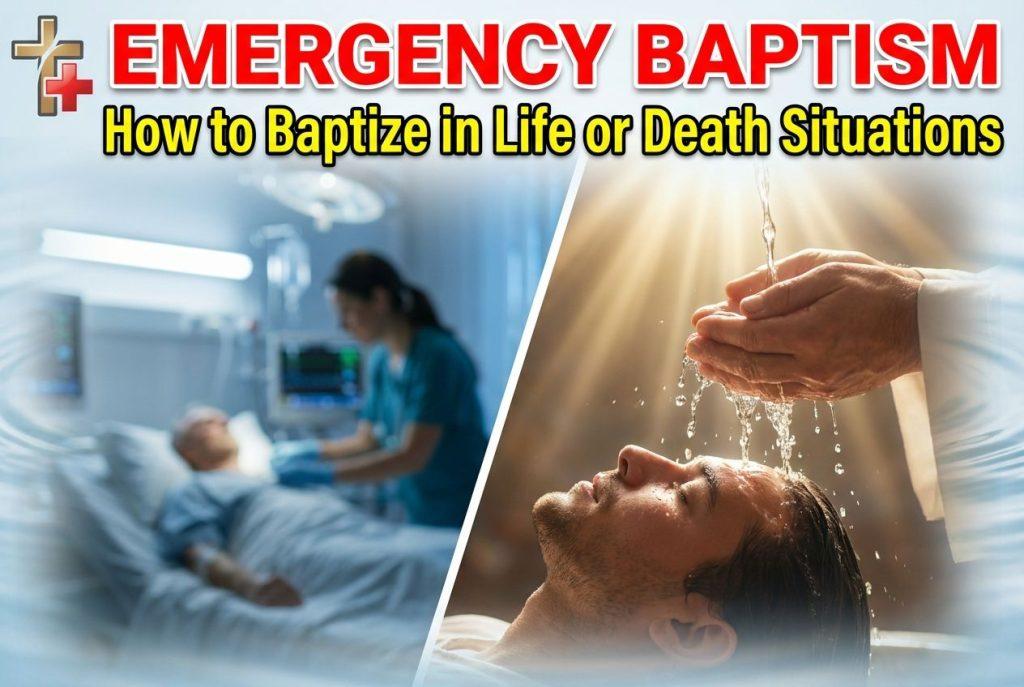
- The minister must pour water over the person’s head while saying the exact words, “I baptize you in the name of the Father, and of the Son, and of the Holy Spirit.”
- For infants in danger of death, baptism should be administered immediately without delay, while adults must show some knowledge of basic Christian truths and express desire for the sacrament.
- After performing an emergency baptism, the person who administered it must notify the local parish as soon as possible so the baptism can be properly recorded in the church registers.
- Emergency baptisms are valid and complete sacraments that need no repetition, though the Church may later supply additional ceremonies if the person survives.
Understanding the Theological Foundation of Emergency Baptism
The Catholic Church holds that baptism stands as the gateway to all other sacraments and to eternal life itself. This sacrament brings about rebirth in water and the Holy Spirit, freeing people from sin and incorporating them into the Body of Christ, which is the Church. The Church teaches that baptism is truly necessary for salvation, as Christ himself commanded his disciples to baptize all nations. This teaching finds its roots in Sacred Scripture, particularly in the Gospel of John 3:5, where Jesus tells Nicodemus that no one can enter the kingdom of God without being born of water and the Spirit. The Lord’s words in Mark 16:16 further emphasize this necessity when he states that whoever believes and is baptized will be saved. The Church takes these commands seriously and recognizes that God desires all people to be saved and come to knowledge of the truth.
Because baptism carries such weight for eternal salvation, the Church provides for emergency baptisms when a person faces imminent death. The Catechism addresses this matter directly, explaining that God has bound salvation to the sacrament of baptism, though he himself is not bound by his sacraments. The Church knows of no other means than baptism that assures entry into eternal happiness. This creates a pastoral urgency when someone’s life hangs in the balance. The Church therefore allows anyone, regardless of their own baptismal status or religious affiliation, to baptize in cases of necessity. This provision reflects both the universal saving will of God and the absolute necessity of baptism for salvation, as outlined in the teachings found in references (CCC 1257). The Church’s wisdom shines through in making this sacrament accessible even when ordinary ministers cannot be present.
The theological principle undergirding emergency baptism rests on the understanding that the sacraments exist for people, not people for the sacraments. While the Church maintains proper order and designated ministers for baptism under normal circumstances, she also recognizes that love and mercy must prevail in emergency situations. The ordinary ministers of baptism are bishops, priests, and in the Latin Church, deacons. However, the Church has always understood that when death approaches and these ministers are unavailable, the need for baptism supersedes the usual requirements. This teaching appears clearly in canon law and in the Catechism, which states that in case of necessity, any person can baptize if they have the required intention. The required intention means willing to do what the Church does when she baptizes and applying the Trinitarian baptismal formula, as referenced in (CCC 1256).
This allowance for universal administration of baptism in emergencies demonstrates the Church’s profound respect for human dignity and eternal destiny. The Church believes that every human person has been created for communion with God and that baptism opens the door to this communion. When someone faces death without having received this sacrament, the Church wants every possible opportunity provided for them to receive it. The permission for anyone to baptize removes all barriers and obstacles that might prevent someone from entering into the divine life. This practice has ancient roots in Christian tradition and reflects the early Church’s understanding of baptism’s crucial role. The Church fathers wrote extensively about baptism by blood, baptism by desire, and the various circumstances under which people might receive this sacrament or its effects, showing that the Church has always sought ways to extend God’s mercy to all people.
The necessity of baptism for salvation does not mean that God cannot save those who die without it through no fault of their own. The Church teaches about baptism of desire and baptism of blood as alternative means by which God can bring people into his grace. Those who suffer death for the faith without having received water baptism are considered baptized by their blood. Similarly, catechumens who die before their baptism, along with others who would have desired baptism if they had known of its necessity, can be saved through their implicit desire. The Church also entrusts to God’s mercy those children who die without baptism, hoping in God’s desire that all people be saved. Nevertheless, these exceptions do not diminish the urgency of actually baptizing those in danger of death whenever possible. The Church remains firm in her conviction that we must use the means Christ established and not presume upon alternative paths when the ordinary means are available to us.
The practice of emergency baptism also reflects the Church’s understanding of the priesthood of all believers. While the ministerial priesthood of ordained clergy differs essentially from the common priesthood of the baptized faithful, all Christians share in Christ’s priestly, prophetic, and kingly office. In emergency situations, this common priesthood finds particular expression when a layperson administers baptism. The Church does not view this as an irregularity or a lesser form of the sacrament, but as a fully valid conferral of grace. The sacrament depends not on the worthiness or status of the minister, but on the proper matter, form, and intention. When these elements are present, Christ himself acts through the minister, no matter who that minister might be. This understanding liberates Catholics from any hesitation they might feel about baptizing in an emergency, knowing that they act as instruments of Christ’s saving work.
The Church’s teaching on emergency baptism also connects to her missionary mandate. Every baptized Christian shares responsibility for spreading the Gospel and bringing others to Christ. While most people will never face a situation requiring emergency baptism, understanding this teaching prepares Catholics to respond if such a situation arises. This preparation involves both knowledge of the proper procedure and awareness of the sacrament’s importance. When Catholics understand why the Church permits and even encourages emergency baptism, they become better equipped to act decisively in moments of crisis. The teaching thus serves both practical and formative purposes, shaping Catholics into people who value eternal realities and who stand ready to help others encounter Christ. This readiness to serve others’ spiritual needs, even in difficult circumstances, exemplifies authentic Christian charity and commitment to the Gospel.
Identifying Situations That Constitute Emergencies
An emergency baptism becomes appropriate when a person faces imminent danger of death and lacks sufficient time to secure the presence of a priest or deacon. The most common scenarios involve medical crises in hospitals, accidents, natural disasters, or any sudden circumstance where death appears likely. For newborn infants, particularly those born prematurely or with life-threatening conditions, emergency baptism should be administered without delay. Medical professionals, including doctors and nurses, frequently perform emergency baptisms in neonatal intensive care units and delivery rooms when babies show signs of critical distress. Parents, family members, or any person present may also baptize these infants. The Church’s canon law explicitly states that an infant in danger of death is to be baptized without any delay, removing any question about whether to wait for better circumstances or more suitable ministers.
The definition of imminent death allows for reasonable pastoral judgment rather than requiring absolute certainty. A person need not be in their final moments for emergency baptism to be appropriate. If medical professionals have determined that death is likely or if the situation appears critical, emergency baptism can proceed. This might include cases of severe trauma, terminal illness with rapid decline, complications during childbirth, or any medical emergency where survival seems uncertain. The Church errs on the side of administering the sacrament rather than waiting, because the eternal consequences of dying without baptism far outweigh any concerns about acting prematurely. If the person survives after receiving emergency baptism, the baptism remains fully valid and need not be repeated, though the Church may later supply the additional ceremonies and prayers that normally accompany the sacrament in more formal settings.
For adults facing death, emergency baptism requires certain conditions beyond the mere presence of danger. An adult in danger of death can be baptized if they possess some knowledge of the principal truths of the faith and have manifested in any way their intention to receive the sacrament. This knowledge need not be comprehensive or sophisticated; basic awareness of God, Jesus Christ, and the Christian message suffices. The person should understand at a fundamental level what baptism means and why they desire it. They must express this desire somehow, whether through words, gestures, or other clear signs of consent. Canon law recognizes that in emergency situations, perfect catechesis cannot be expected, but genuine faith and desire must be present. The person administering the baptism should try to ascertain these elements through conversation if possible, though even minimal communication may suffice in critical circumstances.
The question of consent becomes particularly important with adults because baptism cannot be forced upon someone against their will. Even in emergencies, the Church respects human freedom and dignity. If an unconscious adult has never expressed any desire for baptism or has actively rejected Christianity, emergency baptism should not be administered without clear prior indication of their wishes. However, if the person had been preparing for baptism, had expressed interest in becoming Catholic, or had shown openness to the faith, emergency baptism can proceed. Family members or friends might provide information about the person’s intentions and desires. In cases of genuine doubt where the person cannot communicate and their wishes remain unknown, the Church generally advises that baptism be administered conditionally, adding the phrase “If you are capable of receiving it” before the baptismal formula.
Emergency baptisms also arise in situations involving miscarriage or stillbirth. When a child is miscarried or appears to be stillborn, baptism should be administered if any sign of life exists or if doubt remains about whether life might still be present. The Church teaches respect for human life from conception and recognizes that even very young embryos or fetuses are human persons deserving of baptism. Parents experiencing pregnancy loss often find comfort in baptizing their child, and medical personnel should be prepared to facilitate this when requested. If the child has clearly died and shows no vital signs, baptism cannot be administered because the sacrament requires a living recipient. However, when any uncertainty exists, baptism should be given to ensure that if life is present, even minimally, the child receives this gift of grace.
Situations involving people who are actively dying but not yet deceased require sensitivity and promptness. When someone enters the final stages of dying, whether from old age, disease, or injury, emergency baptism becomes appropriate if they have never been baptized and express desire for it. Hospice patients, individuals withdrawing life support, or those receiving palliative care might request baptism as death approaches. Even if death does not come immediately, the serious danger justifies proceeding with emergency baptism rather than attempting to arrange a more formal ceremony. The Church recognizes that these moments carry profound spiritual significance and should not be delayed by administrative concerns or scheduling difficulties. The person’s immediate spiritual needs take precedence over ceremonial preferences.
The emergency nature of a baptism does not depend solely on physical danger of death. In rare cases, spiritual danger might also warrant expedited baptism, though this typically would not involve the abbreviated emergency rite. For instance, someone facing execution, imminent deportation to a place where they cannot access the Church, or other circumstances preventing future access to the sacrament might receive baptism even without imminent medical danger. These situations would normally involve a priest or deacon if at all possible, but they illustrate that the Church considers various forms of necessity. The overriding principle remains that baptism should not be unnecessarily delayed when someone genuinely desires it and circumstances make waiting imprudent or impossible. The Church’s pastoral approach prioritizes bringing people to Christ over maintaining perfect ceremonial standards.
Understanding these emergency situations helps Catholics recognize when they might need to act. Most people will never face such circumstances, but healthcare workers, first responders, military personnel, and others in certain professions encounter emergencies more frequently. These individuals benefit from knowing the Church’s teaching on emergency baptism so they can respond appropriately if needed. Additionally, expectant parents should understand that if complications arise during or after childbirth, they have the right and ability to baptize their child themselves without waiting for clergy. This knowledge provides both practical preparation and spiritual comfort, knowing that the Church has provided ways to ensure that those in danger can receive the grace of baptism even when ideal circumstances are absent.
The Essential Elements Required for Valid Baptism
A valid baptism requires three essential elements: proper matter, proper form, and proper intention. These elements must all be present for the sacrament to truly occur, and understanding each element helps ensure that emergency baptisms are administered correctly. The matter of baptism refers to the physical element used, which must be natural water. This water can be from any source, whether tap water, bottled water, water from a stream or lake, or any other natural water. The water need not be blessed or holy water, though blessed water can certainly be used if available. What matters is that the substance is genuine water, not some other liquid. Milk, oil, juice, or any other liquid cannot substitute for water in baptism. The requirement for water comes directly from Christ’s command and example, and the Church cannot change this essential element.
The manner of applying the water can vary slightly while remaining valid. The traditional and preferred method involves pouring water three times over the person’s head while pronouncing the baptismal formula. This triple pouring corresponds to the three Persons of the Trinity invoked in the formula. However, a single pouring of water while saying the entire formula also constitutes valid baptism. In situations where the person cannot be positioned for water to be poured over their head, water may be applied to any part of the body that can be reached, though the head remains the preferred location when possible. Some ancient traditions practiced baptism by immersion, fully submerging the person in water, and this method also remains valid. In emergencies, however, immersion rarely proves practical, so pouring remains the standard approach for emergency situations.
The amount of water used should be sufficient to constitute actual washing, not merely a symbolic gesture. While no specific quantity is mandated, the water should flow over the skin rather than simply touching it. A few drops might suffice in extreme circumstances where water is scarce, but more water is preferable when available. The water should actually contact the person’s skin rather than just their clothing or hair alone, though water flowing over hair that reaches the scalp would be acceptable. In hospital settings where intravenous tubes, medical tape, or bandages might cover parts of the head, the minister should attempt to find an area of exposed skin. If absolutely necessary, water can be applied to the forehead, face, hand, arm, or any accessible body part while maintaining the proper intention and formula.
The form of baptism refers to the words that must be spoken while applying the water. The essential formula is: “I baptize you in the name of the Father, and of the Son, and of the Holy Spirit.” These exact words, or their equivalent in another language, must be used. The formula cannot be changed or adapted to suit personal preferences or contemporary sensibilities. Attempts to alter the Trinitarian formula by using different titles for the divine Persons, such as “Creator, Redeemer, and Sanctifier,” render the baptism invalid. The Church has consistently taught that the precise Trinitarian names must be invoked because this formula comes from Christ’s own command in Matthew 28:19. The minister should speak these words clearly and audibly while simultaneously pouring the water, ensuring that the words and action occur together as one unified sacramental sign.
The word “I” in the formula is also essential because it indicates that a specific person is performing the action of baptizing. The formula must be in the first person singular, not in some passive or third-person construction. Saying “You are baptized” or “I baptize this person” would not suffice. The person administering the sacrament must say “I baptize you,” directly addressing the recipient. The name of the person being baptized can be included at the beginning of the formula if known, saying “NAME, I baptize you in the name of the Father, and of the Son, and of the Holy Spirit.” However, knowing or using the person’s name is not required for validity. If the minister does not know the person’s name, they can simply proceed with the formula without it. The essential elements remain the first-person action, the direct address to the recipient, and the invocation of the Trinity.
The intention required for valid baptism means that the minister must will to do what the Church does when baptizing. This does not require that the minister understand all the theology of baptism or even be a believer themselves. Rather, the minister must intend to perform the action that the Christian Church calls baptism, whatever that means. Even an atheist or member of another religion can validly baptize if they intend to do what Christians do in baptism. This intention distinguishes a sacramental baptism from merely pouring water on someone for other purposes, such as washing, playing, or performing in a drama. The internal intention of the minister matters, not their personal faith or lack thereof. In emergencies, a Catholic performing baptism certainly intends to do what the Church does, so this requirement poses no difficulty for the faithful.
The minister should take care that all three elements occur together as one action. The water should be poured while the words are spoken, not before or after. If the water is poured and then the words are said, or vice versa, the baptism would be invalid. The simultaneous unity of matter and form constitutes the complete sacramental sign. In practice, this means beginning to pour the water as the first words are spoken and continuing the pouring through the entire formula. If multiple pourings are used, the words can be divided so that water is poured three times, once each at the mention of Father, Son, and Holy Spirit. Alternatively, the water can be poured continuously as one action while the complete formula is spoken. Either approach works as long as the water and words occur together as a unified sacramental action.
These essential elements apply universally to all baptisms, whether performed in solemn ceremonies in cathedrals or in emergency situations in hospital rooms. The Church makes no distinction between the validity of a baptism performed by a pope in St. Peter’s Basilica and one performed by a frightened parent over a dying infant. When the proper matter, form, and intention are present, Christ himself acts through the minister to bring about the sacramental reality. This teaching should give confidence to anyone who might need to perform emergency baptism. They need not doubt whether their action will be effective or whether they possess sufficient authority or worthiness. By using water, speaking the correct words, and intending to baptize, they become instruments of God’s grace, and the sacrament truly occurs regardless of their personal status or qualifications.
Step-by-Step Procedure for Administering Emergency Baptism
When an emergency situation arises requiring baptism, the first step is to secure water as quickly as possible. Any container of water will work, whether a cup, bottle, bowl, or any other vessel. If no container is available, water can be poured directly from a faucet or fountain. In hospital settings, water can often be found in patient rooms, bathrooms, or water dispensers. The person preparing to baptize should gather the water and bring it to where the person in danger is located. If the person cannot be moved and no water is nearby, someone should be sent to retrieve water while the minister remains with the person. During this time, if the person is conscious, the minister might explain what is about to happen and, if the person is an adult, confirm their desire to be baptized.
Once water is secured, the minister should position themselves near the person’s head if possible. For infants or small children, the minister might hold the child or have someone else hold them in a position that allows water to be poured over the head. For adults in beds or on gurneys, the minister should stand or lean close enough to comfortably reach the person’s head. If medical equipment, tubes, or other devices prevent access to the head, the minister should identify whatever part of the body can be reached. In cases where the person is fully covered with medical equipment, blankets, or bandages, the minister may need to gently move these items or ask medical personnel for assistance in exposing a small area of skin. The goal is to ensure that the water will actually contact the person’s body while maintaining their dignity and not interfering with medical care.
The minister should then explain briefly what is about to happen, especially if the person is conscious. For adults, this explanation provides an opportunity to confirm their consent and desire. A simple statement such as “I am going to baptize you now” suffices. If the person is unconscious or unable to respond, and their desire for baptism has been established through other means, the minister can proceed without this step. For infants, no consent or explanation is necessary because the Church allows parents to choose baptism for their children. The minister might offer a word of comfort to parents present, acknowledging the gravity of the situation while assuring them of God’s love and mercy. This pastoral moment should not be prolonged, however, because the urgency of the situation demands prompt action.
The minister should then take the water and prepare to pour it while speaking the baptismal formula. If using a container, the minister should hold it with one hand in a position that allows water to flow out smoothly. The other hand can be placed gently near or on the person’s head to guide the water if needed. The minister should then begin speaking the formula while simultaneously beginning to pour the water. The words should be spoken clearly, in a voice loud enough to be heard but not shouted. The minister says, “I baptize you in the name of the Father, and of the Son, and of the Holy Spirit,” while water flows over the person’s head or whatever body part can be reached. If the person’s name is known, it can be included: “NAME, I baptize you in the name of the Father, and of the Son, and of the Holy Spirit.”
If the minister chooses to pour water three separate times, the process works slightly differently. The minister begins pouring water while saying “I baptize you in the name of the Father,” then stops pouring. The minister pours again while saying “and of the Son,” stops, and then pours a third time while saying “and of the Holy Spirit.” The Catechism describes this triple infusion as the traditional Latin Church practice, referenced in (CCC 1240). Either the single continuous pouring or the triple pouring method is valid, and the minister should choose whichever feels more natural and manageable in the emergency circumstances. The key remains that water and words occur together, not that a specific number of pourings is used.
After the baptism is complete, the minister should make the sign of the cross on the person’s forehead if possible. This gesture, while not essential for validity, traditionally follows baptism and marks the person as belonging to Christ. The minister might say a brief prayer for the newly baptized person, asking God to receive them into his grace and protect them. If the person is conscious and able, they might be invited to pray as well. If family members or others are present, the minister can invite them to join in prayer. These additional prayers and gestures are not part of the essential sacrament but provide spiritual comfort and acknowledge the sacred moment that has just occurred. They should be kept brief so as not to interfere with medical care or other urgent needs.
The minister should then inform any family members, friends, or others present that the baptism has been completed. This notification helps them understand what has occurred and provides reassurance that their loved one has received this sacrament. If the person who was baptized survives, they and their family should be told that the baptism is permanent and valid, requiring no repetition. However, they should also understand that the Church may later supply the additional ceremonies, prayers, and blessings that normally accompany baptism in the context of a fuller celebration. These supplementary rites do not re-baptize the person but complete the public and communal aspects of Christian initiation that were abbreviated in the emergency. The family should be encouraged to contact their parish to arrange for these ceremonies if the person recovers.
In cases where the minister is not Catholic or is unsure about some aspect of the procedure, they should do their best to follow these essential steps while remembering that God’s grace works through sincere efforts. Minor imperfections in procedure do not invalidate the sacrament as long as the three essential elements of proper matter, form, and intention are present. The minister should not delay baptism due to uncertainty about minor details. If water is available and the person needs baptism, the minister should proceed with confidence, trusting that God will work through their actions. After the crisis passes, questions about the validity or particulars of the baptism can be addressed by consulting with a priest, but in the moment of emergency, action takes precedence over perfection. The Church’s mercy and God’s desire to save souls ensure that sincere attempts to baptize are effective.
Special Considerations for Different Recipients
When baptizing infants in emergency situations, the process generally follows the standard procedure but with particular attention to the child’s fragile condition. Premature or critically ill newborns require gentle handling, and the minister should coordinate with medical staff to ensure that the baptism does not interfere with life-saving measures. Often, nurses or doctors will help position the infant or indicate when a brief pause in treatment allows for baptism. Very small amounts of water suffice for tiny infants, and the water should be at room temperature or slightly warm to avoid causing additional stress to the baby’s system. Parents should be included in the moment if they are present and able to participate, as the baptism of their child holds profound significance despite occurring in traumatic circumstances.
The Church’s teaching permits baptizing infants without parental consent when death appears imminent, based on canon law. This provision exists because the Church believes that eternal salvation takes precedence over parental authority in such extreme circumstances. However, this situation arises rarely and requires genuine danger of death. Under normal circumstances, even in hospitals, parents’ wishes must be respected regarding baptism. Medical personnel and chaplains should always attempt to contact parents or family members when time permits, but when an infant is actively dying and parents cannot be reached, baptism can proceed. The presumption is that loving parents would want their child to receive this grace if they understood its importance, and the Church acts on behalf of the child’s eternal welfare when parents are unavailable.
For older children who have reached an age of reason, typically around seven years old, emergency baptism follows principles similar to adult baptism. These children should be able to express their own desire for baptism, even if in simple terms. A child who says they want to be baptized, believe in Jesus, or go to heaven demonstrates sufficient understanding and desire. The minister should speak to the child directly, explaining simply that baptism makes them part of God’s family and that they are loved by Jesus. The child’s own faith matters more than their parents’ wishes at this age, though ideally both child and parents would agree. If a child clearly refuses baptism despite being in danger of death, their wishes should be respected unless they are too young to truly understand what they are rejecting.
Adults who are unconscious present particular challenges for emergency baptism. If the person had been preparing for baptism, had expressed interest in the Catholic faith, or had given any indication of openness to Christianity, baptism can proceed with confidence. Family members or friends can attest to the person’s intentions and desires. Medical records might also indicate religious affiliation or preferences that help determine whether the person would want baptism. In cases of absolute uncertainty where no information exists about the person’s religious views or desires, the Church traditionally allows conditional baptism. The minister would say, “If you are capable of receiving it, I baptize you in the name of the Father, and of the Son, and of the Holy Spirit.” This conditional formula respects the person’s potential prior baptism or lack of desire while ensuring that if they truly need and want baptism, they receive it.
Adults who are conscious and able to communicate require clear indication of their desire and basic faith before emergency baptism proceeds. The minister should ask simple questions to establish these elements. Questions like “Do you believe in God?” or “Do you want to be baptized?” can elicit the necessary responses. The person need not recite formal creeds or demonstrate extensive theological knowledge. A simple “yes” to questions about faith in Jesus Christ and desire for baptism suffices. Even if the person cannot speak but can nod, blink, or otherwise signal affirmation, this consent is adequate. The minister should avoid lengthy explanations or catechesis in emergency situations, keeping interactions brief while ensuring genuine faith and desire exist.
For people who were already baptized in other Christian denominations, emergency baptism should not be administered. The Catholic Church recognizes the validity of baptism performed in most Christian churches and traditions when the proper matter, form, and intention were used. If someone was baptized in a Protestant, Orthodox, or other Christian church using water and the Trinitarian formula, they are truly baptized and should not be baptized again under any circumstances. Baptism imprints an indelible spiritual mark that can never be repeated. If doubt exists about whether the person was baptized or whether their original baptism was valid, conditional baptism can be used. However, if the person is known to have been baptized validly, even emergency circumstances do not justify rebaptizing them. Instead, if they desire to become Catholic, they would later complete this process through other means once they recover.
People from non-Christian religious backgrounds who face death in emergency situations can be baptized if they show openness to Christianity and desire baptism. A Muslim, Jewish, Hindu, Buddhist, or person from any other religious tradition might encounter Christ in their final moments and express desire for baptism. The minister should not assume that someone’s religious background precludes their potential desire for Christian baptism. However, the person must genuinely want to be baptized, not simply agree to it to please family members or caregivers. The minister should attempt to discern authentic faith and desire, recognizing that God’s grace can work quickly to bring people to faith even at the end of life. Deathbed conversions have occurred throughout Christian history, and the Church welcomes anyone who truly seeks Christ, regardless of their previous beliefs.
Recording and Reporting the Emergency Baptism
After performing an emergency baptism, the person who administered it has an important responsibility to report what occurred to the proper church authorities. This reporting ensures that the baptism is officially recorded in church registers, which serve as permanent documentation of the sacrament. The appropriate place to report the baptism is the parish in whose territory the baptism occurred. For baptisms in hospitals, nursing homes, or other institutions, this means the parish whose geographical boundaries include that facility. For baptisms in private homes or other locations, the relevant parish is the one serving that area. If the person who performed the baptism does not know which parish has jurisdiction, they can contact any nearby Catholic church, and the staff there can direct them to the correct parish or handle the notification themselves.
The notification should be made as soon as reasonably possible after the emergency passes. While the immediate crisis might prevent prompt reporting, the minister should not delay unnecessarily once circumstances allow communication. Some dioceses provide specific forms for reporting emergency baptisms, while others accept notification by phone, email, or letter. The report should include certain essential information: the full name of the person baptized, the date and time of the baptism, the location where it occurred, the name of the person who administered the baptism, and the names of any witnesses present. If the person baptized was an infant, the parents’ names should be included. For adults, any relevant information about their background, residence, or circumstances helps the parish maintain accurate records.
The parish that receives notification of an emergency baptism will record this information in its baptismal register. These registers are official church documents that provide permanent records of sacraments administered. Even though the baptism occurred outside the normal parish setting and without the parish priest’s involvement, it still gets recorded in the parish register because it occurred within that parish’s territory. The notation in the register will typically indicate that this was an emergency baptism and who administered it. This record serves important purposes throughout the person’s life if they survive. Baptismal certificates are often required for receiving other sacraments, for marriage in the Church, for becoming a godparent, and for various other purposes. Having the baptism properly recorded ensures that documentation is available when needed.
If the person who was baptized dies shortly after the baptism or before recovery allows further contact, the emergency baptism still should be reported and recorded. The permanent record serves as testimony to what occurred and provides closure for family members. The parish can note in its records that the person was baptized in emergency circumstances and subsequently died. This information might be relevant for funeral planning, as a baptized person receives a Catholic funeral even if they died before completing any other aspects of Christian initiation. Family members can obtain copies of the baptismal record as confirmation of what took place, which can be meaningful for their grief process and spiritual understanding of their loved one’s final moments.
In cases where the person survives and recovers from the emergency that prompted baptism, additional steps may follow the initial reporting. The Church may invite the person to participate in a ceremony called the “Rite of Bringing a Baptized Child to the Church” or similar ceremonies for adults. These celebrations supply the additional prayers, blessings, and community aspects that were necessarily abbreviated in the emergency. For infants, this might include the white garment, baptismal candle, and other symbols that are part of the full baptism ritual. The person is not baptized again during these ceremonies; rather, the Church publicly celebrates the baptism that already occurred and welcomes the person into the visible community of faith. The person and their family should understand that participating in these additional rites is encouraged but not required, and their baptism is completely valid regardless.
Adult converts who received emergency baptism and then recovered would typically continue their formation in the Catholic faith through adapted catechumenal programs. While they are already baptized and thus not catechumens in the technical sense, they still need instruction in Catholic teaching and practice. They would receive the sacraments of Confirmation and Eucharist when the bishop or priest determines they are prepared. Their path differs from those who complete the full Rite of Christian Initiation of Adults process, but they still need formation and welcome into the Catholic community. The emergency baptism serves as their entry into the Church, but living as a Catholic requires ongoing learning and growth in faith.
The person who administered the emergency baptism might be asked by the parish to provide a written statement or affidavit about what occurred. This document becomes part of the permanent records and might include details about the circumstances, the procedure followed, any witnesses present, and confirmation that proper matter, form, and intention were used. While this might seem bureaucratic, it serves important canonical purposes and ensures that if questions arise later about the validity of the baptism, adequate documentation exists. The minister should cooperate fully with any such requests, understanding that the Church’s concern is to maintain accurate records and protect the integrity of the sacraments. These administrative steps do not diminish the sacred reality of what occurred in the emergency moment but simply ensure proper ecclesial recognition and documentation.
Common Questions and Pastoral Concerns
Many people wonder whether they would be capable of performing emergency baptism if the need arose. The answer is yes for virtually everyone. The ability to baptize in emergency situations requires no special training, ordination, or ecclesiastical permission. Any person who can obtain water, speak the baptismal formula, and intend to baptize can validly administer this sacrament. Catholics should feel confident that if they encounter an emergency situation requiring baptism, they possess both the right and the ability to act. This confidence comes not from personal worthiness but from the Church’s teaching that God works through human instruments to accomplish his purposes. The sacrament’s validity depends on Christ’s promise and power, not on the minister’s qualifications or spiritual state.
Another common question concerns whether mistakes in the procedure invalidate the baptism. Minor errors, such as stumbling over words or spilling some water, do not affect validity as long as the essential elements remain present. If the minister accidentally says the words slightly out of order but includes all three persons of the Trinity, or if some water misses the person but at least some water touches them, the baptism is valid. However, if the minister uses something other than water, if they fail to invoke the Trinity properly, or if they lack the intention to baptize, the sacrament does not occur. In cases of doubt about whether the baptism was valid due to some problem in the procedure, the Church can later investigate and, if necessary, administer conditional baptism. However, people should not worry excessively about making mistakes. God’s desire to save people and the Church’s confidence in the sacraments’ effectiveness mean that sincere attempts succeed even if imperfect.
People sometimes ask whether baptism requires witnesses or whether it can be performed privately. No witnesses are required for valid baptism, though having witnesses helps with later documentation and confirmation that the baptism occurred. In emergency situations, witnesses may be impossible to arrange, and the minister should not delay baptism to find witnesses. If someone is alone with a dying person and administers baptism, that baptism is valid even though no one else observed it. However, when witnesses are present, such as family members, medical staff, or others, their presence should be noted when reporting the baptism to the parish. These witnesses might be asked to confirm what occurred if questions arise later, though their testimony is not required for the baptism’s validity, only for its verification in church records.
The question of whether non-Catholics can receive emergency baptism from Catholic ministers, or whether Catholics can baptize non-Catholics, sometimes causes confusion. The answer is that emergency baptism transcends denominational boundaries. Any person in danger of death who desires baptism and has not been validly baptized can receive emergency baptism from anyone capable of administering it. A Catholic can baptize a Protestant, Orthodox Christian, or member of any other tradition if that person genuinely desires baptism and meets the basic requirements. Similarly, if a Catholic finds themselves in danger of death in a setting where only non-Catholic Christians are present, those Christians can validly baptize them. The universal nature of baptism and its necessity for salvation override denominational distinctions in emergency situations.
Some people worry about whether baptizing someone who is unconscious or unable to express consent might violate their autonomy or force religion upon them against their will. This concern merits respect, and the Church does not advocate baptizing people who have clearly rejected Christianity or who have expressed opposition to baptism. However, in cases where a person’s desires are unknown but death is imminent, the Church’s tradition has erred on the side of providing the sacrament. The theological reasoning holds that baptism cannot harm anyone, and if the person would have wanted it had they been able to express this desire, providing it serves their eternal good. Conditional baptism addresses these concerns by making the sacrament dependent on the person’s capability to receive it, respecting both their potential desire and their potential lack thereof.
Questions about what to do if someone recovers after receiving emergency baptism often arise. The baptism stands as valid and complete, requiring no repetition. However, the person should be encouraged to connect with a Catholic parish to continue their faith formation if they are adults, or to have their child formally received into the church community if the baptized person was an infant. The Church welcomes these individuals and typically celebrates their baptism publicly through the rites that supply additional ceremonies. For adults, this might mean completing their initiation through Confirmation and first Eucharist after appropriate preparation. For infants, it simply means celebrating their baptism within the parish community, providing an opportunity for family and friends to witness and rejoice in what God has done. The emergency baptism does not create second-class Christians but full members of Christ’s body who simply entered through unusual circumstances.
The emotional and spiritual impact of performing emergency baptism should not be underestimated. People who find themselves in these situations often experience intense emotions, both during and after the event. They might feel inadequate, scared, overwhelmed, or uncertain about whether they did everything correctly. These feelings are natural and understandable. The Church’s pastoral response should include support and reassurance for these ministers, affirming their courage in acting when needed and confirming that they served as instruments of God’s grace. If the person who was baptized dies shortly afterward, the minister might struggle with grief or wonder whether their actions mattered. They should be assured that baptism opens the gates of heaven and that they helped usher a soul into eternal life, which is the greatest service anyone can render another person.
The Spiritual Reality and Effects of Emergency Baptism
Despite the abbreviated ceremony and unusual circumstances, emergency baptism accomplishes the full sacramental reality of baptism. The grace conferred is identical to that given in the most solemn baptismal liturgy celebrated in St. Peter’s Basilica at the Easter Vigil. This truth reflects the Church’s teaching that the sacraments work ex opere operato, meaning they are effective by the very fact of being administered with proper matter, form, and intention, regardless of the worthiness of the minister or the elaborateness of the ceremony. When water flows over a person’s head while the Trinitarian formula is spoken by someone intending to baptize, Christ himself acts to bring that person from death to life, from darkness to light, from slavery to sin to freedom as a child of God.
The effects of baptism, as outlined in Church teaching, include the forgiveness of all sin, both original sin inherited from Adam and any personal sins the individual has committed. A person emerges from baptism perfectly clean, with no stain of sin remaining and no punishment due for past sins. This total cleansing means that if someone dies immediately after baptism, they enter directly into the presence of God without passing through purgatory. This truth provides immense comfort when baptism occurs at the moment of death. Parents who baptize their dying infant can trust that their child goes immediately to heaven. The faithful who baptize a dying adult can know that they have opened the gates of paradise for that person, removing every obstacle between them and God.
Baptism also bestows sanctifying grace, which is a share in God’s own life dwelling in the soul. This grace transforms the person fundamentally, making them a new creation in Christ. The baptized person becomes a temple of the Holy Spirit, who comes to dwell within them. This indwelling presence of God’s Spirit continues even if the person is unconscious or unable to consciously experience it at the moment of baptism. The reality of grace does not depend on emotional experience or conscious awareness but on God’s action through the sacrament. The Holy Spirit takes up residence in the soul of the baptized, beginning a relationship that will continue into eternity if the person dies shortly after baptism or that will sustain them in Christian life if they recover.
Through baptism, the person becomes incorporated into Christ and made a member of his Body, the Church. This incorporation is real and permanent, creating an indelible spiritual mark that can never be erased. The baptized person joins the communion of saints, entering into relationship not only with Christ but with all the baptized throughout history and across the world. This membership in the Church is not merely organizational or legal but mystical and spiritual. Even if the person dies immediately after baptism and never consciously experiences life in a faith community, they belong forever to the Body of Christ. If they survive and recover, they are already members of the Church and should be welcomed and integrated into parish life.
Baptism also confers the theological virtues of faith, hope, and charity directly into the soul. These virtues are not earned or developed but given as pure gift by God through the sacrament. The baptized person receives the capacity to believe in God, to hope in his promises, and to love him and neighbor. These virtues operate at a level deeper than conscious thought or feeling. An unconscious person who is baptized receives these virtues even though they cannot exercise them consciously at that moment. An infant receives them and will grow into their exercise over time. These supernatural virtues enable the Christian life and distinguish the baptized from the unbaptized, providing capacities for relationship with God that nature alone cannot give.
The baptized person also shares in Christ’s threefold office as priest, prophet, and king. As sharers in Christ’s priesthood, the baptized can offer spiritual sacrifices and pray in union with Christ. As sharers in his prophetic office, they are called to witness to the truth and proclaim the Gospel. As sharers in his kingly office, they are called to serve others and work for the coming of God’s kingdom. These roles and capacities come immediately through baptism, even in emergency situations. The person who survives emergency baptism will live out these roles in their subsequent Christian life. The person who dies after emergency baptism possesses these dignities in eternity, sharing completely in Christ’s glory.
The permanent character or mark that baptism impresses on the soul deserves particular attention. This spiritual seal cannot be removed, repeated, or undone. It marks the person as belonging to Christ forever, consecrating them for Christian worship and service. Because of this permanent character, baptism can never be repeated, even if the person later abandons Christian faith or commits serious sins. The indelible mark remains. This teaching means that emergency baptism creates a permanent bond between the person and Christ, regardless of what follows. The person who receives emergency baptism and survives carries this mark throughout their life, even if they never actively practice Christianity. From the Church’s perspective, they remain baptized members of Christ’s Body, always welcomed and always called to return to full communion if they have strayed.
Theological Foundations and Biblical Witness
The practice of emergency baptism finds its foundation in Scripture’s clear teaching about baptism’s necessity and Christ’s command to baptize all nations. Jesus himself declared in John 3:5 that “no one can enter the kingdom of God without being born of water and Spirit.” This statement admits no exceptions or alternative paths under normal circumstances. The early Church understood these words as establishing baptism’s absolute necessity for salvation. While the Church later developed understanding of how God can work outside the sacraments when necessary, this development never diminished baptism’s normative necessity. Scripture’s witness consistently presents baptism as the ordinary means by which people enter into salvation and become members of Christ’s Body.
The Great Commission recorded in Matthew 28:19-20 provides the baptismal formula itself, as Jesus commands his disciples to baptize “in the name of the Father, and of the Son, and of the Holy Spirit.” This Trinitarian formula is not merely suggested but commanded by Christ, explaining why the Church insists on its precise use. The fact that Jesus specifically instructs how baptism should be performed indicates its importance and the care with which it must be administered. Yet nothing in this command suggests that only certain people can baptize or that elaborate ceremonies are required. Jesus tells his disciples to baptize all nations, implying widespread administration of this sacrament by many people in various circumstances. The command’s simplicity allows for its universal application, including emergency situations.
The Acts of the Apostles demonstrates the early Church’s practice of prompt baptism whenever people expressed faith in Christ. The Ethiopian eunuch asked Philip, “What is to prevent me from being baptized?” when they came upon water during their journey. Philip baptized him immediately in the available water source without waiting to arrange an elaborate ceremony or gather a congregation. The Philippian jailer and his household were baptized at night immediately after their conversion, with no delay for extensive preparation. These biblical examples show that the early Church valued getting people baptized quickly over ensuring perfect ceremonial conditions. While these were not emergency situations in the sense of imminent death, they demonstrate the principle that baptism should not be unnecessarily delayed when someone needs and desires it.
The theology of baptism developed by St. Paul emphasizes the sacrament’s participation in Christ’s death and resurrection. In Romans 6:3-4, Paul teaches that “all of us who were baptized into Christ Jesus were baptized into his death” and that “we were buried with him through baptism into death, in order that, just as Christ was raised from the dead by the glory of the Father, we too might live in newness of life.” This profound theological meaning remains fully present in emergency baptism despite the abbreviated ceremony. The person who is baptized, whether in a cathedral or a hospital room, truly dies to sin and rises to new life in Christ. The salvific power of Christ’s paschal mystery operates through the sacrament regardless of external circumstances.
St. Peter’s teaching about baptism in his first letter provides additional scriptural foundation for the Church’s practice. He writes that “baptism now saves you, not as a removal of dirt from the body, but as an appeal to God for a good conscience, through the resurrection of Jesus Christ.” This passage affirms baptism’s salvific efficacy and distinguishes the sacramental washing from mere physical cleansing. The baptism that saves is the baptism that connects us to Christ’s resurrection, and this connection occurs through the proper sacramental action regardless of whether that action takes place in ideal or emergency circumstances. Peter’s words assure us that the baptism administered in emergencies truly saves, accomplishing God’s purpose of bringing people to salvation through union with Christ.
The Church fathers consistently taught baptism’s necessity and encouraged its administration whenever possible. Tertullian, Origen, Cyprian, Augustine, and other early theologians wrote extensively about baptism’s role in salvation. While they debated various aspects of baptismal theology, they agreed that baptism should be administered to those in danger of death. Augustine specifically addressed emergency baptism in his writings, affirming that the sacrament’s validity does not depend on the minister’s worthiness or ecclesiastical rank. The ancient practice of allowing lay people to baptize in emergencies developed from these theological principles. The Church did not invent this practice in modern times but inherited it from centuries of tradition rooted in Scripture and theological reflection.
The Council of Trent definitively taught that baptism is necessary for salvation and that the intention to receive it, when the sacrament itself is impossible, can substitute for actual baptism. This doctrine of baptism by desire acknowledges God’s power to work outside the sacraments while maintaining that the sacramental means remains normative and preferable. When both the person’s desire and the physical means of baptizing exist, the sacrament should be administered. Waiting for better circumstances or more qualified ministers when someone might die makes no sense given the Church’s teaching. Trent’s affirmation of lay administration of baptism in necessity cases provides clear magisterial support for the practice of emergency baptism as understood today.
The Second Vatican Council reaffirmed traditional teaching about baptism while emphasizing its ecclesial and communal dimensions. The Council fathers taught that baptism incorporates people into the Church and establishes bonds of unity among all the baptized. This teaching applies fully to those baptized in emergencies. They truly become members of the Church through their baptism, even if they never consciously experience Christian community life before death. The Council’s vision of baptism as both personal sacrament and communal reality means that the Church should recognize and celebrate every baptism, including those administered in emergency circumstances. The ecclesial dimension of baptism does not require elaborate public ceremony but rather acknowledges the fundamental reality that through baptism, people enter into the communion of the Church.
Preparing Hearts and Minds for Potential Emergencies
While most Catholics will never face a situation requiring them to perform emergency baptism, basic preparation can help them respond effectively if the need arises. This preparation begins with understanding the teaching and procedure outlined in this article. Simply knowing that baptism can be administered by any person in an emergency, knowing what water and words to use, and understanding when such baptism is appropriate provides the foundation for effective action. Catholics who work in healthcare, emergency services, military chaplaincy, or other fields where emergencies occur more frequently should pay particular attention to these teachings. However, all Catholics benefit from this knowledge because emergencies can happen to anyone, anywhere, at any time.
Practical preparation might include keeping a small card or note with the baptismal formula written on it in one’s wallet, car, or home emergency kit. In the stress of an actual emergency, even simple words can be forgotten, and having a written reference provides security and confidence. Some Catholics have memorized the formula and occasionally practice saying it, not superstitiously but simply to ensure they would remember it in crisis. Healthcare workers might keep information about emergency baptism in their professional materials, and families with vulnerable members might discuss the topic to ensure everyone knows what to do if the need arises. This practical preparation does not reflect morbid fixation on death but responsible readiness to help others in their most critical moments.
Spiritual preparation for the possibility of administering emergency baptism involves maintaining one’s own baptismal life and commitment to Christ. A person who lives faithfully as a Catholic, receiving the sacraments regularly and praying daily, will be better prepared spiritually to act as an instrument of God’s grace in emergency situations. This spiritual readiness does not make the sacrament more valid, because validity depends on objective elements rather than the minister’s holiness. However, the minister who lives close to God will likely feel more confident and peaceful about baptizing someone in an emergency. They will trust more readily in God’s action through them and will be less likely to second-guess or worry afterward about whether they did everything correctly.
Parents expecting children should specifically prepare for the possibility that their baby might be born in distress requiring emergency baptism. This preparation includes discussing with medical providers what would happen if emergency baptism becomes necessary, ensuring that hospital staff know of the family’s Catholic faith, and understanding that parents themselves can and should baptize their child if medical personnel cannot or will not. Expectant parents might discuss which parent would baptize if needed, or they might agree that whoever is able in the moment should act. Having these conversations before delivery removes uncertainty and ensures that if complications arise, someone is ready to act immediately for the child’s spiritual welfare. This preparation provides peace of mind without creating undue anxiety about possibilities that may never materialize.
Catholic healthcare workers, especially those in obstetrics, neonatal care, emergency medicine, and intensive care, have particular responsibility to understand emergency baptism. These professionals may encounter situations requiring baptism more frequently than other Catholics, and their knowledge and readiness can make eternal differences for patients. Some Catholic hospitals provide specific training on emergency baptism for their staff, but individual healthcare workers should not wait for institutional training. They should take personal initiative to learn the procedure and be ready to act when needed. Their professional expertise in managing medical emergencies transfers naturally to managing the spiritual emergency of someone needing baptism, and they can serve both the body and soul of their patients through their knowledge and willingness to act.
Military chaplains, missionaries, and others who work in dangerous environments or in places where access to clergy may be limited should be thoroughly prepared to baptize in emergencies. These situations might arise frequently in their ministry settings, and their ability to respond can profoundly impact the people they serve. Training in emergency baptism should be part of preparation for these ministries. Additionally, these ministers should educate the people they serve about emergency baptism, empowering them to act if the minister is unavailable when emergencies occur. A soldier who knows how to baptize a dying comrade, or a villager in a remote area who can baptize a critically ill person, extends the Church’s sacramental ministry beyond what clergy alone could accomplish.
The topic of emergency baptism should be included in Catholic education at appropriate levels. Children preparing for first Communion might learn basic information about baptism’s importance, while teenagers in confirmation preparation could learn more detailed information including the possibility that they might someday need to baptize someone. Adult faith formation should certainly include this topic, as should marriage preparation programs for engaged couples. By incorporating emergency baptism into regular catechesis rather than treating it as obscure or technical knowledge, the Church ensures that Catholics are prepared to respond to genuine needs. This education serves both practical and formational purposes, helping Catholics understand baptism’s centrality while preparing them to serve others in crisis.
Disclaimer: This article presents Catholic teaching for educational purposes. For official Church teaching, consult the Catechism and magisterial documents. For personal spiritual guidance, consult your parish priest or spiritual director. Questions? Contact editor@catholicshare.com
Sign up for our Exclusive Newsletter
- 📌 Add CatholicShare as a Preferred Source on Google
- 🎁 Join us on Patreon for Premium Content
- 🎧 Check Out These Catholic Audiobooks
- 📿 Get Your FREE Rosary Book
- 📱 Follow Us on Flipboard
-

Recommended Catholic Books
Discover hidden wisdom in Catholic books — invaluable guides enriching faith and satisfying curiosity. #CommissionsEarned
- The Early Church Was the Catholic Church
- The Case for Catholicism - Answers to Classic and Contemporary Protestant Objections
- Meeting the Protestant Challenge: How to Answer 50 Biblical Objections to Catholic Beliefs
As an Amazon Associate, I earn from qualifying purchases. Thank you for your support.