
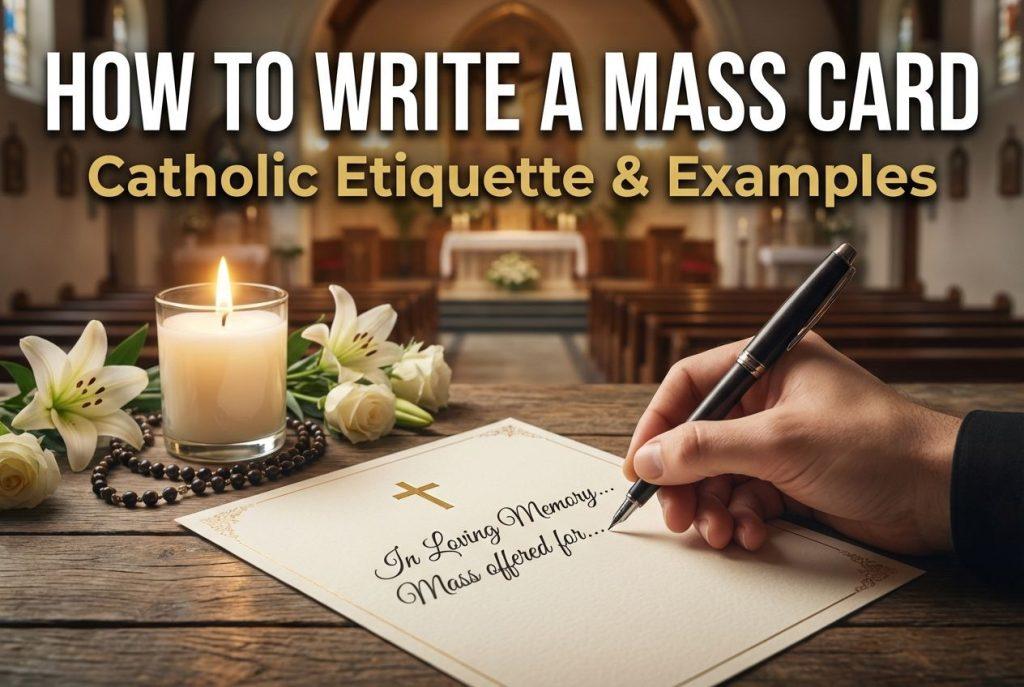
Brief Overview
- A Mass card tells a grieving family that you have arranged for a Catholic Mass to be offered for their deceased loved one or for a specific intention.
- Writing a Mass card requires obtaining the card from your parish after requesting a Mass intention and making the customary offering.
- The card should include a personal sympathy message that expresses your condolences and acknowledges the faith tradition you share with the recipient.
- Mass cards can be given at wakes, funerals, mailed to the family home, or presented during a sympathy visit within weeks of the death.
- The practice of offering Mass intentions for the deceased is rooted in the Church’s teaching on purgatory and the communion of saints found in Catholic tradition.
- Your message should balance spiritual comfort with personal warmth while remaining appropriate for the family’s relationship to you.
Understanding Mass Cards and Their Spiritual Significance
A Mass card represents one of the most meaningful gifts a Catholic can offer to someone who has experienced the loss of a loved one. This simple card carries profound spiritual weight within the Catholic tradition because it signifies that the Holy Sacrifice of the Mass will be offered for a specific intention. The Mass is the greatest prayer the Church can offer because it makes present the salvific sacrifice of Jesus Christ on Calvary. When you give someone a Mass card, you are not merely sending condolences but actively participating in the Church’s mission to pray for the faithful departed. The Catechism teaches that the Eucharistic sacrifice is offered for those who have died in Christ but are not yet wholly purified, helping them enter into the fullness of God’s presence (CCC 1371). Understanding this spiritual dimension helps you appreciate why Mass cards hold such value in Catholic culture. They represent a commitment to prayer that extends beyond the funeral itself and continues as long as Masses are celebrated. The recipient receives comfort knowing that their loved one will be remembered at the altar where heaven and earth meet. This practice connects us to the earliest Christians who understood that we remain in communion with those who have gone before us in faith. A Mass card becomes a tangible reminder of this spiritual bond and the hope we share in the resurrection.
The tradition of offering Masses for the deceased has ancient roots stretching back to the early Church and even to Jewish practices mentioned in Scripture. The Church has always honored the memory of the dead and offered prayers for them, particularly through the Eucharistic sacrifice (CCC 1032). This practice reflects our belief in purgatory, a final purification after death that prepares souls for the perfect joy of heaven. When we offer Mass for someone who has died, we trust that God applies the infinite merits of Christ’s sacrifice to aid that soul in its purification. The Church teaches that we can help the faithful departed through our prayers, almsgiving, and especially through Mass (CCC 1030-1032). This teaching brings great comfort to those who grieve because it means death does not sever our ability to love and care for those who have passed. We continue to serve them through our prayers and sacrifices. A Mass card communicates this beautiful truth to the bereaved family, reminding them that their loved one remains part of the Body of Christ. The card represents a concrete action taken on behalf of the deceased, not just empty words of sympathy. It shows that you take seriously the Church’s call to pray for the dead, which is counted among the spiritual works of mercy. Your decision to request a Mass and send the card demonstrates your faith in the communion of saints and your solidarity with the grieving family in their Catholic faith.
Requesting a Mass Intention at Your Parish
Before you can write a Mass card, you must first arrange for a Mass to be offered at a Catholic church. This process begins by contacting your local parish office, either in person, by phone, or sometimes through the parish website. Most parishes have established procedures for scheduling Mass intentions and will guide you through the process. You will need to provide the name of the deceased person for whom the Mass will be offered, although you can also request Masses for living people or other intentions. The parish secretary or designated staff member will consult the Mass intention book to find an available date. Some parishes have waiting lists, especially during busy seasons like November when Catholics traditionally remember the dead. You should be prepared for the possibility that the Mass may not be scheduled for several weeks or even months after you make the request. The timing does not diminish the value of the Mass; what matters is that the sacrifice will be offered for your specified intention.
When you request the Mass, you will typically make a customary offering, often called a stipend, which helps support the priest and the parish. The suggested amount varies by diocese and parish but commonly ranges from ten to twenty dollars. This offering is not payment for the Mass, which cannot be bought or sold, but rather a traditional donation that has been part of Catholic practice for centuries. The Church allows priests to accept one stipend per day for Mass intentions as part of their modest support. Your offering helps the priest in his ministry and contributes to the parish’s ability to serve its community. After you request the Mass and make your offering, the parish will provide you with a Mass card. These cards are usually simple in design, featuring religious imagery such as a cross, chalice, praying hands, or an image of Jesus or Mary. The card will have spaces for information including the name of the deceased, the date the Mass will be celebrated, the name of the church where the Mass will take place, and a space for your name as the person offering the Mass.
Some parishes provide cards with pre-printed messages while others offer blank cards that allow you to write a fully personalized message. The parish may also allow you to request multiple Masses if you wish to make a more substantial gift. Some Catholic organizations and religious communities offer the option of having Masses said by their priests, and they will mail you cards to give to the bereaved family. These groups often accept Mass requests for missionary work or specific apostolates. Regardless of where you request the Mass, ensure that the information on the card is accurate before you leave the parish office. Verify that the deceased person’s name is spelled correctly and that all other details are complete. Once you have the card in hand, you can add your personal message and prepare to present it to the family. Taking care with these practical details shows respect for both the deceased and the grieving family. The effort you invest in properly requesting the Mass and obtaining the card reflects the sincerity of your concern and your commitment to supporting the family through prayer.
Writing Your Personal Message
The personal message you write in a Mass card should convey your sympathy while acknowledging the spiritual gift you are giving. Begin by considering your relationship to the deceased or to the bereaved family, as this will guide the tone and content of your message. If you knew the deceased person well, you might include a brief personal memory or mention a quality you admired about them. If your connection is primarily through the family members, focus your message on expressing support for them during this difficult time. The message need not be lengthy; a few sincere sentences often carry more weight than elaborate prose. Catholics appreciate simplicity and authenticity in sympathy messages, especially when accompanying a Mass card. Your words should complement rather than overshadow the spiritual significance of the Mass itself.
A typical opening might be as straightforward as “Please accept my deepest sympathy on the loss of your mother.” This simple statement acknowledges the loss without unnecessary embellishment. You might continue with something like “I have arranged for a Mass to be offered for the repose of her soul.” This sentence clearly states the purpose of the card and connects your sympathy to concrete spiritual action. Some people prefer to reference faith more directly by writing “May the Lord grant her eternal rest” or “I pray that she is now enjoying the peace of heaven.” These phrases reflect Catholic hope in the resurrection and eternal life. If you shared memories with the deceased, a sentence like “I will always remember her kindness and generous spirit” adds a personal touch that honors the individual. Closing with an offer of continued prayer is appropriate: “You and your family remain in my daily prayers” or “May God comfort you during this time of sorrow.” Your signature completes the message, and you may add your full name if the family might not recognize your first name alone.
The tone of your message should be warm but not overly emotional, sincere but not dramatic. Avoid phrases that sound artificial or borrowed from generic sympathy card templates unless they genuinely reflect your feelings. Catholic sensibilities generally appreciate restraint and dignity in the face of death, viewing it as a serious passage rather than a crisis requiring excessive emotion. This does not mean your message should be cold or distant, but rather that it should balance compassion with hope. Remember that the real gift is the Mass itself; your words serve to present that gift graciously. Some Catholics choose to include a brief Scripture verse if space permits. Verses from the Gospels that speak of eternal life or God’s comfort can be meaningful additions. For example, you might reference John 14:2-3 where Jesus promises to prepare a place for us, or Matthew 5:4 which blesses those who mourn. Keep any scriptural references brief and ensure they are accurately quoted or properly paraphrased. If you are uncertain about including Scripture, it is perfectly acceptable to omit it and focus on your own words of sympathy and assurance of prayer.
Choosing Appropriate Language and Avoiding Common Mistakes
When writing your message in a Mass card, certain guidelines will help you communicate effectively and appropriately. First, always use the deceased person’s name at least once in your message. This personal touch shows that you are thinking of them as an individual, not just generically acknowledging a death. Write the name correctly, using the form by which the family knew them; if you are unsure whether to write “Elizabeth” or “Betty,” ask someone close to the family or use the name that appeared in the obituary. Respectful language matters deeply when people are grieving, and attention to these details demonstrates your care. Second, keep your sentences clear and direct. Grief often makes it difficult for people to process complex or lengthy messages, so straightforward expression serves them better than elaborate language. You want your meaning to be immediately clear without requiring careful interpretation.
Third, avoid clichés that may sound hollow or even hurtful to the bereaved. Phrases like “Everything happens for a reason” or “God needed another angel” can cause pain rather than comfort, as they may seem to minimize the loss or suggest that God causes suffering. While these expressions are often well-intentioned, they do not reflect sound Catholic theology and may alienate rather than console. Similarly, avoid telling the family “I know how you feel” unless you have experienced a very similar loss, because each person’s grief is unique and claiming to fully understand can seem presumptuous. Instead, acknowledge that you cannot fully comprehend their pain but want to support them. Fourth, do not use the Mass card as an opportunity to share your own spiritual insights or to preach about death and resurrection. The family is not looking for a theology lesson in your sympathy message; they need simple expressions of care and solidarity. The Mass itself proclaims the Gospel; your message need only point to that reality gently.
Fifth, be mindful of the family’s specific circumstances and avoid language that might be inappropriate. If the death was sudden or tragic, do not refer to it as a “blessing” or suggest that the person is “better off.” If the deceased was very young, do not imply that their short life means less loss for the family. If complicated family dynamics exist, keep your message neutral and focused on the immediate recipient. Sixth, proofread your message before writing it in the card. Check for spelling errors, grammatical mistakes, or unclear phrasing that might distract from your meaning. While most people will overlook minor errors given the circumstances, taking care with your writing shows respect and thoughtfulness. Write legibly in pen, using your best handwriting so the family can easily read your message. If your handwriting is difficult to read, consider printing the words clearly or even typing a message on quality paper that you can insert with the card. Seventh, remember that brevity is often a virtue in sympathy messages. Three to five well-chosen sentences typically suffice for a Mass card. You need not fill every blank space on the card or feel obligated to write at length. The family will receive many cards and messages during this time, and a concise, heartfelt note often makes a stronger impression than pages of text.
Presenting the Mass Card to the Bereaved Family
Once you have written your message in the Mass card, you must decide how and when to present it to the family. The most common time to give a Mass card is during the wake or visitation period before the funeral. Many Catholics hold a wake at the funeral home where friends and community members can pay their respects to the deceased and offer condolences to the family. Bringing your Mass card to the wake allows you to hand it directly to a family member while expressing your sympathy in person. When you approach the family at the wake, you might simply say “I am so sorry for your loss” and hand them the card with the explanation “I have had a Mass offered for her soul.” Most Catholic families immediately recognize the significance of a Mass card and will thank you for your thoughtfulness. They may place the card with others they have received or set it aside to read more carefully later. Do not expect or wait for an extended conversation at this time, as the family will likely be greeting many people and may be emotionally overwhelmed.
Alternatively, you can present the Mass card at the funeral itself, although this is somewhat less common. If you do bring the card to the funeral, look for an appropriate moment to give it to a family member, perhaps before the service begins or during the gathering afterward. Be sensitive to the flow of events and do not interrupt important moments to present your card. Some people prefer to mail the Mass card to the family’s home, especially if they cannot attend the wake or funeral in person. Mailing the card is perfectly acceptable and may even be preferable in some situations. A card that arrives in the mail during the difficult days after the funeral can provide comfort when the initial rush of support has subsided. If you mail the card, do so promptly after learning of the death, ideally within the first week. Address the envelope to the closest family member or to the family collectively at their home address. You might include a brief separate note expressing your regret that you could not attend the services in person.
Another option is to deliver the Mass card during a sympathy visit to the family’s home. Many Catholics make such visits in the days or weeks following a funeral to check on the bereaved and offer practical support. If you visit the home, bringing your Mass card along with a meal or other helpful gesture creates a meaningful combination of spiritual and practical charity. When you visit, hand the card to your host with a simple explanation of what it represents if necessary. Some families may not be familiar with Mass cards if they are newer to the Catholic faith, so a gentle word of explanation can help them appreciate the gift. Regardless of how you present the card, never make a show of it or draw attention to yourself. The gift should point toward God and toward the deceased, not toward your own generosity. Humility in giving reflects the spirit of Christian charity and allows the bereaved to receive your gift without feeling burdened by obligation. After presenting the card, do not expect or seek immediate acknowledgment beyond a simple thank you. The family may be too overwhelmed to respond adequately in the moment, and that is entirely appropriate.
Understanding Different Types of Mass Cards and Occasions
While most Mass cards are given when someone dies, the tradition of offering Mass intentions extends to other circumstances as well. Understanding the range of situations in which Mass cards are appropriate helps you use this beautiful Catholic practice more fully. The most common Mass card commemorates a recently deceased person and is given to the family immediately after the death. However, you can also request Masses for the anniversary of a death, particularly on the first anniversary or on significant dates like the deceased person’s birthday. Sending a Mass card to mark these anniversaries shows the family that you continue to remember their loved one and have not forgotten their loss. Anniversaries can be especially difficult for the bereaved, and knowing that others still pray for their family member brings comfort. The card you send for an anniversary might note the occasion: “Remembering your mother on the first anniversary of her death” or “In memory of John on his birthday.”
Mass cards can also be offered for people who are seriously ill or facing major surgery. While we often associate Mass intentions with the deceased, the Church encourages us to offer Mass for the living as well. If someone you know is battling cancer, preparing for a difficult medical procedure, or dealing with chronic illness, you might request that a Mass be offered for their healing and comfort. The Mass card you give them expresses your spiritual support and assures them of your prayers. The message in such a card might read “I have arranged for a Mass to be offered for your health and recovery” or “Praying for you during this challenging time.” These cards can be deeply meaningful to people who are suffering, reminding them that they are not alone and that their faith community surrounds them with prayer. Some Catholics also offer Masses for special intentions such as thanksgiving for blessings received, for someone beginning a new phase of life, or for peace in the world. While these occasions do not typically involve printed Mass cards, you might write a personal note informing someone that you have requested a Mass for their intention.
Additionally, some Catholic traditions involve giving Mass cards for feast days or as gifts on special occasions. In certain cultures, presenting a Mass card for someone’s birthday, particularly milestone birthdays, shows deep respect and spiritual care for that person. Similarly, Mass cards can be appropriate gifts for weddings, anniversaries, or other celebrations, though this practice is less common than offering Masses for the deceased or ill. If you give a Mass card for a celebration rather than a time of sorrow, adjust your message accordingly to reflect the joyful nature of the occasion. You might write “In thanksgiving for your 50 years of marriage, I have arranged for a Mass to be offered for your intentions” or “Celebrating your birthday by having you remembered at Mass.” These variations demonstrate the flexibility of the Mass intention tradition and its capacity to touch various aspects of Catholic life. Understanding these different applications allows you to make this practice a regular part of how you care for the people in your life, not just something you do when death occurs.
Explaining Mass Cards to Non-Catholic Friends
At times you may find yourself wanting to offer a Mass card to someone who is not Catholic or who may not understand the significance of this gift. This situation requires sensitivity and clear explanation so that your gesture is received in the spirit you intend. When offering a Mass card to a non-Catholic, you might include a brief note explaining what it means. You could write something like “In the Catholic tradition, I have arranged for a special prayer service called a Mass to be offered for your mother’s soul. This is our way of remembering her and asking God to receive her into His presence.” This explanation provides context without assuming the recipient shares your beliefs. It frames the Mass as a prayer on their behalf rather than imposing Catholic doctrine on them. Most people, regardless of their faith background, appreciate knowing that someone is praying for them or their loved one. Even if they do not share Catholic beliefs about the Mass, they can recognize the gift as an expression of care and spiritual support.
If the deceased person was not Catholic, you should still feel free to offer a Mass for them, as the Catholic Church prays for all the faithful departed regardless of their denomination. God’s mercy extends to all people, and we trust that our prayers benefit anyone who died in God’s friendship. However, be thoughtful about how you present this gift to a non-Catholic family. Avoid language that might seem to claim the deceased for the Catholic faith or suggest that Catholic prayers are superior to other traditions. Instead, emphasize the universal aspects of your gesture: love, memory, and prayer. You might say “I wanted to honor your mother’s memory in the way my faith tradition teaches, by having prayers offered for her soul.” This phrasing respects both your own religious practice and the family’s possible different beliefs. If you sense that a non-Catholic family might not appreciate or understand a Mass card, you could simply send a regular sympathy card with your personal message about having them in your prayers. You need not mention the Mass specifically if doing so might cause confusion or discomfort.
When working in professional environments or with people whose religious backgrounds are unknown to you, exercise discretion about giving Mass cards. In some contexts, a more neutral sympathy card may be more appropriate than one that explicitly references Catholic practices. You can still request and attend a Mass for your colleague or acquaintance without giving them a formal Mass card if that seems more suitable. The important thing is your prayer and solidarity with the person who is grieving, not whether you deliver a card. On the other hand, if you know that the recipient will understand and appreciate the Catholic meaning of a Mass card, offer it with confidence. Many Protestant Christians have come to appreciate Mass cards when Catholic friends explain their significance, seeing them as a profound expression of faith in action. Jewish friends may particularly understand the Mass card tradition given their own strong practices of remembering the dead through prayer. Building these bridges of understanding helps people of different faiths support one another in times of loss. Your willingness to explain your tradition and your openness to their response models the kind of respectful religious dialogue the Church encourages in our pluralistic society.
The Theology Behind Offering Mass for the Deceased
To write a Mass card with genuine conviction, it helps to understand why Catholics offer Masses for the dead and what the Church teaches about this practice. The foundation lies in the doctrine of purgatory, which the Church defines as a final purification that occurs after death for those who die in God’s grace but still need cleansing before entering heaven. The Catechism teaches that all who die in God’s friendship are assured of eternal salvation, but they may need to undergo purification to achieve the holiness necessary for heaven (CCC 1030). This purification is not punishment in the sense of hell’s damnation, but rather a process of being made ready for the full presence of God. Fire imagery is sometimes used to describe this purification, drawing on biblical and traditional sources that speak of a cleansing fire. The Church has taught this doctrine consistently, particularly at the Councils of Florence and Trent, and it has deep roots in Scripture and apostolic practice.
The practice of praying for the dead appears in Scripture itself. The Second Book of Maccabees describes Judas Maccabeus making atonement for dead soldiers so they might be freed from their sins. This action presupposes that the dead can be helped by the prayers and offerings of the living. From the Church’s earliest days, Christians have honored the memory of the dead and offered prayers for them, especially through the Eucharistic sacrifice (CCC 1032). The Mass is particularly powerful as prayer for the dead because it makes present Christ’s own sacrifice on Calvary. When the priest offers Mass, he does not repeat Christ’s sacrifice but makes that one eternal sacrifice present on the altar in an unbloody manner. The Mass unites us to Christ’s perfect offering of Himself to the Father, an offering that has infinite value because Jesus is both God and man. When a Mass is offered for a particular intention, whether for a deceased person or any other purpose, the graces of that sacrifice are applied in a special way to that intention.
The Church’s teaching on this matter brings great comfort because it means death does not sever the bonds of love between Christians. We remain in communion with those who have gone before us, a reality the Church calls the communion of saints. This communion connects the Church on earth, the souls in purgatory, and the saints in heaven in one Body of Christ. Because we are united in this mystical body, we can help one another through prayer and sacrifice. The souls in purgatory can no longer merit for themselves but can be aided by our prayers, almsgiving, and especially by Mass offered for them (CCC 1032). This teaching gives purpose to our grief, allowing us to channel our love for the deceased into concrete spiritual action. Rather than feeling helpless in the face of death, we can actively help our loved ones by praying for them. Saint John Chrysostom, an early Church Father, urged Christians not to hesitate to help the dead by offering prayers for them. This ancient wisdom remains vital for Catholics today, shaping how we respond to death and loss.
When you request a Mass for someone who has died, you participate in this beautiful tradition of the Church. You acknowledge that your loved one may need purification, but you trust in God’s mercy and in the power of Christ’s sacrifice to complete that purification. You also express hope in the resurrection and eternal life that Christ promised to all who believe in Him. The Mass card you give to the bereaved family communicates these profound truths in a simple, tangible way. It says that death is not the end, that we remain connected through Christ, that prayer matters, and that the Church continues to care for her members even after they leave this earthly life. Understanding this theological foundation enriches your own practice of offering Masses for the dead and deepens the meaning of the Mass cards you write and give. It transforms what might otherwise be just a sympathy gesture into an act of faith, hope, and love rooted in the heart of Catholic teaching.
Practical Considerations and Etiquette
Several practical matters of etiquette should guide you as you give Mass cards. First, consider the question of how many Masses to offer for one person. There is no required number; even a single Mass is a generous and meaningful gift. However, some people choose to request multiple Masses, especially for someone who was very close to them or who held a special place in their community. If you want to offer several Masses, you might request them at different parishes or through missionary organizations that accept such requests. When you give a card indicating multiple Masses, the family will appreciate your extraordinary generosity. Just be certain that you can afford the offerings you make; the Church does not want anyone to strain financially in order to request Masses. If your budget is limited, a single Mass offered with love and prayer has great value in God’s eyes and to the grieving family.
Second, consider the timing of when you request the Mass and when you give the card. Ideally, request the Mass soon after learning of the death so that the scheduled date is not too far in the future. However, as noted earlier, popular parishes may have waiting lists. If the Mass will not be celebrated for several weeks or months, you should still give the card promptly to the family. The card tells them that a Mass will be offered, and knowing this brings comfort even if the actual celebration is delayed. Some people choose to request a Mass on a significant date such as the deceased person’s birthday or the anniversary of their death. If you plan to do this for future anniversaries, you need not give a new card each time unless you want to remind the family that you continue to remember their loved one. A phone call or note mentioning that you have arranged another Mass can be a touching gesture on difficult anniversary dates.
Third, be aware of cultural variations in how Mass cards are used and given. Catholic communities from different ethnic backgrounds sometimes have distinct customs around Mass cards. For example, Irish and Italian Catholics often have strong traditions of giving Mass cards and may give many cards for a single deceased person. In some Hispanic communities, families may arrange for multiple Masses and distribute cards to extended family members as a way of ensuring broad prayer support. Understanding these cultural dimensions helps you respond appropriately in different contexts. If you are part of a multicultural parish or have friends from various Catholic backgrounds, observe how they handle Mass cards and follow their lead when appropriate. What matters most is not following a specific cultural protocol but showing genuine care and respect for the deceased and the bereaved family.
Fourth, keep a personal record of the Masses you request. You might note in your calendar or journal the name of the person for whom you requested the Mass, the date it will be celebrated, and the church where it will take place. This record serves multiple purposes. It reminds you to attend that Mass if possible, joining your prayers in person to the intention you requested. It also helps you track your spiritual commitments and can be meaningful to review during your own times of prayer. Some Catholics make it a practice to attend Masses they have offered for others whenever possible, sitting quietly in prayer for that intention during the celebration. While attendance is not required when you request a Mass intention, it can deepen your own spiritual life and your connection to the person for whom you are praying. If the Mass will be celebrated at a time or location that makes your attendance difficult, you can still unite yourself spiritually to that Mass by praying at that time wherever you are.
Including Mass Cards as Part of Broader Bereavement Support
A Mass card should not be your only response to someone’s loss, but rather one part of a broader pattern of support and care. The Catholic faith calls us to practice the corporal and spiritual works of mercy, and comforting the grieving is chief among these responsibilities. After giving a Mass card, continue to check on the bereaved family in the days and weeks that follow. The initial period after a death often brings an outpouring of support, but this attention frequently fades as time passes and others return to their normal routines. The family may feel most alone and overwhelmed several weeks after the funeral when daily life resumes but grief remains acute. Reaching out during this later period shows enduring care rather than just momentary sympathy.
Practical help often matters as much as spiritual support. Consider bringing meals to the family, offering to run errands, helping with household tasks, or caring for children so parents can attend to funeral arrangements and their own grief. If the deceased person lived alone, the family may need help sorting through belongings or handling estate matters. Offering specific, concrete assistance is more helpful than saying “Let me know if you need anything,” which places the burden on the grieving person to identify and request help. Instead, say “I am bringing dinner on Tuesday at six” or “I can drive you to appointments next week.” This direct approach makes it easy for the family to accept your help. Your practical service complements the spiritual gift of the Mass, demonstrating that Catholic charity addresses both soul and body.
Continue to remember the deceased person in your personal prayers long after the funeral. Develop a habit of praying for the dead regularly, perhaps including them in your daily rosary intentions or remembering them at Mass. You might add the names of deceased friends and family members to a prayer list you keep and review regularly. This ongoing prayer fulfills your baptismal commitment to the communion of saints and keeps you connected to those who have gone before you. If you maintain contact with the bereaved family, occasionally mention that you continue to pray for their loved one. Hearing this weeks or months after the death reassures them that their family member is not forgotten. You might send a card on the anniversary of the death with a note saying “Still remembering John in my prayers” or “A year has passed, but I continue to pray for your mother’s soul.” These small gestures can be deeply comforting to people navigating the long process of grief.
Your witness as a Catholic who takes seriously the call to pray for the dead also serves an important evangelical function. People who are disconnected from the Church or who have only nominal faith may be moved by seeing authentic Catholic charity in action. Your consistent care, rooted in your belief in eternal life and the communion of saints, preaches the Gospel more effectively than many words. The bereaved person may find themselves drawn toward deeper faith through your example and may eventually return to the sacraments or strengthen their own prayer life. Even if such dramatic conversions do not occur, your faithful practice of giving Mass cards and supporting the grieving bears witness to the truth that our faith makes a real difference in how we face life’s hardest moments. This quiet evangelization fulfills Christ’s command to let our light shine before others so that they may see our good works and give glory to God.
Common Questions About Mass Cards
Several questions frequently arise about Mass cards, and addressing them helps clarify this practice for those less familiar with it. One common question is whether you should give a Mass card if the family has requested donations to a charity instead of flowers. The answer is yes; a Mass card is separate from and complementary to charitable donations or flower arrangements. When an obituary says “In lieu of flowers, donations may be made to…” this indicates the family’s preference regarding flowers specifically. A Mass card is not a flower arrangement but a spiritual gift, so it is always appropriate regardless of what the obituary says. You might give both a Mass card and make a charitable donation in the deceased person’s name if you wish. These different forms of remembrance serve different purposes and need not conflict with each other.
Another question concerns whether you can request multiple Mass intentions for the same Mass. Church law generally stipulates that a priest accepts one stipend per Mass, which supports the principle that each Mass has its own integrity and should not be commercialized. However, some variations exist. For example, a priest celebrating Mass in a monastery or religious house might offer that Mass for all the intentions held by his community without individual stipends. Similarly, some parishes celebrate a monthly or annual Mass for all the intentions of their parishioners. When you request a Mass for a specific person, you typically receive a card indicating a particular date and that Mass is offered for your stated intention. If you wish to have many Masses said, you request them individually, each with its own card and offering. Missionary organizations sometimes use a different system where they promise to remember your intention at many Masses celebrated by their priests; these groups can provide certificates or cards explaining their practice.
A third common question is whether you need to be Catholic to request a Mass or give a Mass card. Anyone can request a Mass intention at a Catholic parish; the Church welcomes prayers for all people and does not restrict Mass intentions to Catholics only. Non-Catholics who wish to honor a Catholic friend or family member by requesting a Mass can certainly do so, and the parish will assist them with the process. The person receiving the Mass card need not be Catholic either, as discussed earlier. However, only Catholics fully understand and appreciate the theological significance of the Mass as the sacrifice of Christ, so some explanation may be necessary when giving Mass cards in interfaith contexts. The universal nature of prayer and the human experience of grief create common ground that allows Mass cards to bridge religious differences when offered with sensitivity and respect.
The Role of Mass Cards in Catholic Funeral Culture
Mass cards occupy a significant place in Catholic funeral culture and understanding this context helps you use them appropriately. When a Catholic dies, the family typically receives many Mass cards along with sympathy cards, flowers, and charitable donations. These cards are often displayed at the wake or funeral home, sometimes on a table dedicated to memorial items. The family collects them and later reads through them, finding comfort in knowing how many Masses have been offered for their loved one. Some families keep Mass cards in a special box or album as lasting mementos of the support they received. The accumulation of many Mass cards represents the community’s love for the deceased and faith in the power of prayer. In close-knit Catholic communities, it is not unusual for a popular person to have dozens of Masses offered for them, each represented by a card given to the family.
The tradition of giving Mass cards has evolved over time but remains strong in many Catholic communities. Earlier generations of Catholics gave Mass cards almost automatically when someone died; it was simply what you did as part of the Catholic response to death. More recent generations sometimes struggle to maintain this tradition as Catholic practice in general has weakened in some areas. However, many Catholics are rediscovering the beauty of this tradition and making efforts to keep it alive. Younger Catholics who are serious about their faith often embrace practices like giving Mass cards as part of reclaiming authentic Catholic culture. This renewal of traditional practices strengthens Catholic identity and creates continuity between generations. When you give a Mass card, you participate in this living tradition and help pass it on to the future.
Mass cards also reflect Catholic theology about the funeral itself. The Catholic funeral is not merely a memorial service but a liturgical celebration that entrusts the deceased to God’s mercy and prays for their soul. The funeral Mass is itself the greatest prayer the Church offers for the deceased. However, one Mass is not necessarily sufficient for the person’s needs in purgatory, which is why multiple Masses are requested and celebrated over time. The Mass cards given by friends and community members extend the funeral liturgy into the future, creating an ongoing network of prayer around the deceased person. This network mirrors the communion of saints, where all believers support one another through prayer and spiritual solidarity. The Mass cards become tangible signs of this invisible spiritual reality, giving material form to the Church’s belief that we are all connected in Christ. Understanding Mass cards within this larger framework of Catholic funeral culture helps you appreciate why this small card carries such weight and why families treasure the cards they receive during their time of loss.
Adapting the Tradition for Contemporary Circumstances
While the core practice of giving Mass cards remains constant, some adaptations may be necessary for contemporary circumstances. For example, many people today maintain friendships and family connections across great distances. You may learn of a death through social media or email rather than through a local obituary or phone call. In these situations, you can still request a Mass and send a card, but you might mail it to the family rather than attending the funeral in person. You could also scan the completed Mass card and email it to the family if they live far away or if time is short, though sending a physical card by mail is generally preferable. The physical card has more presence and permanence than a digital image, and it can be saved and treasured more easily.
Another contemporary consideration involves the increasing number of Catholics who become disconnected from parish life. You might know someone who was raised Catholic but no longer practices regularly. When such a person dies, their family may not think to request Masses or may not even have a funeral Mass. If you wish to offer a Mass for someone whose family is not actively Catholic, you can certainly do so and give the card to a family member who might appreciate it. This gesture may remind them of their Catholic heritage and the beautiful traditions they have forgotten. It might even inspire them to reconsider their relationship with the Church. At the very least, it shows that you remember their family member and honor them in the way your faith teaches. Similarly, if you are the one who is disconnected from parish life, requesting a Mass when someone dies can be an opportunity to reconnect with your faith community and to practice your religion in a concrete way.
Technology also offers new possibilities for requesting Mass intentions. Many parishes now allow you to request Masses online through their websites, paying the offering electronically and receiving confirmation by email. Some websites serve as clearinghouses for Mass intentions, connecting people who want to request Masses with priests who will celebrate them. While these modern conveniences can be helpful, especially for people with mobility challenges or those who live far from a Catholic church, there is value in visiting your parish in person to request a Mass. This personal contact strengthens your connection to your faith community and gives you an opportunity to pray at your church. However, if circumstances make an in-person visit difficult, electronic methods of requesting Masses serve a useful purpose. What matters most is that the Mass is celebrated and that you maintain the spiritual practice of praying for the dead, regardless of whether you use traditional or contemporary methods to arrange it.
Writing Mass Cards for Special Circumstances
Certain circumstances require particular sensitivity when writing and giving Mass cards. When a child dies, parents face unspeakable grief that requires the most gentle and careful response. Your Mass card message should acknowledge the profound loss while expressing hope in God’s love. You might write “I cannot imagine the depth of your sorrow, but I trust that God holds your precious child in His loving arms.” Avoid any suggestion that the death happened for a reason or that the parents should find comfort in having other children. Simply express your sorrow, mention the Mass you have requested, and assure them of your continuing prayers. When writing about a child, always use their name and treat them as the unique person they were, however brief their life.
When someone dies by suicide, families often struggle with complicated emotions including guilt, anger, and confusion. The Catholic Church teaches that we cannot judge the state of a person’s soul and that mental illness diminishes responsibility for one’s actions. You can and should offer Mass for someone who died by suicide, trusting them to God’s infinite mercy. Your Mass card message should avoid any mention of how the person died; simply express sympathy and assure the family of your prayers. They need to know that their loved one is not excluded from the Church’s prayers and that God’s mercy extends even to this painful situation. Your Mass card offers them this reassurance and helps counter any fear they might have that the Church condemns their family member.
When the deceased person was quite elderly or had been seriously ill for a long time, families sometimes experience a sense of relief along with their grief. They are sad but also glad that their loved one is no longer suffering. Your Mass card message can acknowledge this complex emotional reality by writing something like “May your mother now be at peace with the Lord after her long illness” or “I pray that your father has found the rest he deserved.” This phrasing honors the difficulty of the situation while maintaining hope in eternal life. When someone dies suddenly or traumatically in an accident, violence, or natural disaster, the shock makes grief even more difficult. Your message might say “I am heartbroken by this sudden loss and pray that God will comfort you and grant eternal rest to his soul.” The word “sudden” acknowledges the traumatic nature of the death without dwelling on painful details. In all these special circumstances, your Mass card serves as an anchor of faith, reminding the bereaved that the Church walks with them through even the most difficult losses and that prayer continues even when words fail.
Maintaining the Practice Throughout Your Life
Making Mass cards a regular part of your Catholic practice enriches your spiritual life and serves your community well. As you go through life, you will inevitably experience the deaths of family members, friends, colleagues, neighbors, and fellow parishioners. Each of these losses presents an opportunity to request a Mass and give a card to the bereaved. Over the years, this practice becomes a habit that shapes how you respond to death and grief. You develop a repertoire of appropriate messages and become comfortable with the practical aspects of requesting Masses and writing cards. This facility allows you to respond quickly and effectively when someone dies, providing timely comfort to those who grieve. Your consistent practice also witnesses to your faith and may inspire others to adopt the same tradition.
Consider keeping a supply of general sympathy cards at home along with information about your parish’s process for requesting Mass intentions. When you learn of a death, you can act immediately rather than scrambling to find a card or remember how to contact the parish office. Some Catholics keep this as part of their household organization, much like maintaining a first-aid kit or emergency supplies. Being prepared allows you to respond promptly to others’ needs and reduces the stress of trying to figure out logistics during an emotional time. You might also keep a list of Masses you have requested and cards you have given, creating a personal record of how you have prayed for the deceased over your lifetime. This record can become a meaningful spiritual document that you can review during your own preparation for death, seeing the pattern of love and prayer that has marked your Catholic life.
Teaching this tradition to younger generations ensures its continuation into the future. If you have children, involve them in requesting Masses and writing cards when appropriate. Explain to them what a Mass card means and why Catholics give them. Take them with you when you request a Mass at the parish office so they see how the process works. When someone in your extended family dies, let your children help you choose a card and decide what to write. These experiences form their Catholic identity and teach them how to respond to death with faith and charity. Similarly, if you are a catechist, youth minister, or teacher in a Catholic school, look for opportunities to discuss Mass cards and the tradition of praying for the dead. Young people who understand these practices are more likely to maintain them as they mature. Your efforts to pass on this tradition contribute to the vitality of Catholic culture and ensure that future generations continue to support one another through the ancient practice of praying for the faithful departed. The simple act of writing a Mass card thus connects you to centuries of Catholic tradition while preparing the way for its continuation in the years to come.
Disclaimer: This article presents Catholic teaching for educational purposes. For official Church teaching, consult the Catechism and magisterial documents. For personal spiritual guidance, consult your parish priest or spiritual director. Questions? Contact editor@catholicshare.com
Sign up for our Exclusive Newsletter
- 📌 Add CatholicShare as a Preferred Source on Google
- 🎁 Join us on Patreon for Premium Content
- 🎧 Check Out These Catholic Audiobooks
- 📿 Get Your FREE Rosary Book
- 📱 Follow Us on Flipboard
-

Recommended Catholic Books
Discover hidden wisdom in Catholic books — invaluable guides enriching faith and satisfying curiosity. #CommissionsEarned
- The Early Church Was the Catholic Church
- The Case for Catholicism - Answers to Classic and Contemporary Protestant Objections
- Meeting the Protestant Challenge: How to Answer 50 Biblical Objections to Catholic Beliefs
As an Amazon Associate, I earn from qualifying purchases. Thank you for your support.