
Consecration to the Sacred Heart Is a Covenant Not a Mood
Brief Overview
- Devotion to the Sacred Heart of Jesus is not a sentimental practice but the Church’s formal veneration of the divine and human love of the incarnate Word, centered on the physical heart of Christ as its living symbol (CCC 2669).
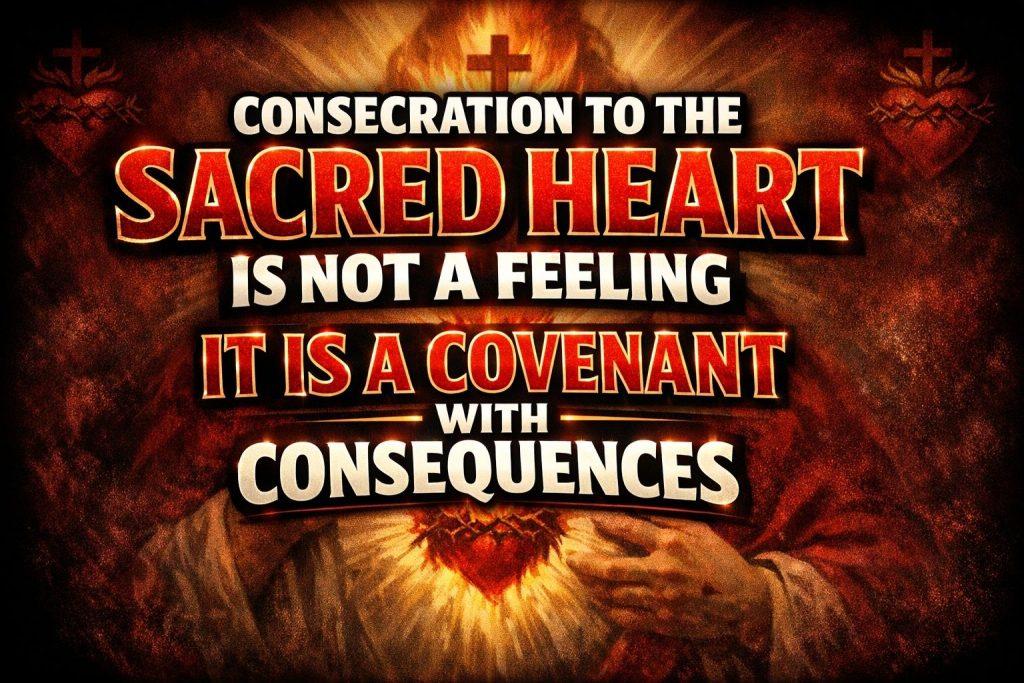
- Consecration to the Sacred Heart commits you to specific obligations including reparation for sin, frequent Communion, First Friday devotions, and the enthronement of Christ as King of your household.
- Most Catholics who make this consecration treat it as a one-time prayer event rather than a binding covenant that restructures their relationship with God and their daily habits.
- The Catechism teaches that Jesus knew and loved each of us during His life, agony, and Passion, and gave Himself for each one of us with a human heart (CCC 478), making this devotion intensely personal and correspondingly demanding.
What the Sacred Heart Devotion Actually Claims
The Sacred Heart is not a metaphor. When the Church venerates the Heart of Jesus, she venerates the actual physical heart of the incarnate Son of God as the symbol of His total love, both divine and human. Pope Pius XII made this explicit in his 1956 encyclical “Haurietis Aquas,” teaching that Christ’s Heart, as the noblest part of human nature united to the divine Person, deserves the same worship of adoration the Church gives to Christ Himself. The Catechism echoes this, stating that the prayer of the Church venerates and honors the Heart of Jesus just as it invokes His most holy name (CCC 2669).
This matters because many Catholics approach the Sacred Heart devotion as if it were primarily about warm feelings toward Jesus. It is not. The devotion is a theological claim about the nature of God’s love. Christ’s Heart was pierced on the cross. Blood and water flowed from the wound (John 19:34). That pierced Heart is the source from which the sacraments flow and the love of God becomes tangibly, physically present in history. When you consecrate yourself to the Sacred Heart, you are not making a devotional gesture. You are acknowledging that this wounded, loving Heart has a claim on your entire life.
The Promises That Come With Conditions
Between 1673 and 1675, Christ appeared to St. Margaret Mary Alacoque, a Visitation nun in Paray-le-Monial, France, and communicated twelve promises to those who would practice devotion to His Sacred Heart. These promises include graces necessary for one’s state of life, peace in the home, comfort in affliction, refuge in life and especially at death, and blessings on every undertaking. The twelfth and most famous promise states that those who receive Holy Communion on the first Friday of nine consecutive months will receive the grace of final repentance.
These promises are not unconditional. They are tied to specific practices of devotion, and the Church has consistently taught that they presuppose genuine conversion, not mere mechanical observance. You do not collect nine First Friday Communions like stamps and then live however you please. The promises assume that a person devoted to the Sacred Heart is actively pursuing holiness, making reparation for sin, and growing in love for Christ. If you treat the First Fridays as a spiritual insurance policy while ignoring the conversion of heart that the devotion demands, you have fundamentally misunderstood what you have committed to.
Catholic Share is a one-person ministry. If this content helps you, consider supporting it.
What Consecration Actually Requires of You
A consecration to the Sacred Heart is a formal act by which you recognize Christ’s sovereignty over your life and dedicate yourself, your family, or your home to His love and His kingship. The most common form of this is the Enthronement of the Sacred Heart, in which a family installs a prominent image of the Sacred Heart in their home and prays a formal act of consecration together, often with a priest present.
After the ceremony, the obligations begin. Families who enthrone the Sacred Heart are expected to maintain specific devotional practices. These include daily family prayer, frequent attendance at Mass beyond Sunday obligation, monthly Communion of reparation on First Fridays, and regular examination of conscience. The image in your home is not decoration. It is a visible reminder that your household has acknowledged Christ as its King, and kingship implies obedience. You have invited the Lord into the center of your domestic life, and that invitation carries real weight. The days when you would rather skip evening prayers, when the First Friday falls at an inconvenient time, when the kids resist and your spouse is tired, those are precisely the days when the consecration costs you something.
The Reparation Nobody Wants to Talk About
One of the central elements of Sacred Heart devotion is reparation. Christ told St. Margaret Mary that His Heart was wounded not only by the sins of the world at large but specifically by the coldness, ingratitude, and irreverence of those who claimed to love Him. The call to reparation means that your consecration is not only about receiving blessings. It is about making amends for sins committed against the love of God, both your own and those of others.
Reparation takes concrete forms. It means offering Communions, prayers, sacrifices, and acts of penance specifically in atonement for offenses against the Sacred Heart. Pope Pius XI, in his 1928 encyclical “Miserentissimus Redemptor,” taught that reparation to the Sacred Heart is not optional for those who take this devotion seriously but constitutes a duty of the highest importance. This is the part that separates casual devotees from those who have actually entered the covenant. Reparation means choosing to suffer, voluntarily and deliberately, because the Heart of Christ has been offended and you have accepted responsibility for consoling Him. That is not a comfortable addition to your prayer routine. It is a radical reorientation of your spiritual life around the wounds of Christ.
How This Devotion Changes Your Relationship With Sin
When you consecrate yourself to the Sacred Heart, your experience of your own sin changes. Before the consecration, sin may have felt like a private failure, something between you and your conscience. After a genuine consecration, sin begins to feel like a personal wound inflicted on someone you love. Christ showed St. Margaret Mary His Heart burning with love and crowned with thorns, and He told her that the thorns represented the sins of those consecrated to Him. Your sins are not anonymous anymore. They have a face, and that face belongs to the One whose Heart you have claimed to honor.
This shift in perspective is both a grace and a burden. It makes Confession more urgent because you cannot live comfortably with the knowledge that your habitual sins are piercing the Heart of the One you have consecrated yourself to. It makes the examination of conscience sharper, more specific, and more painful. And it makes the First Friday devotion something other than a ritual. When you receive Communion on the First Friday in reparation, you are not performing an obligation. You are standing before the pierced Heart and saying, “I am here because I know what my sins cost you, and I want to console you.” That is not sentiment. That is covenant.
What Happens to Your Family Over Time
Families who sustain the Sacred Heart enthronement over years, not weeks, report consistent patterns. The prayer life of the household deepens. Children grow up with a visible, daily reminder that Christ holds authority in their home. Decisions about money, entertainment, relationships, and time begin to filter through a question that was not there before: does this honor the Heart of Christ that we have enthroned? The changes are gradual, rarely dramatic, and sometimes invisible to outsiders. But the families who maintain the practice will tell you that the Sacred Heart holds them accountable in ways no other devotion has.
This is also where the cost becomes most visible. Maintaining family prayer when teenagers resist, keeping the First Friday commitment when schedules collide, treating the enthroned image as a genuine sign of Christ’s presence rather than a forgotten wall hanging, all of this requires sustained effort from every member of the household. The Sacred Heart does not force itself on a family. But the consecration you made asks you to choose, every single day, to treat that commitment as real.
So, Is Consecration to the Sacred Heart Right for You?
Consecration to the Sacred Heart is not a devotion for people who want to add a pleasant spiritual layer to their existing routine. It is a covenant, a formal acknowledgment that the love of Christ, symbolized and made present in His wounded Heart, has absolute authority over your life, your home, and your daily choices. The Catechism teaches that Jesus loved us each and all with a human heart (CCC 478), and this devotion asks you to respond to that love not with feelings but with fidelity, reparation, sacrifice, and sustained commitment to the practices Christ Himself requested through St. Margaret Mary. The twelve promises are real, but they belong to those who take the devotion seriously, not to those who treat it as a one-time prayer.
If you are willing to enthrone the Sacred Heart in your home and then live as though that enthronement means something every morning when you wake up, this covenant will reshape your spiritual life from the inside. If you are looking for a devotion that asks little and delivers comfort, look elsewhere. The Sacred Heart does not offer comfort first. It offers love, and love in the Catholic tradition has always looked like a cross.
Keep reading. Keep sharing.
Follow Catholic Share wherever you spend your time — and share this article with someone who needs it.