
Brief Overview
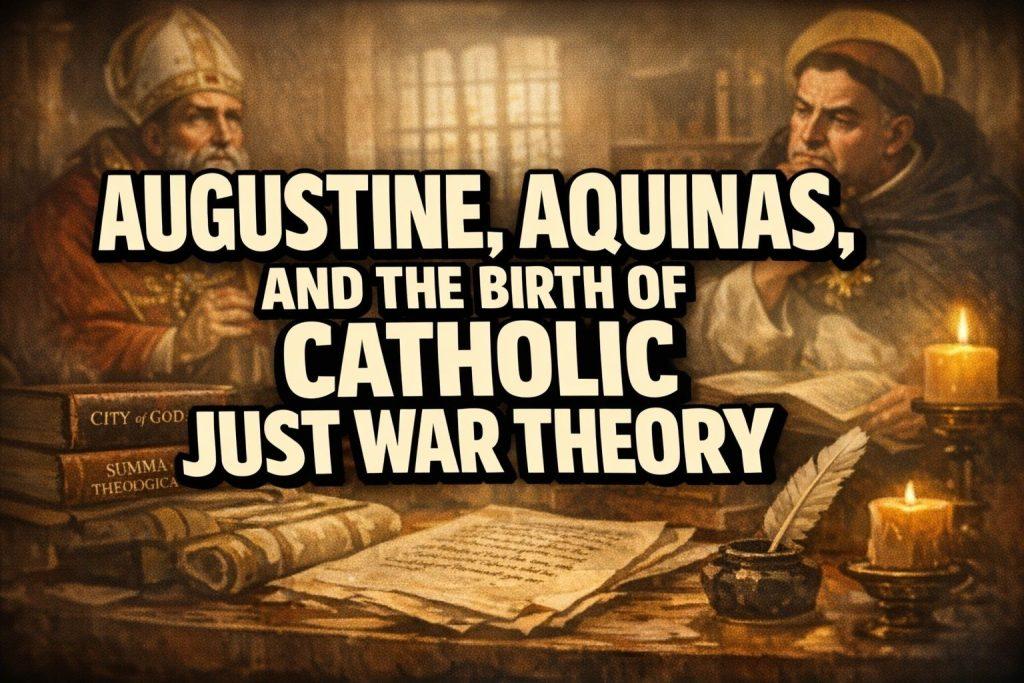
- St. Augustine and St. Thomas Aquinas did not invent the idea that some wars could be moral; they built a rigorous theological framework that transformed scattered intuitions about violence into a systematic doctrine the whole Church could apply.
- Augustine’s foundational insight, that war can be an act of charity when it protects the innocent and restores order, sits in direct tension with his equally insistent view that war is always a grief and never a good in itself.
- Aquinas sharpened Augustine’s thinking into three precise conditions, sovereign authority, just cause, and right intention, which the Church has carried forward and expanded ever since.
- The just war tradition shaped international law, the Geneva Conventions, and modern military ethics in ways that most people never trace back to their Catholic theological origins.
The World Augustine Inherited, and Why It Forced the Question
Augustine of Hippo wrote his most significant work on war during one of the most violent periods in Western history. The Roman Empire was fracturing. Barbarian armies had sacked Rome in 410 AD. Christians were asking whether their faith permitted them to fight at all, and whether Rome’s collapse was a divine punishment on a society that had, ironically, converted to Christianity. Augustine’s response in The City of God was not a simple permission slip for violence. It was a careful moral reckoning with power, justice, and the limits of earthly peace.
Augustine drew on earlier thinkers, particularly Cicero and St. Ambrose, but he grounded the argument in Scripture in a way they could not. He pointed to Luke 3:14, where John the Baptist tells soldiers to avoid extortion and be content with their wages, but conspicuously does not tell them to abandon their profession. He noted that Christ praised the centurion’s faith without condemning his military service (Matthew 8:10). From these observations, Augustine concluded that soldiering is not sinful in itself, and that violence carried out under proper authority for a just cause is not a violation of the commandment against killing. The key distinction is between private vengeance, which is always forbidden, and public authority acting to protect the innocent and restore order.
Augustine’s Core Argument: War as Reluctant Charity
The most surprising element of Augustine’s position is where he places it morally. He does not treat just war as a regrettable permission granted by necessity. He frames it, carefully and conditionally, as an act of love. In his letter to Marcellinus, Augustine argued that punishing a wrongdoer is not a betrayal of Christian charity but an expression of it, because allowing grave injustice to continue unchallenged also harms the aggressor’s soul. A father who disciplines a child is not acting against love. A state that restrains a violent aggressor operates on the same principle.
This does not mean Augustine was comfortable with war. He was not. In The City of God, he described the wise man who wages a just war as someone who does so with grief, not satisfaction. “Let every one, then, who thinks with pain on all these great evils, so horrible, so ruthless, acknowledge that this is misery,” Augustine wrote. The grief is not weakness. It is the proper moral response to the fact that war, even when necessary, represents a failure of the peace that God intends for human beings. That tension, war as sometimes necessary but never good, is the foundation of everything that follows in Catholic moral tradition.
Aquinas Builds the Framework That Lasts
Eight centuries after Augustine, Thomas Aquinas took the scattered moral intuitions of the tradition and organized them into a structure that has endured to the present day. In Question 40 of the Summa Theologiae, Aquinas laid out three conditions that must be simultaneously present for a war to be just. First, the sovereign authority must declare it, because private individuals have no right to commit a community to war. Second, a just cause must exist, meaning those attacked must have done genuine wrong deserving of response. Third, the belligerents must have right intention, meaning they fight to advance good or prevent evil, not to satisfy cruelty, domination, or revenge.
Aquinas placed his entire treatment of war under the virtue of charity, which was a deliberate and significant theological move. It signaled that just war is not merely a legal or political question but a moral one, rooted in the Christian obligation to love one’s neighbor. A war fought without right intention, even if it satisfies the first two conditions, fails because it violates the love that should govern all human action. Aquinas quoted Augustine directly: “The passion for inflicting harm, the cruel thirst for vengeance, an unpacific and relentless spirit, the fever of revolt, the lust of power, all these are rightly condemned in war.” This standard is demanding. It rules out most of what passes for justified war in ordinary political rhetoric.
What the Church Did With This Foundation
The tradition Augustine and Aquinas established did not stay in the library. It entered the bloodstream of Catholic moral teaching and, through that, shaped Western civilization’s attempts to regulate armed conflict. Francisco de Vitoria, a sixteenth-century Dominican theologian, applied just war principles to the Spanish conquest of the Americas and concluded that many of those campaigns were unjust, a radical and costly position to take in the political climate of his time. Hugo Grotius, often called the father of international law, built his framework for the laws of war directly on the scholastic tradition Aquinas had developed. The Geneva Conventions, which govern the treatment of prisoners and civilians in armed conflict, carry the moral logic of jus in bello, the rules governing conduct within war, that Aquinas and his successors articulated.
The modern Catechism of the Catholic Church carries this tradition forward in CCC 2307 through CCC 2317, affirming that the Church insistently urges the avoidance of war while acknowledging that legitimate defense by military force remains morally possible under strict conditions. The framework has grown since Aquinas. The four conditions articulated in CCC 2309 expand his original three by adding proportionality and probability of success, developments that reflect the Church’s deepening engagement with modern warfare’s capacity for mass destruction.
The Uncomfortable Legacy You Need to Sit With
Here is what the tradition’s defenders do not always say clearly enough. Augustine and Aquinas built a rigorous moral framework, but throughout history, rulers and commanders invoked it selectively to justify wars that plainly failed its conditions. The Crusades, colonial conquest, and numerous European dynastic conflicts all received theological endorsement that the actual criteria of just war did not support. The framework was sound. Its application was frequently corrupt.
This matters for how Catholics engage with just war doctrine today. The theory is not a tool for finding theological cover for wars already decided on political or economic grounds. It is a demanding moral examination that, honestly applied, should make going to war harder, not easier. As Romans 13:4 affirms, legitimate authority bears the sword as God’s servant for good, not as a license for domination. Augustine and Aquinas gave the Church the vocabulary to make that distinction. Whether any particular war honors that vocabulary remains the difficult and non-negotiable question.
So, What Does This History Actually Mean for You?
Understanding Augustine and Aquinas matters because just war doctrine is not an abstraction. Every time a Catholic government goes to war, every time a Catholic soldier receives orders, and every time a Catholic citizen is asked to support a military campaign, this tradition is the moral framework that should be governing those decisions. Knowing where it came from, and how serious its founders were about its conditions, gives you the tools to evaluate those situations honestly rather than simply deferring to whoever holds political authority.
The tradition begins and ends with peace as the goal. Augustine wrote that the wise man wages war only because he must, and only so that peace may be restored. Aquinas agreed: those who wage war justly aim at peace and are therefore not opposed to it. The Church has never moved from that position. War, when it is truly just, is always in service of a peace that human sinfulness made temporarily unreachable by other means. That is a demanding standard, and Augustine and Aquinas intended it to be.
Disclaimer: This article presents Catholic teaching for educational purposes. For official Church teaching, consult the Catechism and magisterial documents. For personal spiritual guidance, consult your parish priest or spiritual director. Questions? Contact editor@catholicshare.com
Sign up for our Exclusive Newsletter
- 📌 Add CatholicShare as a Preferred Source on Google
- 🎁 Join us on Patreon for Premium Content
- 🎧 Check Out These Catholic Audiobooks
- 📿 Get Your FREE Rosary Book
- 📱 Follow Us on Flipboard
-

Recommended Catholic Books
Discover hidden wisdom in Catholic books — invaluable guides enriching faith and satisfying curiosity. #CommissionsEarned
- The Early Church Was the Catholic Church
- The Case for Catholicism - Answers to Classic and Contemporary Protestant Objections
- Meeting the Protestant Challenge: How to Answer 50 Biblical Objections to Catholic Beliefs
As an Amazon Associate, I earn from qualifying purchases. Thank you for your support.